Knowledge Hub

Vigyan Darshan Blogs

Explore our collection of insightful articles about science, spirituality, and the universe from the perspective of ancient Vedic wisdom.

Showing 1 to 9 of 31 posts

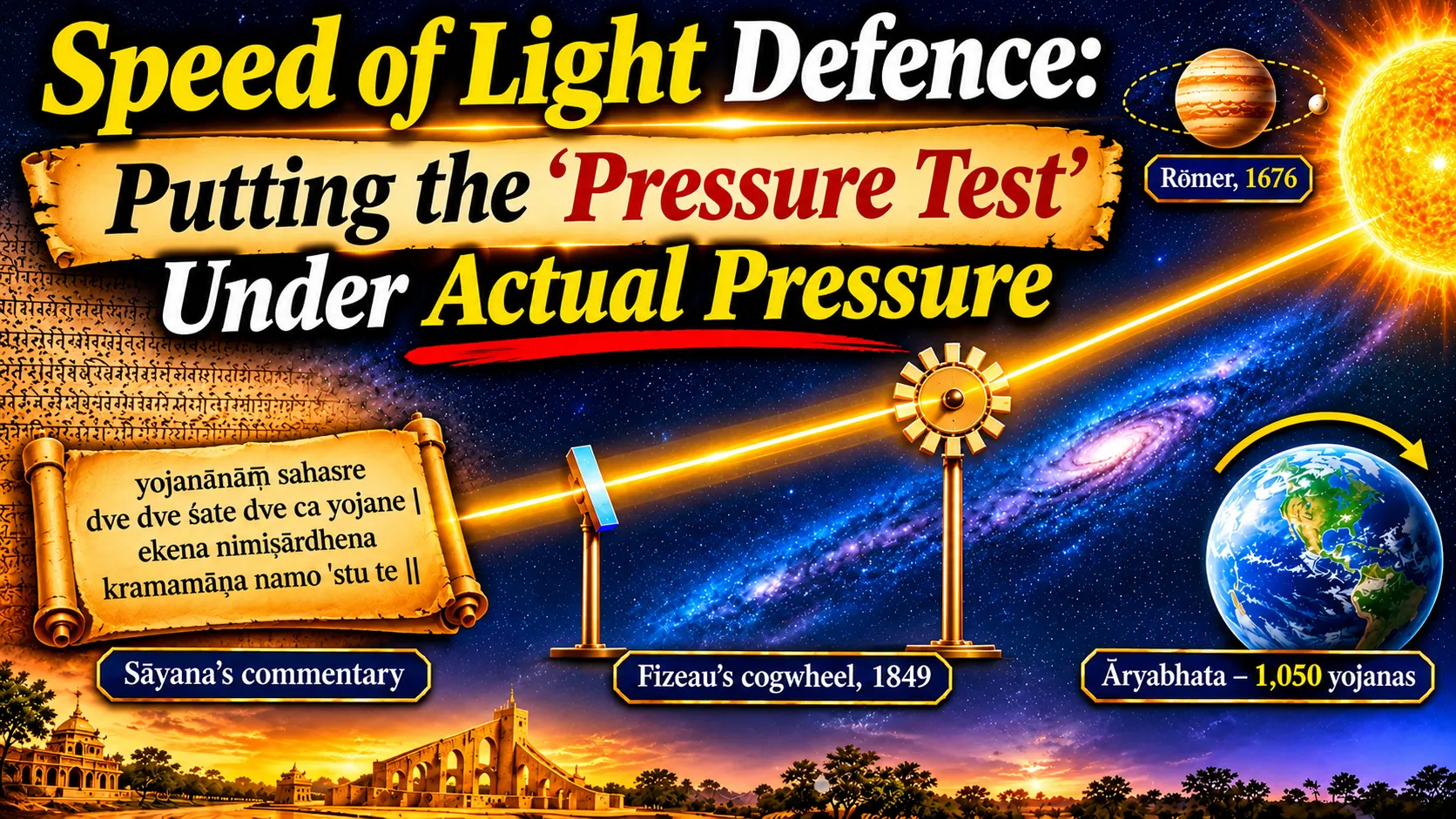
Speed of Light Defence: Putting the ‘Pressure Test’ Under Actual Pressure

Speed of Light Defence: Putting the ‘Pressure Test’ Under Actual Pressure

Speed of Light Defence: Putting the ‘Pressure Test’ Under Actual Pressure Feed a Peer-Reviewed Paper to an AI, Fantasize About Retractions, and Call the Ranting ‘Rigour’ ContentsIntroduction and BackgroundTextual Foundations, Metrological Traditions, and the Calculation FrameworkTerrestrial Calibration, Ground-Level Units, and Methodological ValidityRebuttal to Objections on Astronomical Distance and Speed DeterminationThe "Physics Pressure Test": A Methodological Blunder in the History of ScienceArthaśāstra Metrology, Commentator Tradition, and Unit ConsistencySelection Criteria for Yojana Standards and Methodological SafeguardsMinor Discrepancies, Textual Continuity, and Historical Technological CapabilityStrength of the Argument: Robustness Analysis, Numerical Specificity, and the Opponent’s Flawed PremisesFrom Chatbot Prompts to Retraction Fantasies: Dissecting the Video1. Introduction and BackgroundIn August 2026, our peer-reviewed paper, "Pre-Rømer Reflections on the Speed of Light in Indian Texts: A Scientific and Philological Reassessment of Sāyaṇa’s Ṛgveda Commentary," was published in the Proceedings of the Indian National Science Academy (Springer Nature). Recently, a blog post titled "Did an Ancient Text Know the Speed of Light? I Put the Claim to a Physics Test" (by Kshitij Pandey) attempted to dissect our work. While critical engagement is the lifeblood of scholarship, a closer look at the critique reveals a pattern of strawman arguments, selective reading, and a fundamental misunderstanding of the textual traditions involved. For those who prefer a conversational breakdown of our findings before diving into this point-by-point rebuttal, my podcast episode on this paper, "Kya India Ne Sabse Pehle Discover Ki Thi Speed of Light?" on Decoding with Kartik (http://www.youtube.com/watch?v=jpyJRa_nqUU), is also available to watch. All co-authors of our study previously convened on the Sanatan Reveals channel (linked here) to address Kshitij’s video critique live and in full. Rather than offering a direct scholarly reply to that session, Kshitij opted to host a separate video flanked by two sidekick rented atheists.  Accordingly, this post also refutes every new objection introduced in that broadcast that was absent from Kshitij’s blog, offering readers, as a welcome bonus, an unvarnished showcase of their academic buffoonery. The opponent opens his piece with an emotional, self-serving preamble designed to cast himself as an objective admirer of Indian heritage, claiming, "When I question an idea like this, I don't mean that ancient India had nothing to offer. I study Indian astronomy in my free time..." and adding that one of his "future plans is to study and explore ancient Indian astronomy more deeply and make documentaries about it." Yet this carefully curated persona of a neutral truth-seeker collapses the moment one examines his actual body of work. For someone who claims to study and admire classical Indian astronomy, his platform contains not a single scholarly paper, detailed breakdown, or educational video celebrating the genuine scientific achievements of the Āryabhaṭīya or the Sūrya Siddhānta. Instead, his content is overwhelmingly dedicated to critiquing researchers like Mohit Gour and Vigyan Darshan while systematically dismissing scientific insights within classical Indian texts.Kshitij is the kind of armchair debunker who parades himself as a great admirer of ancient Indian knowledge, yet his pronunciation of Āryabhaṭa is so butchered ("Āryabhaṭṭa") that it sounds less like one of India’s greatest astronomers and more like he is talking about bhaṭā (brinjal). Sure, maybe he only ever read English translations and picked up the colonial spelling habit, but he is an Indian, not a Briton. Had there been any real sincerity behind his claimed commitment to evidence-based Indian science, his channel would be packed with detailed breakdowns of genuine milestones, such as Āryabhaṭa’s formulation of Earth’s axial rotation, his explanation of the Moon shining by reflecting sunlight, the Kerala school’s infinite series for , or the geometric theorems in Baudhāyana’s Śulbasūtras. Tellingly, he maintains a deafening silence on all of these, conveniently parking his alleged admiration in the eternal waiting room of "future plans". Empty disclaimers like "not of our heritage, but of claims..." are merely cheap camouflage, a thin mask of fake neutrality worn by a critic whose entire brand runs on cynicism rather than scholarship. True objectivity is shown through constructive engagement with primary texts, not by declaring oneself neutral while exclusively targeting and undermining Indian knowledge traditions. 2. Textual Foundations, Metrological Traditions, and the Calculation FrameworkBefore addressing the specific objections raised against our study, it is essential to place the primary textual evidence, variables, and methodological framework clearly before the reader. This context ensures that the debate remains anchored in primary sources rather than misinterpretations.2.1 The Vedic Context and Sāyaṇācārya’s Quoted VerseThe discussion centres on the fourth mantra of the Sūrya Sūkta in the Ṛgveda (1.50.4), which celebrates the all-illuminating nature of solar light:Ṛgveda 1.50.4 तरणिर्विश्वदर्शतो ज्योतिष्कृदसि सूर्य । विश्वमा भासि रोचनम् ॥While commenting on this verse and its continuation into Ṛgveda 1.50.5 and following verses, where the Sun’s light pervades and beholds the entire cosmos, the 14th-century commentator Sāyaṇācārya invokes a traditional smṛti verse to illustrate the extraordinary speed of solar illumination:Verse Quoted in Sāyaṇa’s Commentary [Ṛgveda 1.50.4] (Devanagari):तथा च स्मर्यते—योजनानां सहस्रे द्वे द्वे शते द्वे च योजने । एकेन निमिषार्धेन क्रममाण नमोऽस्तु ते ॥(Translation: "And thus it is remembered: Salutations to thee [O Sūrya/solar light], who traverses two thousand two hundred and two yojanas in half a nimeṣa.")2.2 Variables and Mathematical FormulaThe quoted verse provides a direct ratio of distance to time governed by two historical metrological variables:Y (Distance Variable): The modern metric equivalent of 1 yojana in kilometres, making the total distance 2,202 × Y.N (Time Variable): The modern equivalent of 1 nimeṣa in seconds, making the elapsed time half a nimeṣa, or 0.5 × N.Converting this classical ratio into modern units yields a straightforward formula:Speed of Light = (2,202 × Y) / (0.5 × N)2.3 Metrological Traditions ExaminedBecause Sāyaṇa’s smṛti quotation states the numerical ratio without specifying which textual school’s definitions apply, an unbiased scientific reassessment cannot cherry-pick a single conversion. Instead, our paper systematically evaluates standard values across two primary metrological frameworks:The Siddhāntic Astronomical Tradition: Encompassing both major astronomical schools, the Āryapakṣa (rooted in Āryabhaṭa’s Āryabhaṭīya and continued by later astronomers such as Nīlakaṇṭha Somayājī and Yallaya) and the Saurapakṣa (centred on the Sūrya Siddhānta and reflected in works such as Bhāskara II’s Karaṇakutūhala), alongside foundational treatises like Varāhamihira’s works and Bhāskara II’s Siddhānta Śiromaṇi, where the yojana is calibrated against Earth’s planetary dimensions. The Purāṇic, Dharmaśāstric, and Arthaśāstra Metrological Tradition: Comprising classical normative, statecraft, and encyclopedic texts, such as the Manusmṛti, Kauṭilya’s Arthaśāstra, Mahābhārata, Viṣṇu Purāṇa, Matsya Purāṇa, Brahmāṇḍa Purāṇa, and Bhāgavata Purāṇa, which preserve detailed hierarchies of human and cosmic time (nimeṣa, kāṣṭhā, kalā, muhūrta) alongside ground-level linear units, where the Arthaśāstra’s spatial standard is anchored to standardized Indus-Harappan archaeological measurements (such as the 1.763 cm aṅgula documented at Dholavira) rather than relying on translator estimates. 3. Terrestrial Calibration, Ground-Level Units, and Methodological ValidityIn "Turning a Yojana into Kilometres," Kshitij Pandey argues that deriving a yojana from Earth’s dimensions is conditional, absorbs errors, and fails to confirm Earth-based speeds. This objection fails on three main counts:3.1 Standard Academic MetrologyCalibrating historical units against terrestrial dimensions is standard practice across Indian astronomical history, used by scholars like K. V. Sarma, S. Balachandra Rao, and P. Venugopal.3.2 Earth-Independent Closest MatchesAs detailed in Sections 4.4 and 6.2, the three pairings closest to c (Manusmṛti, Brahmāṇḍa Purāṇa, and Arthaśāstra) rely on ground-level metrological units anchored to traditional standards and the Harappan aṅgula rather than Earth-diameter calibrations.3.3 Transparency Over Selection BiasPrecisely because Sāyaṇa’s verse does not specify a metrological school, an unbiased reassessment must test all major historical standards, both terrestrial-calibrated (Siddhāntic) and ground-measured (Purāṇic and Arthaśāstric), rather than cherry-picking only favourable ones.4. Rebuttal to Objections on Astronomical Distance and Speed DeterminationIn the opening of his "Physics Pressure Test," Kshitij Pandey demands that astronomical numbers make sense within a tradition's own model, yet admits that Āryabhaṭa and the Sūrya Siddhānta do not use the nimeṣa and that his calculations are mere cross-textual comparisons. This exposes a basic category error: applying planetary distance tables from Siddhāntic astronomy to a Purāṇic text-transmission verse. A detailed breakdown dismantling these Sun-distance objections is provided in Section 4.3.Testing a Strawman Model: Sāyaṇa’s quoted smṛti verse belongs to the Purāṇic and Dharmaśāstric tradition where the nimeṣa is native. Incorporating Siddhāntic parameter pairings in our sensitivity tables provides an exhaustive parameter map, but treating those pairings as proof that Sāyaṇa’s verse depends on Āryabhaṭa’s planetary geometry attacks a claim we never made.4.1 The "Physics Pressure Test": A Methodological Blunder in the History of ScienceMost critically, subjecting a classical Indian textual verse to a modern "physics pressure test" reflects a profound ignorance of both Indology and the history of science. In the Indian intellectual tradition, scientific, mathematical, and astronomical knowledge was not recorded in the format of modern experimental research papers but preserved and transmitted across generations in concise, poetic aphorisms (ślokas). The verse in question is demonstrably pre-Rømer, attested not only in Sāyaṇācārya’s 14th-century commentary but also earlier in the 12th–13th-century Kāśī Khaṇḍa of the Skanda Purāṇa and as far back as the 11th-century commentary of Bhaṭṭa Bhāskara (a philological lineage highlighted in Prof. Subhash Kak’s work and cited in our paper). Clearly, a scientific formulation originally composed in an early treatise entered the broader cultural memory as a poetic maxim and diffused across traditions. Applying a modern laboratory physics test to a historical text-transmission problem is a fundamental methodological blunder that violates the basic principles of the history of science. In reconstructing historical units like the yojana, our study follows established metrological methods in Indology and the history of Indian science, building directly on the work of scholars such as P. Venugopal, S. Balachandra Rao, K. V. Sarma, Subhash Kak, Subhash Patra, and Michel Danino. Their research confirms that ancient Indian measurement systems must be evaluated within their proper textual and archaeological contexts rather than through anachronistic demands for modern, uniform SI-like standards. Moreover, even if one sets aside Earth-diameter calibrations altogether, we will demonstrate below using the Āryabhaṭīya that deriving the yojana strictly from its 8,000-nṛ (puruṣa/daṇḍa) definition and the archaeologically attested aṅgula yields an even stronger correspondence with c.4.2 Standard Metrological Calibration vs. Circular ReasoningIn his "Test 1", Pandey argues that because our study derives the yojana from Earth’s dimensions and the nimeṣa from the length of the day, any agreement with Earth’s rotational velocity is merely "built-in" and cannot independently validate the speed of light.This objection misrepresents basic metrological practice and ignores how our primary results were actually obtained:Unit Conversion Is Standard Practice, Not Circular Reasoning: Converting ancient units into modern equivalents by anchoring them to shared physical constants is the universal standard in the history of science and is routinely employed by Indologists worldwide. For instance, ancient Indian texts divide a full day and night into nimeṣas, ghaṭikās, and praharas, whereas modern timekeeping divides the exact same day into 24 hours (86,400 seconds). Comparing the two to determine how many seconds equal one nimeṣa is completely normal and indisputable, especially since classical Indian astronomers already knew the length of the solar year (~365 days) with high precision, leaving no fundamental discrepancy between ancient and modern day-lengths. The exact same principle applies to converting the yojana into kilometers: alongside terrestrial calibrations, we also have physical, ground-level standards such as the Harappan aṅgula excavated at Dholavira and standard anatomical aṅgula averages. Because this calibration method is the standard consensus followed across the entire field of Indology, the opponent ought to first refute that entire scholarly consensus before pointing fingers at our paper.Furthermore, in our paper, under the section Analysis and discussions (subsection Quantitative analysis of the speed of light, sub-heading Key observations and implications, p. 8), we explicitly stated:"During the time of Sāyaṇa (thirteenth-fourteenth century), who quoted Bhaṭṭa Bhāskara (eleventh century), (Kak 1999) it can be said that they were aware of the Purāṇic and Dharmaśāstric concept of distance and time... It is most probable that the source that quoted Sāyaṇa and his predecessor, Bhaṭṭa Bhāskara (Kak 1999), was based on the Purāṇic-Dharmaśāstric tradition. This yields values numerically close to the modern accepted value."Because we explicitly grounded Sāyaṇa’s source in the Purāṇic–Dharmaśāstric tradition rather than Siddhāntic planetary models, testing our main premise against Āryabhaṭīya or Sūrya Siddhānta solar distances leaves our core argument completely intact.Note: Opponents should not mistake cautious academic phrasing like "most probable" for a lack of conviction on our part. In peer-reviewed journals, scholarly restraint is simply how serious research is written, though polemicists accustomed to loud, sweeping assertions often confuse basic academic etiquette with self-doubt. Earth-Calibration Independence: As established in Section 3 and detailed further in Sections 4.4 and 6.2, our closest pairings to c do not rely on Earth-calibrated yojanas, rendering "Test 1" entirely moot.The Boomerang Critique: There is an old rule in polemics: before throwing a boomerang, make sure it doesn’t come back and shave ten percentage points off your opponent’s error margin.In the Āryabhaṭīya (Gītikāpāda 7), Āryabhaṭa defines one yojana as 8,000 nṛ (puruṣas), which is the exact same 8,000-daṇḍa standard preserved across the Purāṇic and Dharmaśāstric traditions. Kauṭilya’s Arthaśāstra (2.20.18) explicitly equates daṇḍa, dhanuḥ, nālikā, and pauruṣa as synonymous units of four aratnis (hastas), or 96 aṅgulas. This yields 768,000 aṅgulas per yojana. Applying the archaeologically attested Harappan aṅgula of 1.763 cm from Dholavira (Danino, 2008), Āryabhaṭa’s yojana works out to 13.54 km, or 8.41 miles, matching the Brahmāṇḍa Purāṇa yojana as well as the Viṣṇu Purāṇa and Mahābhārata traditions, both of which also share the exact same nimeṣa value (0.213 s). Crucially, even if we concede the opponent’s objection against calibrating the yojana from Earth’s modern diameter and adopt this ground-level archaeological measure instead, our position only grows stronger: whereas Āryabhaṭa’s Earth-calibrated yojana (12.13 km) previously gave an error of about -16% (-16.34% to -16.46%), this 13.54 km yojana, paired with the Viṣṇu Purāṇa and Mahābhārata nimeṣa (0.211 s and 0.213 s), yields 279,881 km/s to 280,268 km/s, slashing the error to just -6.75% to -6.62%. Once again, the pūrvapakṣa manages to raise an objection that only ends up fortifying our central thesis.4.3 Sāyaṇa’s Context: Light Propagation vs. Orbital MotionIn "Test 2", the opponent claims that "read literally, the line contradicts the astronomy" because attributing the verse directly to the Sun’s physical motion makes it "more than 200,000 times faster" than Āryabhaṭa’s orbital rate, concluding that "to get a speed-of-light reading, it has to be reinterpreted, which is what the paper does."This entire objection attacks a strawman while ignoring both our paper and the primary Sanskrit text:First, we already established this astronomical constraint in our paper: citing Prof. Subhash Kak (p. 9, which the opponent himself highlights in Figure 8), we explicitly noted that neither Siddhāntic nor Purāṇic astronomy attributes such a velocity to the physical solar orb. That is precisely why the verse does not describe the Sun’s orbital chariot.Second, reading the verse as light requires zero "reinterpretation": it is the explicit, primary subject of Ṛgveda 1.50.4 and Sāyaṇācārya’s surrounding commentary itself:तथा 'ज्योतिष्कृत्', ज्योतिषः प्रकाशस्य कर्ता । सर्वस्य वस्तुनः प्रकाशयितेत्यर्थः । ... रात्रौ हि अम्मयेषु चन्द्रादिबिम्बेषु सूर्यकिरणाः प्रतिफलिताः सन्तः अन्धकारं निवारयन्ति । यथा द्वारस्थदर्पणोपरि निपतिताः सूर्यरश्मयो गृहान्तर्गतं तमो निवारयन्ति तद्वदित्यर्थः ॥(“Likewise, [He is called] Jyotiṣkṛt, the creator of light, meaning the one who illuminates all things. At night, the rays of the Sun, after being reflected from the celestial bodies such as the Moon, dispel darkness. Just as the Sun’s rays, falling upon a mirror placed at a doorway, are reflected into the interior of a house and dispel the darkness within, so too [do the Sun’s rays reflected from the Moon and other celestial bodies illuminate the surroundings].” )A commentator who in the very same breath defines Sūrya as prakāśasya kartā ("creator of light") and illustrates the reflection of sūryakiraṇāḥ ("solar rays") off a mirror (dvārasthadarpaṇa) is plainly speaking of the propagation of solar radiance, not planetary orbital tables.4.4 Dismantling False Premises on Celestial DistancesIn "Test 3", the opponent argues that "read as light, it doesn't fit these traditions' skies" because applying Sāyaṇa’s rate to the Sun’s distances in Āryabhaṭīya (459,585 yojanas), Sūrya Siddhānta (684,870 yojanas), and Viṣṇu Purāṇa (100,000 yojanas) yields solar light-travel times of 22.3 s, 13.7 s, and 4.8 s instead of the modern 499 seconds, claiming that "three things can't all be right at once: its Sun distance, its yojana, and Sayana's line as the speed of light."This entire test rests on a chain of elementary logical and historical blunders:1. A Completely False Premise, Earth-to-Sun Distance Is Not Required: Pandey notes that pre-telescopic astronomers underestimated the Earth–Sun distance and treats this as a litmus test against the verse. Yet knowing celestial distances is not a physical prerequisite for determining the speed of light. In 1849, Hippolyte Fizeau measured c entirely within the terrestrial domain using a rapidly rotating toothed wheel (cogwheel) and a mirror, requiring no astronomical distances whatsoever. (While Ole Rømer’s 1676 observation of Jupiter’s moon Io established light’s finite speed and Christiaan Huygens later applied an estimate of Earth’s orbital diameter to convert that delay into a linear velocity, Fizeau proved that astronomical geometry is completely dispensable.) Intricate rotating mechanical gear-systems (yantra assemblies) are explicitly documented in classical Indian engineering treatises such as King Bhoja’s Samarāṅgaṇasūtradhāra (cited on p. 12 of our paper).2. Cross-Textual Category Error & Self-Refuting Concessions: As we already demonstrated, Sāyaṇa’s smṛti verse belongs to the Purāṇic–Dharmaśāstric tradition, not to Āryabhaṭīya or Sūrya Siddhānta planetary tables. Even worse, the opponent undermines his own table by admitting that "we already know the Sun distances are wrong, so this test alone can't tell us the speed is wrong" and conceding that Viṣṇu Purāṇa’s 100,000 yojanas is "a different kind of picture" rather than a modern centre-to-centre distance. An error in one independent variable (pre-telescopic solar distance) never invalidates another independent physical constant (c).3. The Absurdity of "Sun-Calibrated" Units: Simply put, the Earth–Sun distance is neither required to validate the speed-of-light formulation nor needed to calibrate the yojana. While both our paper and this blog transparently record the Sūrya Siddhānta and Āryabhaṭīya readings (following established metrological studies such as S. Balachandra Rao et al.), pre-telescopic astronomy worldwide underestimated the Earth–Sun distance by roughly a factor of twenty-five due to the impossibility of naked-eye solar parallax, and as earlier Vedic knowledge traditions eroded, medieval treatises did not preserve an accurate solar distance. Consequently, the opponent’s arithmetic stunt of plugging these underestimated distances into time = distance / c or dividing the modern Earth–Sun distance by them to inflate the yojana is an empty mathematical tautology. Inserting a known ~25× underestimate mechanically shrinks the travel time by ~25×, just as dividing the modern distance by it mechanically inflates the yojana—and hence the resulting speed—by ~25×. All this proves is a textbook fact nobody disputes: pre-telescopic solar distances were too small, especially as earlier knowledge traditions suffered disruption during the medieval era. It leaves Sāyaṇa’s speed-of-light verse completely untouched; to establish the yojana, the classical 8,000-daṇḍa standard backed by the archaeological aṅgula is more than enough, a simple fact that somehow keeps flying right over the head of our self-appointed physics tester. 1. Moving the Goalposts, Reviewing Internet Folklore Instead of Our Paper: By admitting that "the paper disclaims a measurement" yet attacking "the popular claim," the opponent commits a textbook strawman fallacy. Our paper explicitly states in both the Introduction (p. 2) and Conclusions (p. 12) that we do not present Sāyaṇa’s verse as a modern laboratory measurement. A serious critique must engage with what our paper actually argues, not with viral social media claims.4.5 Absence of Experimental Logs and the Terrestrial Measurement RouteIn "Test 4," the opponent opens with a telling admission: "The paper disclaims a measurement, but the popular claim usually implies one." After recounting textbook summaries of Galileo, Rømer (1676), Bradley (1729), and Fizeau (1849), he notes that our paper "cites no instrument or procedure for either route," selectively quotes a single clause from page 12 ("direct evidence of telescopic devices is absent"), and concludes that "agreement with c, reached by choosing units, doesn't validate the conversion on its own."This closing argument fails on four independent grounds:2. Ancient Indian Masters Did Not Write Modern Lab Manuals: Demanding a 19th-century European experimental logbook from pre-modern Indian treatises is an anachronistic error. Classical scholars like Āryabhaṭa, Varāhamihira, and the authors of the Sūrya Siddhānta did not write modern research papers or step-by-step laboratory manuals; the modern peer-reviewed paper format did not exist. Traditional Indian knowledge systems preserved and transmitted validated results across generations in concise, aphoristic (sūtra) form. As we documented on page 11 (Precision and reasoning in ancient Indian texts), foundational achievements, from the Pythagorean theorem in the Baudhāyana Śulbasūtras and Āryabhaṭa's accurate approximation of π to Yāska's (Nirukta II.6) recognition that the Moon shines by reflected sunlight, are all stated directly without accompanying experimental protocols. If the absence of a lab manual invalidated ancient results, half the history of Indian mathematics and astronomy would have to be dismissed as "coincidence". Absence of evidence is not evidence of absence.3. Plausibility of Optical and Mechanical Instruments: Ancient Indian texts explicitly document optical analogies (such as the upanetra in Śaṅkarācārya’s Aparokṣānubhūti) and mechanical gear assemblies (Samarāṅgaṇasūtradhāra); full textual and historical evidence for these is detailed in Section 7.1.4. ±6% Across Three Distinct Textual Traditions Is Not "Choosing Units":Kauṭilya’s Arthaśāstra (Dholavira-validated yojana of 15.23 km + Arthaśāstra’s own nimeṣa of 0.24 s) → 279,467 km/s (−6.78% error).Manusmṛti (yojana of 12.87 km + Manusmṛti’s own nimeṣa of 0.177 s) → 318,784 km/s (+6.33% error).Brahmāṇḍa Purāṇa (aṅgula-derived yojana of 13.54 km + Purāṇic nimeṣa of 0.213 s) → 279,936 km/s (−6.62% error).The opponent’s reliance on page 12 ("direct evidence of telescopic devices is absent") is a textbook case of selective quotation. By lifting a single clause out of context, he conceals the broader discussion in our paper (Critical Analysis → Observational Precision and Instruments, pp. 11–12, and Conclusions, p. 12), where we explicitly note that "It is plausible that convex or concave pieces were fashioned and experimented with for optical purposes, possibly even elementary projection or magnification."5. Arthaśāstra Metrology, Commentator Tradition, and Unit ConsistencyThe opponent tries to turn basic unit conversions and classical commentator traditions into a mystery, while demanding modern lab manuals from ancient statecraft texts. What follows is a straightforward breakdown of why his Arthaśāstra objections collapse against both the Sanskrit text and archaeology. 5.1 Archaeological vs. Translator Estimates for the AṅgulaThe opponent's core question is whether our paper's speed-of-light estimates within ~7% of c rest on independent textual evidence or merely on selecting and combining modern conversion units (such as the Harappan 1.763 cm aṅgula, 108- vs. 96-aṅgula dhanuṣ, and commentator-based 8,000-unit yojana readings), alongside asking why ancient Indian texts lack evidence of modern laboratory or high-speed optical experiments. Furthermore, the pūrvapakṣa needlessly insists on running calculations with R. Shamasastry’s 1.6 cm aṅgula, overlooking the fact that 1.6 cm is merely a translator’s rough estimate. Given the clear metrological continuity and historical proximity between Dholavira and Kauṭilya’s Arthaśāstra, prioritizing the archaeologically attested 1.763 cm aṅgula over a modern approximation is not just preferable, it is the only methodologically sound choice. 5.2 Textual Equivalence of Metrological Units and Commentator TraditionsIn Arthaśāstra (2.20.18), Kauṭilya explicitly equates daṇḍa, dhanuḥ, nālikā, and pauruṣa at four aratnis:चतुर्-अरत्निर्दण्डो धनुर्-नालिका पौरुषं च गार्हपत्यं ०२.२०.१८ ॥This establishes puruṣa and daṇḍa as equivalent designations within that standard. Combined with the Āryabhaṭīya tradition, which treats 8,000 puruṣas as one yojana, and the classical commentator tradition recorded in the textual apparatus (such as 2,000 dhanus per goruta, yielding 8,000 dhanus per yojana across four gorutas, cf. द्विधनुः-सहस्रं गोरुतं ।। ०२.२०.२५ ।। and चतुर्गोरुतं योजनं ।। ०२.२०.२६ ।।), Kshitij is needlessly rejecting the traditional commentator cited by Shamasastry without any basis. Dismissing a classical commentator out of hand without specific counter-evidence neither breaks the tradition nor invalidates the Arthaśāstra, and leaves our thesis completely intact.5.3 Functional Taxonomy of the Dhanus and Archaeological AlignmentWe did not invent calculations on our own. Our prioritization of the 108-aṅgula dhanus rests directly on Kauṭilya’s own functional taxonomy, prior scholarship (including Subhash Kak, 2009), and archaeological convergence. In the Arthaśāstra, the 96-aṅgula unit of 2.20.18 is explicitly designated as gārhapatya (a domestic/ordinary measure), whereas the very next sūtra (2.20.19: अष्ट-शत-अङ्गुलं धनुः पथि-प्राकार-मानं पौरुषं चाग्नि-चित्यानां) defines the 108-aṅgula dhanus specifically as the standard for roads (pathi) and fortification walls (prākāra), while keeping specialized land-grant units such as the brahmadeya daṇḍa (2.20.20: षट्-कंसो दण्डो ब्रह्मदेय-आतिथ्य-मानं) distinct. Because a yojana is a long-distance road measure, and because the deśa-māna (spatial/distance measurement) section defines the goruta specifically in terms of the dhanus (2.20.25) before culminating in the yojana—the road-measuring 108-aṅgula dhanus is the exact domain-appropriate unit.This textual choice is directly reinforced by archaeological metrology. In his study of Dholavira’s urban planning, Michel Danino reconstructed a master measurement unit of approximately 190.4 cm, corresponding to 108 aṅgulas of 1.763 cm each, and linked it directly to this Arthaśāstra standard. The chronological gap between the Harappan era of Dholavira and the Mauryan period of Kauṭilya is not so vast as to rule out metrological continuity, confirming that the 108-aṅgula measure remained current within that tradition.Nor does a ~−17% reading from the 96-aṅgula variant refute our paper: we can present calculations across variables without forcing every variant into one number, and even a −17% error in antiquity is far closer to the modern 299,792.458 km/s than Rømer’s ~214,000 km/s estimate (approximately 28.28% lower than the accepted value). Too lazy to open the original Sanskrit Arthaśāstra, or even read the pages of our paper where Subhash Kak is clearly cited, the opponent throws out an objection that reads like a sloppy AI copy-paste. (As we will see in Section 9, they later confessed to doing exactly that in a video.) 6. Selection Criteria for Yojana Standards and Methodological SafeguardsRather than arbitrarily tuning units to fit c, our selection of yojana standards is governed by strict textual, functional, and archaeological safeguards that keep each metrological tradition internally consistent. 6.1 Historical Metrological TaxonomyIn our paper, we wrote:"Hereby, the smaller estimates of the yojana shall be disregarded, as they are typically employed for minor localised calculations and are not considered suitable for astronomical or scientific contexts, such as the computation of the speed of light, where larger and more consistent units are required."The opponent fails to grasp the depth of this sentence simply because he lacks even a cursory familiarity (cañcu-praveśa) with ancient Indian metrological systems. We never claimed that modern physics requires a large unit to express a large velocity; obviously, c is invariant whether expressed in kilometres or millimetres per second. Rather, our statement addresses historical Indian metrological taxonomy. Even the opponent concedes that a real local-versus-astronomical distinction could exist while demanding historical evidence for the quotation rather than unit size alone. That evidence is explicit in the text and tradition: Sāyaṇa’s context in his Ṛgveda commentary is classical and cosmological; the traditional verse quoted by Sāyaṇa isn’t calculating boat fares for a village ferry or local road, making the canonical (Purāṇic–Dharmaśāstric) yojana the historically appropriate unit, even if that distinction is easy to miss if one reads texts like a checklist rather than actually understanding them. 6.2 Systemic Traditions and Internal ConsistencyThe term yojana did not denote one universally fixed linear distance across all Indian astronomical traditions. Our previously published study (Iyer, Gour, & Maurya, 2026) explicitly examines the systemic divergence between the Āryapakṣa (≈ 12.13 km/yojana) and Saurapakṣa (≈ 8.35 km/yojana) traditions, a ratio of ≈ 1.5 independently corroborated by Parameśvara’s Goladīpikā (30–31), which notes that Āryabhaṭa’s terrestrial and planetary measures scale up by about one and a half times under other astronomical reckonings due to the differing yojana adopted. Because linear units were system-dependent, velocity calculations must pair spatial and temporal parameters from compatible frameworks (without claiming that the Saurapakṣa itself explicitly defines a nimeṣa in direct proportion to its yojana), rather than mixing units drawn from unrelated systems.Crucially, this systemic separation is direct proof that the speed-of-light correspondence in Sāyaṇa’s verse is not a product of mere coincidence. As Richard L. Thompson demonstrates, classical Indian astronomy preserved strict internal metrological consistency. Within the Saurapakṣa (Sūrya Siddhānta), calibrating its 1,600-yojana Earth diameter yields a ~5-mile (~8–8.35 km) yojana that accurately reproduces Earth–Moon geometry inside its own system. By contrast, the Purāṇic and Arthaśāstra traditions operate on a distinct ~8–8.5-mile (~12.87–13.54 km) yojana standard. When Sāyaṇa's verse is evaluated strictly within those native frameworks, three distinct textual lineages (Manusmṛti at +6.33%, Brahmāṇḍa Purāṇa at -6.62%, and Arthaśāstra at -6.78%, the latter two calibrated on the same 1.763 cm aṅgula) converge tightly around 300,000 km/s while preserving a non-round integer (2,202). A lucky guess or poetic hyperbole does not produce multi-system coherence like that. (See Section 4.4 for additional metrological breakdown).6.3 Canonical Standards and Archaeological EvidenceRetaining the canonical standard rests on converging textual and archaeological evidence, as established in Section 6. This standard represents a cross-genre consensus across gaṇita, jyotiṣa, and Purāṇic paribhāṣā texts, including Āryabhaṭīya (Gītikāpāda 7: 8,000 nṛ), Līlāvatī (Paribhāṣā: 4 krośas = 8,000 daṇḍas = 32,000 hastas), and the Brahmāṇḍa, Vāyu, and Viṣṇu Purāṇas. On the exact same principle of canonical consistency, we excluded Śrīdhara’s nimeṣa valuation because it diverges from the broader textual tradition, a discrepancy already noted by H. H. Wilson and explicitly addressed in our paper.6.4 Exclusion of Geographic Back-CalculationsBy contrast, the exceptionally small ≈ 0.29 km estimate is excluded on primary-source grounds. No Purāṇic paribhāṣā supplies this figure as an explicit metric conversion; rather, it is a modern geographic back-calculation obtained by dividing an assumed terrestrial span of roughly 2,600 km by 9,000 yojanas (≈ 0.289 km/yojana), presupposing an unverified one-to-one mapping between cosmographic text and modern geography. Ganesh Swaminathan (From the Beginning of Time, 2020) similarly notes that "some verses suggest smaller conversions, including one as small as 0.29 km to a yojana," before citing a separate Matsya Purāṇa passage to illustrate contextual variation. Although he references a different Matsya Purāṇa context, modern scholarly analyses standardly arrive at the ~0.29 km figure through precisely the geographic back-calculation outlined above (as seen in Viṣṇu Purāṇa 2.3 and Matsya Purāṇa 114.9–10, where adjacent verses themselves yield sharply divergent implied scales). Incompatible with both the 8,000-dhanus textual standard and the Dholavira scale, this isolated geographical estimate has no place in astronomical metrology.6.5 Methodological Safeguards and Protection Against RetrofittingFinally, this protocol directly refutes the charge of retrofitting. Our inclusion criteria are a priori and outcome-independent: a unit is admitted only if it is (1) explicitly attested in a primary paribhāṣā or established tradition, (2) situated within the astronomical/cosmological domain rather than derived from a modern geographic back-calculation, and (3) paired with a compatible temporal framework. Applying these historical filters eliminates the 0.29 km estimate prior to any calculation involving c. More decisively, retrofitting requires suppressing canonical results that miss the target value (299,792.458 km/s), whereas we transparently retain canonical siddhāntic calibrations even where they overshoot c by more than +30%. Because velocity scales linearly with yojana length, adopting a canonical astronomical standard does not artificially lock results onto c; our study evaluates order-of-magnitude consistency (~10⁵ km/s) across attested astronomical traditions rather than decimal curve-fitting, upholding philological fidelity, historical plausibility, and methodological transparency.6.6 The Manusmṛti Consensus: Beyond Ganganath Jha’s GlossSimilarly, the opponent’s dismissal of our Manusmṛti row as resting merely on Ganganath Jha’s parenthetical "(8 miles)" gloss misses the broader textual, lexicographical, and metrological consensus. As H. H. Wilson notes in his translation of the Viṣṇu Purāṇa (Book I, Chapter 6, p. 46, footnote), the Vāyu Purāṇa explicitly cites the authority of Manu (manor yāni pramāṇāni, मनोर्यानि प्रमाणानि) to record the exact linear scale: 24 aṅgulas (fingers) = 1 hasta, 4 hastas = 1 dhanu, 2,000 dhanus = 1 gavyūti, and 8,000 dhanus = 1 yojana. While Wilson correctly observes that this specific verse does not appear in the extant Manu Saṃhitā, that is hardly surprising in textual history: the Manusmṛti underwent documented additions and omissions over time, and numerous classical nibandhakāras and ācāryas quote verses attributed to Manu that are absent from surviving recensions. Crucially, this confirms that there was no substantive divergence in yojana computation between the Purāṇic and Dharmaśāstric lineages—which is precisely why we treat both within a single unified Purāṇic–Dharmaśāstric tradition. Jha, Monier-Williams, and Apte did not invent an arbitrary conversion; their 4-krośa (8–9 mile) range simply reflects this established classical consensus, with the upper 9-mile bound representing a colonial-era anatomical approximation (assuming an 18-inch hasta) of the exact same 8,000-daṇḍa/dhanus standard that the archaeologically attested Dholavira aṅgula (1.763 cm) anchors right in the middle at 13.54 km (8.41 miles). More importantly, even if one substitutes the 9-mile (14.48 km) figure into Manusmṛti’s own nimeṣa (0.1778 s), the resulting speed (~358,661 km/s, or +19.64%) still falls well within our paper’s transparently published range (−16% to +39%) and remains closer to c than Ole Rømer’s 1676 estimate (−28.28%). Thus, the objection leaves our central thesis completely untouched. 7. Minor Discrepancies, Textual Continuity, and Historical Technological CapabilityThe opponent points out a few minor typographical and rounding discrepancies while himself conceding that they do not affect the central thesis of our paper; such clerical slips can be readily resolved through a standard corrigendum.7.1 Textual Continuity of Ṛgveda 1.50.5While Sāyaṇa introduces the velocity formula in his commentary on the fourth mantra (Ṛgveda 1.50.4), the reference to 1.50.5 reflects its thematic continuity (saṅgati) with the fifth and subsequent mantras, specifically the broader textual context (prakaraṇa) in which Sūrya is described as beholding and illuminating the entire world.7.2 Recalibrating the Sūrya Siddhānta CircumferenceSimilarly, we candidly acknowledge an attribution slip regarding the 4,800-yojana Earth circumference: that figure belongs to Bhāskara II’s Karaṇakutūhala rather than directly to the Sūrya Siddhānta, an oversight that occurred because Venugopal et al. (2019, p. 403) classify Karaṇakutūhala itself within the Saurapakṣa tradition. However, correcting this to Burgess’s exact Sūrya Siddhānta circumference of 1,600105,059.56yojanas (~5,060 yojanas) only strengthens our case. Calibrating against Earth’s equatorial circumference (~40,075 km) yields a yojana of 7.92 km (instead of 8.35 km). Plugging this into Sāyaṇa’s formula with our tabulated nimeṣa of 0.088 s gives:Speed=2,2027.92km0.50.088s396,360km/sThis cuts the deviation from c from +39.4% down to +32.2% (and further down to +31.3% if the unrounded 0.0886 s nimeṣa is used), moving the result over seven percentage points closer to the modern value, a point the opponent himself concedes.Having addressed these minor textual and numerical details, we can now turn to the broader question of ancient technological capability and the validity of historical reconstruction.7.3 Historical Technological Capability and the Legitimacy of ReconstructionOur primary evidence rests directly on physical artifacts and primary texts. We deliberately refrained from claiming a documented telescope or modern experimental protocol simply because no such explicit text has surfaced in our research, a basic standard of scholarly integrity that evidently baffles critics accustomed to loud, sweeping assertions. Nobody with a functioning grasp of history waves away advanced ancient engineering or optical insight as "coincidence" simply because surviving manuals are incomplete.Offering plausible reconstructions where records have vanished is entirely legitimate, and, as our paper has already established and this rebuttal makes even clearer, India’s pre-Rømer speed-of-light figure is anything but a coincidence. Across the ancient world, the absence of surviving technical manuals has never been treated as proof against empirical or engineering mastery. Neither the Great Pyramids of Egypt, with their extraordinary astronomical alignments and precision-fitted masonry, nor Stonehenge, with its megalithic solstice geometry, comes with an extant blueprint detailing every tool and method employed. One sees the exact same principle in India’s own living heritage: the intricate monolithic granite carvings of classical temple architecture exhibit a remarkable geometric exactitude and symmetry that continue to impress modern engineers. No surviving workshop manual tells us the exact mechanical tooling used to achieve such precision, yet these monuments, from Giza and Stonehenge to India’s classical temples, stand before us as undeniable evidence of advanced engineering instruments and technical mastery.The same holds true for optical knowledge: classical Indian texts explicitly preserve references to optical principles, from the upanetra ("secondary eye", perceiving a distant object as if brought near through a crystal or lens) in Ādi Śaṅkarācārya’s Aparokṣānubhūti (Śloka 81) to the sūryakāntamaṇi, a sunstone functioning on the exact principle of a convex lens by focusing solar rays to ignite fire. The sūryakānta is attested as early as the Mahābhārata (Śānti Parva 12.211.28: रेतो वटकणिकायां घृतपाकाधिवासनम् । जातिस्मृतिरयस्कान्तः सूर्यकान्तोऽम्बुभक्षणम् ॥), where it is cited alongside the magnet (ayaskānta) as an established natural phenomenon of subtle physical power, and is later famously invoked by Kālidāsa in the Abhijñānaśākuntalam (2.7):शमप्रधानेषु तपोधनेषु गूढं हि दाहात्मकमस्ति तेजः । स्पर्शानुकूला इव सूर्यकान्तास्तदन्यतेजोऽभिभवाद्वमन्ति ॥ ("In ascetics rich in tranquility lies a hidden, burning radiance; like sun-stones [sūryakāntas] that are cool to the touch, they emit fire when acted upon by another brilliance [solar rays].")Just as no serious scholar dismisses the Pyramids, Stonehenge, or Indian temple engineering as "accidents" for lack of surviving blueprints, dismissing India’s pre-Rømer speed-of-light formulation as mere coincidence simply because the original observational record has not survived is historiographically indefensible.8. Strength of the Argument: Robustness Analysis, Numerical Specificity, and the Opponent’s Flawed PremisesIn his closing section, "How Strong Is the Argument?", the opponent tries to weaken our conclusions by attacking claims our paper never actually makes. Specifically, he raises four objections: that our sixteen velocity values are merely sixteen readings of a single statement rather than sixteen independent measurements; that writing 2,202 rather than 2,200 (a 0.09% difference, dwarfed by our -16% to +39% unit spread) proves nothing about method or accuracy; that our paper allegedly escalates its claims across pages 9, 11, and 12 (from a "figurative" reading to "postulating" a value while disclaiming an "experimental determination"); and that traditional Sun distances lend no independent support to the sunlight reading. Every one of these objections collapses under basic philological and logical scrutiny.8.1. Sixteen Readings Are a Robustness Analysis, Not Sixteen Lab TrialsDemanding sixteen independent experimental measurements from a single textual passage, especially in the history of science, is an exercise in absurdity. Our paper explicitly examines one numerical formulation (2,202 yojanas in half a nimeṣa) transmitted across Bhaṭṭa Bhāskara, the Kāśī Khaṇḍa of the Skanda Purāṇa, and Sāyaṇa’s Ṛgveda commentary. Because traditional Indian knowledge systems did not operate under a single modern SI standard, yojana and nimeṣa varied across astronomical, administrative, and Purāṇic frameworks. Accordingly, our sixteen velocity/time values function as a sensitivity and robustness analysis across attested historical standards. This directly refutes the charge of cherry-picking: rather than relying on one convenient conversion or uncritically adopting earlier readings such as Raghavarao and Verma’s ~29.3 km yojana, which lacks adequate metrological support, we test whether the order-of-magnitude correspondence (~105 km/s) holds across gaṇita, jyotiṣa, and Purāṇic traditions.8.2. Injecting a 0.09% Comparison into a Philological Point Is a Category MistakeDragging an arithmetic comparison of 0.09% (between 2,202 and 2,200) against our -16% to +39% metrological spread completely misses the point of pages 10–11. We never equated numerical specificity with modern error bars or empirical instrumentation; in fact, the negligible 0.09% gap beside the broader unit spread only underscores that the transmitted figure does not depend on artificial decimal tuning. Our observation is philological: in classical Sanskrit and Purāṇic literature, poetic hyperbole (atiśayokti) relies on sweeping, round magnitudes – 100, 1,000, 10,000, or ten lakṣa yojanas. The preservation of a conspicuously non-round numeral like 2,202 (dve sahasre dve śate dve ca) breaks that literary convention. Recurring across at least three distinct textual witnesses from the 11th to the 14th century, it signals an established traditional formulation encoding an underlying metrological concept rather than an ad hoc poetic flourish. Conflating why a classical verse preserves a non-round integer with how modern conversions vary across historical unit definitions is a textbook category mistake.8.3. No Shifting Claims: A Basic Failure to Understand Both "Postulate" and Indian Scientific VerseThe charge that our argument contradicts itself across pages 9, 11, and 12 exposes a basic failure to read either English or Sanskrit literature accurately:Poetic figurativeness and quantitative postulation are not mutually exclusive: The opponent imposes a modern divide between poetry and science that, if applied consistently, would erase India’s classical scientific canon. Because foundational works of gaṇita, jyotiṣa, Āyurveda, and mechanics, from the Āryabhaṭīya, Sūrya-siddhānta, and Bhāskarācārya to the Caraka and Suśruta Saṃhitās and the Samarāṅgaṇasūtradhāra, are composed in ornate verse (śāstrakāvya), his logic would let one dismiss all of Indian astronomy (khagola), medicine, and engineering as "mere poetry" simply because it scans in metre. Across the Dharmaśāstras, Purāṇas, Rāmāyaṇa, Mahābhārata, and technical śāstras, kāvya and vijñāna walked hand in hand; metrical style was the medium of transmission, never a disclaimer of substance. Reading the verse as both a figurative depiction of sunlight through the sun's motion (p. 9) and a quantitative postulate (p. 11) is therefore strict fidelity to the genre, not a shift in claims.The semantic blunder over "postulate": In standard English and the philosophy of science, to postulate means to put forward or posit a proposition or numerical value; it does not mean to establish it through a modern laboratory experiment. Stating on page 11 that Sāyaṇa’s commentary postulates a numerical value and disclaiming an experimental determination on page 12 is not a retreat; the two statements are completely consistent.Anachronistic expectations of modern lab manuals: Ancient Indian texts transmitted knowledge via concise, validated aphorisms rather than step-by-step experimental manuals. Disclaiming an experimental protocol while recognizing the text’s numerical postulate demonstrates basic academic discipline, not a retreat in argument.8.4. The Sun-Distance Objection Rests on an Arbitrary, Flawed PremiseFinally, the opponent’s Sun-distance objection rests on an arbitrary premise, as knowing the Earth–Sun distance is neither logically nor physically required to evaluate the speed of light. After a critique built on strawmen, his conclusion (“So, Where Does This Leave Us?”) merely recycles refuted talking points alongside a patronizing sermon on Indian astronomy. His subsequent video, joined by two associates, followed the same script, ignoring my prior rebuttal on the Sanatan Reveals channel (which had already dismantled the Sun-distance claim) to repeat the same debunked points. Without detailing who raised which objection, it is worth dismantling the fresh claims and publishing blunders they unveiled during that video, starting with the Bhāgavata Purāṇa and the Kāśī Khaṇḍa.9. From Chatbot Prompts to Retraction Fantasies: Dissecting the VideoIf the opponents’ blog objections were weak, the new claims they introduced during their video, ranging from careless misreadings of the Bhāgavata Purāṇa and Kāśī Khaṇḍa to a comical grasp of academic publishing, border on farce. Let us, then, examine their videoed buffoonery point by point.9.1 On the Bhāgavata Purāṇa Nimeṣa ValuationOpponent’s Claim: The opponent alleges that we first stated the Bhāgavata Purāṇa (BP) nimeṣa as 0.4 s, changed it to 0.2 s in the next paragraph, and then excluded it to retrofit our results.One almost pities the sheer intellectual laziness on display here; this is what happens when you outsource your reading comprehension to Claude and blindly parrot its hallucinations in a video to play pretend-scholar. Had the opponent possessed the basic literacy or the attention span to actually read even this single section of our paper himself, he might have spared himself the public humiliation of peddling such a pathetic, two-bit accusation. Rebuttal:   This accusation reflects a careless reading of the section titled "Nimeṣa in other Siddhāntic, Purāṇic, and Dharmaśāstric texts". After surveying mainstream texts, Siddhānta-śiromaṇi (~0.0886 s), Manusmṛti (~0.177 s), Mahābhārata (~0.213 s), and Viṣṇu Purāṇa (~0.213 s), our paper introduces BP separately and explicitly records its value as 0.425 s without ever altering it:"BP, on the contrary, gives another set of time divisions. In this scheme, one hundred truṭis make a vedha, three vedhas a lava, and three lavas a nimeṣa... Altogether, this framework yields 202,500 nimeṣas in a day, giving each nimeṣa a duration of about 0.425 s in modern terms."The subsequent paragraph concludes the entire comparative section, not BP alone:"By comparing the total nimeṣas given in these texts to the modern duration of a day, the value of 1 nimeṣa in seconds can be determined. For a solar day of 86,400 s or a sidereal day of 86,164 s, 1 nimeṣa corresponds approximately to 0.24 s, providing a bridge between ancient measurements and modern time units."The phrase "total nimeṣas given in these texts" plainly refers to the collective mainstream consensus (~0.2 s), not a fabricated alteration of BP.Excluding BP from the primary calculation is standard methodology, not retrofitting. Because BP’s nimeṣa is a clear outlier against the broader Purāṇic and Dharmaśāstric consensus, we followed the exact same principle applied by H. H. Wilson in his Viṣṇu Purāṇa translation when rejecting Śrīdhara Svāmī’s divergent nimeṣa valuation. (Amusingly, the pūrvapakṣa’s Three Musketeers of selective reading completely missed this line before crying "deliberate omission", despite our clear reasoning, and the exact same principle holds for the Bhāgavata Purāṇa).  9.2 Antiquity of the Kāśī Khaṇḍa and Pre-Rømer HorizonOpponent’s Claim: The opponent argues that the oldest Skanda Purāṇa manuscript dates to the 8th century CE and does not contain this verse, since the verse belongs to the Kāśī Khaṇḍa.Rebuttal: The opponents are heroically demolishing a claim we never made. Nowhere did we date the Kāśī Khaṇḍa itself to the 8th century CE; we merely noted the antiquity of the broader Skanda Purāṇa tradition: "Moreover, in the Skanda Purāṇa (Tripāṭhī 1991), whose manuscripts are believed to predate 800 CE (Mann 2011), the same śloka appears with minor textual variations."More hilariously, they concede in their own video that the Kāśī Khaṇḍa and this verse appear around the 14th century CE, leaving one to wonder whether they sat down to perform khaṇḍana (refutation) or accidentally delivered maṇḍana (validation). Unless the 14th century somehow occurred after Ole Rømer’s 1676 CE estimate, their big "gotcha" only confirms our explicitly pre-Rømer thesis.Worse still for their chronology, even the Purāṇic scholars they invoked in their video, such as Hans Bakker and Diana Eck, place the underlying textual layers well before the modern era, while the British Library's Endangered Archives Programme catalogues two Kāśī Khaṇḍa manuscripts (EAP781/1/1/363 and EAP781/1/1/506) from the 13th century CE, physical evidence earlier scholars like R. C. Hazra did not have access to. Because extant manuscripts establish only a terminus ante quem, the text could well be older still. To refute us, the opponents would need to prove the verse post-dates 1676 CE; instead, with the formulation attested across Bhaṭṭa Bhāskara, the Kāśī Khaṇḍa, and Sāyaṇa, their own concessions graciously do our job for us.9.3 The Myth of the Rubber-Stamp Reviewer: A Crash Course in Data Availability During the same video At 42:00, one speaker tried to question our journal’s peer review with a point that wasn’t even clearclaiming experimental papers get a free pass just because "it’s an experiment," with no real check on data availability, while hinting that text- or śāstra-based work gets waved through without serious scrutiny. If he thinks śāstra-based papers get an easy pass, someone who couldn’t even read our Bhāgavata Purāṇa nimeṣa section properly should spare us the lecture on peer reviewer, who are, after all, experienced professors and working scientists. Conversely, if he meant that reviewers do check textual work properly, why did he claim elsewhere in the very same video that the reviewers failed to do their job? (Yes, minor typos exist, they slip into top-tier papers all the time, but they hardly invalidate a study.) And if he believes experimental papers are published without data checks, he has clearly never seen Data Availability Statements or supplementary appendices, which in many scientific journals run two to three times longer than the paper itself, packed with raw experimental data and step-by-step details. Watching three armchair critics sit in a video and grade experienced scientists is comedy at its finest. For the record, our paper went through three full rounds of review before it was accepted.  9.4 Chatbot Forensics Gone Wrong: The Myth of the "Hidden" ValuesThe insinuation that we hid inconvenient values or manipulated numbers collapses under its own absurdity. If we were in the business of concealing inconvenient facts, why on earth would we transparently publish error margins stretching from -16% all the way to +30–39%? Sweeping those under the rug would have made our job infinitely easier. Even better: Raghava Rao had already produced a convenient match for the speed of light by pairing the Bhāgavata Purāṇa’s nimeṣa with a 29 km yojana. If our sole objective were to force a result by any means necessary, we could have simply stopped there; why bother writing an entirely new, critically vetted paper? This entire line of attack makes neither head nor tail.At 45:33, the mask slips entirely: one of the three cut-rate armchair debunkers openly confesses that he simply fed our paper into an AI to hunt for errors. That single, embarrassing admission explains the entire circus. Devoid of the Sanskrit literacy to touch a primary text and too intellectually lazy to verify a single metrological equation themselves, they outsourced their thinking to a chatbot and then recorded its prompt output in a video as if they were a panel of groundbreaking peer reviewers. The comedy practically writes itself: self-appointed guardians of "academic rigour" who spend an hour lecturing published researchers on scholarly standards, yet lack the basic reading comprehension to survive a twelve-page paper without an AI spoon-feeding them every talking point. That explains everything: it is precisely why they mistook our Bhāgavata Purāṇa discussion for an error and never even bothered to read the Śrīdhara argument sitting right in front of them. 9.5 Retraction Fantasies and Our Open ChallengeAt 35:30, one of the panellists launches into a solemn sermon about publishing an ACS paper where a single erroneous value had to be corrected at his supervisor’s insistence before grandly declaring that an error in a "fundamental assumption" warrants a full retraction. The implied insinuation is obvious, and it betrays a remarkable confusion about how academic publishing actually works. Under standard COPE (Committee on Publication Ethics) guidelines, retraction is reserved for misconduct, fabricated data, or fatal errors that invalidate a study’s core conclusions, not for a YouTube panel’s methodological disagreements or minor clerical points that academic publishing routinely resolves with a simple Corrigendum or Erratum. What breathtaking folly: expecting an author to march back to a journal and retract a peer-reviewed study when our central thesis has not been refuted even remotely.More importantly, which fundamental assumption of ours has been invalidated? Every single objection they raised has backfired: dropping Earth-calibration for Āryabhaṭa’s yojana slashed our error margin from −16% to -6.6%, and their own video citations of scholars like Bakker and Eck on the Kāśī Khaṇḍa still left the text centuries earlier than Ole Rømer. Sitting on YouTube and ranting into a microphone does not magically trigger retractions.If this self-styled guardian of ACS standards genuinely believes he has uncovered a fatal flaw, the remedy is not a videoed retraction fantasy built on chatbot prompts; it is to step out of the video echo chamber and submit a formal, peer-reviewed Comment or rebuttal paper to the journal. In fact, we openly and unequivocally challenge him: take your Claude-generated "findings", write directly to the editorial board of Proceedings of the Indian National Science Academy (INSA), and try to get our paper retracted. Good luck; we will gladly wait.  Rest assured, however, that we will indeed write a comprehensive follow-up paper that addresses and dismantles every possible objection, actual or anticipated, while further strengthening our core arguments and calculations, proving indisputably that the speed of light had been determined in the ancient Indian tradition. In fact, we owe you, and your remarkable foolishness, a genuine debt of gratitude: you have generously handed us plenty of fresh material to add to it.ReferencesApte, V. S. (1890). The practical Sanskrit-English dictionary. Shiralkar.British Library Endangered Archives Programme. (2015a, January 27). Kāśīkhaṇḍa of the Skanda Purāṇa [Sanskrit manuscript, EAP781/1/1/363, 13th century CE]. British Library. https://searcharchives.bl.uk/catalog/040-003395635British Library Endangered Archives Programme. (2015b, March 19). Kāśīkhaṇḍa of the Skanda Purāṇa [Sanskrit manuscript, EAP781/1/1/506, 13th century CE]. British Library. https://searcharchives.bl.uk/catalog/040-003395778Burgess, E. (Trans.). (1935). Translation of the Sūrya Siddhānta. University of Calcutta.Chinmayananda, S. (1985). Aparokṣānubhūti: Intimate experience of the reality (1st ed., Śloka 81, p. 87). Central Chinmaya Mission Trust.Danino, M. (2008). New insights into Harappan town-planning, proportions and units, with special reference to Dholavira. Man and Environment, 33(1), 66–79.Danino, M. (2015). Issues in Indian metrology, from Harappa to Bhāskarāchārya. Gaṇita Bhāratī, 37(1–2), 125–143.Hazra, R. C. (1940). Studies in the Purāṇic records on Hindu rites and customs. University of Dacca.Iyer, K., Gour, M., & Maurya, G. (2026). Pre-Rømer reflections on the speed of light in Indian texts: A scientific and philological reassessment of Sāyaṇa’s Ṛgveda commentary. Proceedings of the Indian National Science Academy. https://doi.org/10.1007/s43538-026-00814-xJha, G. (Trans.). (1920). Manusmṛti with the commentary of Medhātithi. https://www.wisdomlib.org/hinduism/book/Manusmrti-with-the-commentary-of-medhatithi/d/doc201341.htmlKak, S. (1999). The speed of light and Purāṇic cosmology. Annals of the Bhandarkar Oriental Research Institute, 80(1/4), 113–123.  https://www.jstor.org/stable/41694580 Kak, S. (2009). The universe, quantum physics, and consciousness. Journal of Cosmology, 3, 500–510. https://thejournalofcosmology.com/QuantumConsciousness100.html Kanungo, A. (2023). Development of glass in India. In Encyclopaedia of the history of science, technology, and medicine in non-Western cultures. https://www.academia.edu/99348091/Development_of_Glass_in_IndiaMann, R. D. (2011). The rise of Mahāsena: The transformation of Skanda-Kārttikeya in North India (p. 187). Brill.Monier-Williams, M. (1899). A Sanskrit-English dictionary. Oxford University Press.Parameśvara. (1916). Goladīpikā. Government Press, Trivandrum.Shamasastry, R. (Trans.). (1951). Arthaśāstra (4th ed.). Raghuveera Printing Press.Swaminathan, G. (2020). Concepts of distance and time from the Purāṇas [Book extract]. In From the beginning of time. https://www.academia.edu/49986599/Concepts_of_Distance_and_Time_from_the_Puranas_a_book_extractTagare, G. V. (Trans.). (1958). Brahmāṇḍa Purāṇa (Part 1 of 5). Thompson, R. L. (2004). Vedic cosmography and astronomy. Motilal Banarsidass. (Original work published 1989) Thompson, R. (1997). Planetary diameters in the Sūrya-siddhānta. Journal of Scientific Exploration, 11(2), 193–200. https://richardlthompson.com/sites/default/files/1997_JSE_Planetary_Diameters_SuryaSiddhanta_0.pdfTripāṭhī, K. P. (Ed.). (1991). Kāśīkhaṇḍa (Part One) of Maharṣi Vyāsa, with commentaries Rāmānandī and Hindi Nārāyaṇī (Gaṅgānātha Jhā Granthamālā, Vol. 13). Sampūrṇānanda Sanskrit University.Venugopal, P., Rupa, K., Uma, S. K., & Rao, S. B. (2019). The concepts of deśāntara and yojana in Indian astronomy. Journal of Astronomical History and Heritage, 22(3), 401–406.https://www.researchgate.net/publication/338209126_The_Concepts_of_Desantara_and_Yojana_in_Indian_Astronomy Wilson, H. H. (Trans.). (1840). The Vishnu Purana: A system of Hindu mythology and tradition. John Murray.https://archive.org/details/in.ernet.dli.2015.220642/page/46/mode/2up  
Speed of light in ancient indiaSayana rigveda commentary+18
Kartik IyerNov 28, 2026
63
Namit Malhotra’s ‘Ramayana’ and Maharishi Valmiki’s Adi-Kavya: Creative Freedom or Historical Distortion?

Namit Malhotra’s ‘Ramayana’ and Maharishi Valmiki’s Adi-Kavya: Creative Freedom or Historical Distortion?

In cinema, "creative freedom" means adapting a story for the visual medium while safeguarding its core soul—not distorting historical and scriptural characters to impose a modern ideological agenda. The tampering with Maharishi Valmiki’s Ādi-Kāvya (the primordial epic) in the film Ramayana—produced by Namit Malhotra and directed by Nitesh Tiwari (previously also discussed in connection with references like Manoj Rathi, etc.)—is not a mere narrative alteration, but a calculated ideological discourse.Namit Malhotra’s Ramayana not only disregards Sage Valmiki’s original Ādi-Kāvya and Indian history, but also completely bypasses the universally accepted, popular essence of the Ramayana that we have heard and lived since childhood through our grandmothers' lullabies, folktales, and traditional Ramlilas. Mounted on a colossal budget of ₹4,000 crore, this magnum opus undoubtedly sets a grand benchmark that inspires other producers and directors to bring our great historical and epic figures to the big screen. While we wholeheartedly welcome and encourage such ambitious cinematic ventures, we stand firmly against any attempt to distort historical facts and subvert sacred traditions under the guise of creative freedom.Unfortunately, under this very pretext of "creative freedom," a deeply calculated ideological propaganda has been served within this film. On one hand, Ravana has been fabricated as a modern "communist" or "socialist" revolutionary—declaring to his followers, "What I eat, you shall eat; what I wear, you shall wear"—while depicting the Asuras as oppressed by the Devas to inject the same old, toxic narrative of a fabricated "Aryan-Dravidian" and "Brahmin-Shudra" conflict into the minds of the audience. In reality, there is not even a shred of evidence in the scriptures or the Puranas of any such exploitation of Asuras by the Devas. On the other hand, forced and unwarranted "feminism" has been shoehorned into the film—whether it is Sita needlessly wielding a sword, Ravana’s mother Kaikesi being turned into a military commander of the Rakshasas, or the character of the cruel Shurpanakha being whitewashed. It crosses all limits when, in an attempt to prove even the lustful Ravana to be a "feminist," a false scene is fabricated in which he engages in a duel and kills his own brother-in-law (Vidyutjihva) for grabbing a maidservant's hand. It is evident that this film is not a cultural presentation, but merely a vehicle to promote ideological propaganda aimed at distorting Sanatan values.In this article, we will examine the hidden ideological propaganda, the violation of Indian poetics (Kāvyaśāstra), and the artificial whitewashing of Ravana’s character in the film, supported by scriptural evidence.1. The 'Victim' Portrayal of Asuras: Fueling the Aryan-Dravidian and Oppressor-Oppressed NarrativeRight in the opening scenes of the film, an absurd and anti-scriptural sequence is fabricated: the Devas drop rice (food grains) from the sky above, while the Asuras live below the earth in dark tunnels or caves, scavenging for it. Meanwhile, the Devas roam the skies seated on elephants. This scene is a deliberate attempt to reinforce the discredited colonial-era "Aryan-Dravidian" and "oppressor-oppressed" theory, which portrays the Devas (or Aryans/upper castes) as tyrants and the Asuras (or indigenous people) as enslaved and deprived.Scriptural Reality: Nowhere in the Valmiki Ramayana, the Mahabharata, or any of the Puranas are the Asuras depicted as impoverished or starving for food in caves. On the contrary, the opulence of the abodes of the Asuras and Danavas (Patala Loka and Lanka) is described as surpassing even heaven (Svarga):In the Sundarakāṇḍa, when Hanuman enters Lanka, he is astonished by the splendor of the golden city and compares it to Indra’s Amaravati:toraṇaiḥ kāñcanair divyair latāpaṅktivicitritaiḥ |dadarśa hanumān laṅkāṃ divi devapurīṃ yathā || 18 || (Sundarakāṇḍa, Sargas 2–3)In the Viṣṇu Purāṇa (Book 2, Chapter 5), while describing Patala Loka, Maharishi Parashara states that the palaces, jewels, and gardens of Patala built by Maya Danava are so enchanting that even Devarshi Narada declared Patala to be more magnificent than heaven itself.Therefore, depicting Asuras as impoverished victims is not only contrary to Puranic facts, but also a planned piece of ideological propaganda.2. Irrelevant 'Feminism' and the Distortion of CharactersIn Indian Sanātana tradition, women have always held the highest honor and authority—from the scholar-philosophers Gargi and Maitreyi to Queen Kaikeyi, who accompanied King Dasharatha onto the battlefield. Yet, in modern cinema, the fundamental nature of characters has been tampered with in the name of showcasing "feminism":The Fictional Military Leadership of Kaikesi: In the film, Ravana’s mother, Kaikesi, is presented as a warrior or military commander. However, according to the Uttarakāṇḍa of the Valmiki Ramayana (Sargas 4 to 9), the war against the Devas and Lord Vishnu was fought by Ravana’s maternal grandfather Sumali and his brothers Mali and Malyavan. Defeated in battle, Sumali retreated to Rasatala and later sent his daughter Kaikesi to Maharishi Vishrava so that illustrious progeny could be born. Kaikesi was never a general.Sita Unnecessarily Wielding a Sword: The character of Janaki (Sita) embodies sacrifice, radiant fidelity (Pātivratya), wisdom, and spiritual strength. Showing her repeatedly drawing a sword to fight without any scriptural basis is a cheap attempt to force her into the mold of a modern "action heroine"—a choice that later creates glaring contradictions within the film’s own screenplay (as will be examined in the Sita abduction episode).3. Casting on the Touchstone of Poetics (Kāvyaśāstra) and AestheticsIndian poetics (Nāṭyaśāstra, Sāhityadarpaṇa, etc.) lay down clear canons regarding the qualities and physical grace of the hero (Nāyaka) and heroine (Nāyikā). A hero must be Dhīrodātta (noble, resolute, and self-controlled), bearing serenity and gravitas on his face and vigor in his voice.Ranbir Kapoor as Shri Rama and Parashurama: Valmiki describes Shri Rama’s countenance as "saumyaḥ saumyataraḥ" (gentle and exceedingly serene) and "ājānubāhuḥ sumukhaḥ" (long-armed and handsome-faced; Ayodhyākāṇḍa 1.10–12). Ranbir Kapoor’s face lacks that divine serenity, and his dialogue delivery lacks the vigor of the Vedic era—so much so that he struggles to clearly pronounce simple Sanskrit names like "Agastya." Casting the same actor for both avatars of Lord Vishnu (Rama and Parashurama) may be conceptually acceptable, yet he fails completely to embody Parashurama’s fierce aura and thunderous roar—on top of which, showing Parashurama kneeling before Shri Rama violates all Puranic dignity.The Inverted Portrayal of Sita and Shurpanakha: In the Valmiki Ramayana, Sita is described as "sarvalakṣaṇasampannā" (endowed with all auspicious marks and unmatched beauty), whereas in the Araṇyakāṇḍa, Shurpanakha is described as terrifying, pot-bellied (mahodarī), deformed-eyed, and harsh-voiced. In complete inversion of the text, the film presents Shurpanakha as remarkably attractive, while Sai Pallavi as Sita falls short of the classical aesthetic standards laid out in Kāvyaśāstra.4. The Whitewashing of Ravana and Disregard for the Facts of UttarakāṇḍaRather than depicting Ravana as the cruel, lust-driven, and unrighteous antagonist of the Valmiki Ramayana, the filmmakers have gone out of their way to turn him into an "idealistic anti-hero":Sole Credit for Penance and Conquest: While the visual depiction of Ravana’s penance is cinematically grand, showing that Ravana performed penance alone and defeated the entire army of the Devas single-handedly and unarmed upon receiving his boon is completely false. According to the Valmiki Ramayana (Uttarakāṇḍa, Sarga 10), Kumbhakarna and Vibhishana also performed severe austerities alongside Ravana at the Gokarna hermitage. Similarly, during the assault on heaven, Ravana was not alone; the Devas were defeated largely through the prowess of Meghanada (Indrajit) and Kumbhakarna (Uttarakāṇḍa, Sargas 27–29). Moreover, the scenes of Ravana wandering around appear to be a direct copy of the character Gorr from the Hollywood film Thor: Love and Thunder.Kaikesi’s Insult to Kubera: In the film, Kaikesi calls her own stepson and Lokapala, Kubera, "the shoe at the feet of the Devas," which runs entirely counter to the decorum and dialogue style of the Valmiki Ramayana.The Falsehood of the Ashvamedha Yajna: The film shows Ravana performing an Ashvamedha Yajna, which is historically and scripturally absurd. Only a Chakravarti Samrat (universal emperor) performed the Ashvamedha. According to the Valmiki Ramayana, King Dasharatha was the sovereign emperor of the entire earth up to the oceans. Ravana had merely subjugated a few islands and kings by brute force; portraying him as a Chakravarti emperor is an unwarranted glorification of a villain.The Distorted Episode of Vidyutjihva’s Slaying: This is the most blatant example of whitewashing Ravana’s character. The film shows Shurpanakha’s husband, Vidyutjihva, getting drunk in court, molesting a maidservant, and taunting Ravana as a "slave"—prompting Ravana to kill him in a duel to defend women’s honor and Rakshasa pride.The Truth: According to the Valmiki Ramayana (Uttarakāṇḍa, Sarga 23.16–18), while Ravana was warring against the Kalakeya Danavas, blinded by battle-frenzy and arrogance, he slaughtered his own brother-in-law Vidyutjihva. There was neither an insult to any maidservant nor any moral nobility on Ravana’s part.Khara-Dushana and the Artificial Shaiva-Vaishnava Divide: Ravana’s brothers Khara and Dushana are portrayed in the film as gory, feral beasts. Furthermore, by placing Shaiva tilaks on the foreheads of the Rakshasas and Vaishnava tilaks on Rama and his companions, the film propagates the false notion that Rakshasas were worshippers of Shiva while humans worshipped Vishnu. In reality, Lord Rama himself establishes the Shivalinga at Rameshwaram (Yuddhakāṇḍa, Sarga 123), and the worship of Lord Brahma was equally prominent in Ravana’s lineage. This Shaiva-Vaishnava binary is entirely modern and ahistorical.5. Bālakāṇḍa and Ayodhyākāṇḍa: Chronological Anachronisms and Violation of DecorumAuthenticity of chronology and setting is vital in adapting any historical or Puranic epic. The film grossly neglects both:The Bizarre Appearance of Jatayu During Rama’s Youth and Wedding: In the film, when a young Shri Rama is horseback riding, and later during his wedding in Mithila, Jatayu and a flock of vultures appear flying overhead. Vultures circling over an auspicious wedding ceremony is not only contrary to Indian omen-lore (Śakuna-śāstra), but also completely incoherent narratively. In the Valmiki Ramayana, Jatayu enters the narrative directly in the Araṇyakāṇḍa (Sarga 14), when Shri Rama encounters him en route to Panchavati and Jatayu introduces himself as a friend of King Dasharatha.'Lily' Flowers in Mithila: During the Swayamvara scenes, modern foreign "lily" plants and trees are shown in the gardens of Mithila. In the Valmiki Ramayana, the groves of Mithila and Janakpur are described with indigenous Indian flora such as Ashoka, Champaka, mango, Kadamba, lotus, and Malati (Bālakāṇḍa, Sarga 67). This oversight reflects a severe lack of research.6. Violation of Gurukula Decorum: Pre-Marital Garden Strolls and 'College Boy' DialogueThe most objectionable aspect of the Bālakāṇḍa sequence is the trivialization of Rama and Lakshmana’s characters. Two radiant Kshatriya princes under the tutelage of Maharishi Vishvamitra are shown behaving like modern college students:Undignified Curiosity Before Vishvamitra: Prior to the wedding, Rama and Lakshmana speak to Maharishi Vishvamitra in a casual tone suggesting it would be nice to know something about—or meet—the brides beforehand. Such dialogue destroys the gravity of the Guru-Śiṣya (teacher-disciple) tradition.Pre-Marital Garden Courtship: Worse still, before the wedding rites are even performed, all four brothers (Rama, Lakshmana, Bharata, and Shatrughna) are shown strolling and romancing in gardens with their prospective brides (Sita, Urmila, Mandavi, and Shrutakirti).Scriptural Truth: In Arya culture and the Valmiki Ramayana, secluded romantic trysts between bride and groom prior to the Pāṇigrahaṇa (wedding) sacrament were strictly forbidden. The first sight of Rama and Sita occurs within dignified bounds in the flower garden (Puṣpavāṭikā in Tulsidas’s Ramcharitmanas) or at the Swayamvara/wedding pavilion. In Bālakāṇḍa (Sarga 73) of the Valmiki Ramayana, the weddings of all four brothers take place with Vedic chants in the presence of Maharishi Vasishtha and King Janaka, with no mention whatsoever of any prior garden trysts.7. The Tataka Slaying and Subahu Episode: Flawed Scriptural Logic and 'Video Game' AestheticsIn the episode of protecting Vishvamitra’s yajna, the filmmakers sacrifice both logic and scripture:Vishvamitra’s Misleading Dialogue: When Shri Rama hesitates to shoot an arrow at Tataka, Vishvamitra in the film states, "A Rakshasi has no dharma." This dialogue is scripturally inaccurate. In the Sundarakāṇḍa of the Valmiki Ramayana, Hanuman himself hears Vedic chanting and scriptural recitation (svādhyāya) coming from the homes of Rakshasas in Lanka (Sundarakāṇḍa, Sargas 4 and 18). Rakshasas were learned in the Vedas, yet they were Adharmī (tyrants and destroyers of sacrifices). In the original text, Vishvamitra explains to Shri Rama that for a king sworn to protect his subjects, slaying a wicked oppressor is the supreme dharma, even if the perpetrator is a woman (Bālakāṇḍa, Sarga 25.17–18):"na hi te strīvadhakṛte ghṛṇā kāryā narottama |cāturvarṇyahitārthaṃ hi kartavyaṃ rājasūnunā ||"Subahu’s Disguise and 'Zombie' Monsters: The film shows Subahu arriving disguised as Vishvamitra, which has no basis in the Valmiki Ramayana. The battle against Tataka, Maricha, and Subahu has been staged to resemble a Hollywood Avengers movie or a "zombie" attack from a video game. Furthermore, showing Shri Rama running away from Tataka and her cohorts is an insult to his Kshatriya valor.8. The Parashurama Dialogue and Screenplay Inconsistency Regarding the Divine BowThe arrival of Parashurama during the return journey from Janakpur is depicted with immense majesty in the Valmiki Ramayana (Bālakāṇḍa, Sargas 74–76), yet the film commits two major blunders here:Internal Screenplay Contradiction: Earlier in the film, Maharishi Vishvamitra tells Shri Rama that to wield divine astras, he will need a celestial bow such as the Shiva-Dhanush or the Vaishnava-Dhanush. Subsequently, the story has Rama break the Shiva-Dhanush, thereby demolishing the film’s own narrative setup.Demeaning Parashurama: Depicting Parashurama kneeling before Shri Rama goes against Puranic decorum. In the Valmiki Ramayana, Parashurama places his Vaishnava bow into Shri Rama’s hands, has him string it, recognizes Rama’s supreme radiance, and departs respectfully toward Mount Mahendra—he never falls to his knees.9. Ayodhyākāṇḍa: Relying on an Interpolated Vow and Lakshmana Drawing His Sword on KaikeyiThe manner in which Queen Kaikeyi’s demand for her boons is presented in the film violates both textual criticism and familial decorum:False Mention of a Marriage-Time Promise (Rājya-śulka): In the film, Manthara reminds Kaikeyi that at the time of her marriage, King Dasharatha promised her father (Ashvapati) that Kaikeyi’s son would become the King of Ayodhya.Scriptural Evidence: Throughout the Ayodhyākāṇḍa of the Valmiki Ramayana, Kaikeyi cites only the two boons she earned by saving Dasharatha’s life during the Deva-Asura war (Ayodhyākāṇḍa, Sargas 9 and 11). A mention of a marriage-time promise of the kingdom appears at only one isolated verse in the entire text (when Bharata visits Rama at Chitrakuta—Ayodhyākāṇḍa, Sarga 107.3), which modern textual critics and authoritative critical editions (such as the BORI Critical Edition) have conclusively proven to be a later interpolation (Prakṣepa). Had such a vow ever existed, King Dasharatha, Vasishtha, Kaushalya, and Bharata himself would not have repeatedly affirmed that under the Ikshvaku dynastic tradition, the eldest son (Rama) alone inherits the throne ("jyeṣṭho rājā bhavatīti" — Ayodhyākāṇḍa 101.2).Lakshmana Drawing a Sword Against Stepmother Kaikeyi: Upon hearing of the boons in the film, Lakshmana draws his sword in rage against his own mother (stepmother) Kaikeyi. This scene is a direct stain on Lakshmana’s character. In the Valmiki Ramayana, Lakshmana certainly expresses anger at King Dasharatha’s unjust decision and urges Shri Rama to seize the kingdom by force (Ayodhyākāṇḍa, Sarga 21), yet he would never even dream of committing the grave sin of raising a weapon against his mother Kaikeyi.10. Unrealistic Depiction of Dandakaranya and 'New Age' DialogueRight at the start of the Araṇyakāṇḍa, the film’s visual design strays from both realism and scripture:Lilliputian Proportions and Gigantic Trees: The trees in the Dandakaranya forest are rendered so unnaturally colossal that Shri Rama, Lakshmana, and Sita appear like "Lilliputians" (ant-sized dwarfs). Rather than reflecting the authentic ecology of Indian forests, this looks like a scene from a fantasy video game.Absurd 'Law of Attraction' Dialogue in the Vedic Era: Shri Rama is made to utter the line, "Bow to the universe and thank it." This is the vocabulary of modern Western "New Age spirituality" (thanking the Universe / Law of Attraction), which has zero connection to Vedic or Treta Yuga culture. In the Vedic tradition, worship was offered to Surya, Agni, Varuna, Indra, or Parabrahman—not to an abstract modern concept of saying "thank you" to the universe.11. The Whitewashing of Shurpanakha and Aspersions on Shri Rama and LakshmanaIn the film, Shurpanakha’s character is completely overhauled into a sensitive, rational, and wronged woman, while Shri Rama and Lakshmana are painted as guilty and helpless. Violating the foundational rules of Indian poetics, the antagonist is given unwarranted "character development" to diminish the protagonists:Arrival on a Lion-Drawn Chariot and Fabricated Dialogue: Shurpanakha arrives seated on a bizarre chariot pulled by lions and questions Shri Rama as to why he killed the Rakshasas, to which Rama replies, "In self-defense." Thereafter, she adorns herself, proposes to Rama while he is chopping wood, and eventually assumes Sita’s form—whom Rama fails to recognize!Distorted Mutilation Scene and Sita Rebuking Lakshmana: In the film, Lakshmana merely makes a light scratch on Shurpanakha’s nose with his sword, and she transforms into a bird and flies away! Even more objectionably, Sita afterward reprimands Lakshmana, saying, "For a woman, her beauty is everything; you should not have disfigured her," to which Lakshmana offers an excuse that he did so because she had impersonated Sita. Thus, instead of acting on Shri Rama’s command, Lakshmana is portrayed as committing an act of cruelty on his own whim.[ Note: We authored a research paper titled “Was Rāvaṇa an Ideal Brother? A Comparative Reading of the Rāmāyaṇa,” published as part of the Eighth International Ramayana Conference (2025). Through a comparative and evidence-based examination of episodes from the Rāmāyaṇa, the paper challenges the conventional portrayal of Rāvaṇa as an ideal brother or an exemplary human being. It critically examines his lustful and unethical conduct, particularly his behaviour towards women. The paper also discusses Śūrpaṇakhā’s advances towards Rāma and Lakṣmaṇa, her subsequent attack on Sītā after being rejected, and the episode in which Lakṣmaṇa cuts off her nose and ears at Rāma’s direction. A detailed discussion of these issues, supported by textual analysis, is presented in the research paper. Readers interested in these questions may consult the original publication for a comprehensive examination.- Iyer, K., & Gaur, M. (2025). Was Rāvaṇa an ideal brother? A comparative reading of the Rāmāyaṇa. In O. K. Gupta & S. Agrawal (Eds.), Rāmāyaṇa aur satat vikās: Eighth International Ramayana Conference (pp. 435–444). ISBN 978-1-960627-07-0.]The Actual Episode in the Valmiki Ramayana (Araṇyakāṇḍa, Sargas 17–18):Shurpanakha’s True Form and Lustful Conduct: In the original text, Shurpanakha does not arrive on any chariot; she is a terrifying, pot-bellied (mahodarī), deformed-eyed (virūpākṣī), copper-haired (tāmramūrdhajā), harsh-voiced Rakshasi (Araṇyakāṇḍa 17.8–10). Overcome with lust upon seeing Shri Rama’s beauty, she initiates a carnal proposal.Lethal Attack on Sita: When Shri Rama declines on account of being married and gestures toward Lakshmana—and Lakshmana refuses by declaring himself Rama’s servant—a humiliated Shurpanakha lunges like a blazing meteor to devour Sita alive ("abhidudrāva vaidehīṃ mahāulkeva rohiṇīm" — Araṇyakāṇḍa 18.17).Shri Rama’s Explicit Command: To protect Sita’s life, Shri Rama himself orders Lakshmana to disfigure the cruel and wicked Rakshasi ("virūpayitumarhasi" — Araṇyakāṇḍa 18.20). Lakshmana then severs both her nose and ears with his sword, causing blood to gush forth as she flees screaming in terror (she does not turn into a bird and fly away).12. The Khara-Dushana Battle: Cowardice of Shri Rama and Hollywood ImitationWhen Khara and Dushana arrive in the film to avenge Shurpanakha’s humiliation, Shri Rama is shown apologizing to them—an act diametrically opposed to Kshatriya dharma and the core ethos of the Ramayana. Additionally:Fleeing Heroes and Guerrilla Warfare: Throughout the film, from Tataka to Khara-Dushana, Rama, Lakshmana, and Sita are repeatedly shown running away or hiding to wage "guerrilla warfare."Imitation of Hollywood Films and Video Games: Shri Rama conjuring a tornado to destroy Khara-Dushana’s army is a direct copy of the tornado scene that destroys the Destroyer at the climax of Marvel’s first Thor film (2011). Meanwhile, the sword fight slaying Khara and Dushana looks straight out of the PlayStation 2 video game Mortal Kombat.Scriptural Truth (Araṇyakāṇḍa, Sargas 19–30): In the Valmiki Ramayana, Shri Rama neither apologizes nor fights from hiding. Entrusting Sita’s protection to Lakshmana, he stands alone on the open battlefield and, within just one and a half muhūrtas (approximately 72 minutes), annihilates Khara, Dushana, Trishira, and 14,000 Rakshasas in direct combat using celestial weapons and his bow.13. Ravana’s Fake 'Brotherly Love', and the Blunder of the 'Final Avatar'Upon Shurpanakha’s arrival in Lanka, the film fabricates another major falsehood—a subject also examined in detail in our research paper (by Kartik Iyer and Mohit Gour) presented at the International Ramayana Conference at IIT Kharagpur (2025):The False Agenda of Avenging a Sister’s Honor: The film claims Ravana abducts Sita to avenge his sister Shurpanakha’s humiliation. In reality, according to the Valmiki Ramayana (Araṇyakāṇḍa, Sarga 34), the cunning Shurpanakha completely conceals from Ravana that she had approached Rama out of lust. Instead, to inflame Ravana’s carnal desire, she deliberately tells him: "Sita is the most beautiful woman in the three worlds; I was bringing her to be your wife when Rama and Lakshmana reduced me to this state." Ravana plots Sita’s abduction not out of brotherly affection, but out of his own blind lust.Concealing Ravana’s Crimes: While the film dramatizes the curses behind Ravana’s multiple heads, it suppresses the fact that Ravana was a habitual adulterer and rapist who violated women such as Punjikasthala, Rambha (betrothed to Nalakubara), and the ascetic Vedavati (Uttarakāṇḍa, Sargas 17, 26; Yuddhakāṇḍa 13.11–14).Arya Samaj Influence and the Hiranyagarbha Sukta: The film includes a dialogue featuring Vedic mantras and the Hiraṇyagarbha Sūkta (Ṛgveda 10.121) between Ravana and Sita, which aligns appropriately with the broader Vedic spirit of the narrative.The Grave Error of Vishnu’s 'Final Avatar': In the film, Ravana addresses Shri Rama as the "final avatar" (Antima Avatāra) of Lord Vishnu! This is an unforgivable mythological and historical blunder. According to the scriptures, Shri Rama is the seventh avatar of Vishnu, followed by Shri Krishna, Buddha, and finally Kalki at the end of Kali Yuga.14. The Abduction of Sita: Demeaning the Heroic Janaki or a 'Business Class' Flight?In the abduction sequence, the film’s screenplay collapses into its own trap:Internal Contradiction: When Maricha cries out in Shri Rama’s mimicked voice and Lakshmana explains it is Rakshasa illusion, Sita in the film draws her sword to go fight, leaving Lakshmana helpless. Yet, ironically, the very Sita who was brandishing a sword moments earlier fails to lift a blade, throw a punch, or put up any physical struggle when Ravana arrives!Sita Like a 'Business Class' Passenger: The Valmiki Ramayana (Araṇyakāṇḍa, Sarga 49.16–20) describes how the wicked Ravana seizes Sita’s hair with one hand and her thighs with the other, forcing her into the Pushpaka Vimana. Distraught and weeping, Sita fearlessly rebukes Ravana mid-air—calling Shri Rama a "lion" (Siṃha) and Ravana a "jackal" (Śṛgāla; Araṇyakāṇḍa, Sargas 47–48). By contrast, in the film, Sita’s face shows no trace of struggle; she sits calmly inside the aircraft as though traveling in "business class"!The Inverted Scene of Dropping Ornaments: In the film, Ravana himself rips off Sita’s ornaments and throws them down! According to the Valmiki Ramayana (Araṇyakāṇḍa, Sarga 54.1–4), while Ravana was carrying her away, Sita spotted five Vanaras (Sugriva and his companions) seated atop Mount Rishyamuka and, discreetly out of Ravana’s sight, tied her divine ornaments in her yellow upper garment (uttarīya) and dropped them down so Shri Rama could trace her path. (While the battle between Jatayu and Ravana is cinematically commendable, it cannot compensate for the distortion of the core narrative.)ConclusionMaharishi Valmiki’s Ramayana is not merely a story; it is the benchmark of India’s cultural consciousness and ethical decorum (Dharma-Maryādā). When villains like Ravana and Shurpanakha are glorified in the name of cinema, while the radiant characters of Maryada Purushottama Shri Rama, Lakshmana, and Mata Sita are weakened, rendered dubious, or reshaped to fit modern propaganda, it is not "creative freedom"—it is cultural distortion. It is the duty of viewers and researchers alike to look beyond superficial spectacle, recognize the authenticity of Maharishi Valmiki’s original Ādi-Kāvya, and logically counter every such fabricated narrative.BibliographyMaharishi Valmiki. Valmiki Ramayana.Vishnu Purana.Bharata Muni. Natyashastra.Kaviraja Vishwanatha. Sahityadarpana.Iyer, K., & Gaur, M. (2025). Was Rāvaṇa an ideal brother? A comparative reading of the Rāmāyaṇa. In O. K. Gupta & S. Agrawal (Eds.), Rāmāyaṇa aur satat vikās: Eighth International Ramayana Conference (pp. 435–444). ISBN 978-1-960627-07-0.

HistoryEntertainment+1
Kartik IyerNov 19, 2026
85
नमित मल्होत्रा की ‘रामायण’ और महर्षि वाल्मीकि का आदि-काव्य: रचनात्मक स्वतंत्रता या इतिहास-विकृति?

नमित मल्होत्रा की ‘रामायण’ और महर्षि वाल्मीकि का आदि-काव्य: रचनात्मक स्वतंत्रता या इतिहास-विकृति?

सिनेमा में ‘रचनात्मक स्वतंत्रता’ (Creative Freedom) का अर्थ मूल कथा की आत्मा को सुरक्षित रखते हुए उसे दृश्य माध्यम के अनुकूल बनाना होता है, न कि इतिहास और शास्त्रों के मूल चरित्रों को विकृत कर किसी आधुनिक वैचारिक एजेंडे को थोपना। नमित मल्होत्रा निर्मित और नितेश तिवारी निर्देशित ‘रामायण’ (जिसे पूर्व में मनोज राठी आदि के संदर्भों के साथ भी चर्चित किया गया) में महर्षि वाल्मीकि के आदि-काव्य के साथ जो खिलवाड़ किया गया है, वह केवल कथा-परिवर्तन नहीं, बल्कि एक सोचा-समझा वैचारिक विमर्श है।नमित मल्होत्रा निर्मित यह ‘रामायण’ न केवल महर्षि वाल्मीकि के मूल आदि-काव्य और भारतीय इतिहास की अवहेलना करती है, बल्कि रामायण के उस सर्वमान्य और लोक-प्रचलित स्वरूप को भी सिरे से ‘बाईपास’ करती है, जिसे हमने बचपन से अपनी दादी-नानी की लोरियों, लोककथाओं और पारंपरिक रामलीलाओं में सुना और जिया है। 4000 करोड़ रुपये के विशाल बजट पर बन रही यह भव्य फिल्म निस्संदेह भारतीय सिनेमा के लिए एक बड़ा कदम है, जो अन्य निर्माताओं और निर्देशकों को भी हमारे महान ऐतिहासिक और पौराणिक पात्रों पर बड़े स्तर की फिल्में बनाने के लिए प्रेरित करती है। हम ऐसे भव्य प्रयासों का हृदय से स्वागत और समर्थन करते हैं, परंतु 'रचनात्मक स्वतंत्रता' के नाम पर इतिहास के तथ्यों को तोड़-मरोड़कर और सनातन परंपरा को विकृत करके प्रस्तुत करने के हम सख्त विरुद्ध हैं।दुर्भाग्यवश, ‘रचनात्मक स्वतंत्रता’ की इसी आड़ में इस फिल्म के भीतर बेहद सोचा-समझा वैचारिक प्रोपेगेंडा परोसा गया है। एक ओर रावण को किसी आधुनिक ‘कम्युनिस्ट’ या ‘समाजवादी’ क्रांतिकारी की तरह गढ़ दिया गया है—जो अपने साथियों से कहता है कि “जो मैं खाऊंगा, वही तुम खाओगे; जो मैं पहनूंगा, वही तुम पहनोगे”—और असुरों को देवताओं द्वारा शोषित दिखाकर वही पुराना छद्म ‘आर्य-द्रविड़’ और ‘ब्राह्मण-शूद्र’ संघर्ष का विषैला नैरेटिव दर्शकों के दिमाग में बोने का प्रयास किया गया है। जबकि शास्त्रों और पुराणों में देवताओं द्वारा असुरों के ऐसे किसी शोषण का लेशमात्र भी प्रमाण नहीं है। दूसरी ओर, फिल्म में अकारण और थोपा हुआ ‘फेमिनिज्म’ (नारीवाद) ठूंसा गया है—चाहे वह सीता जी का अकारण तलवार चलाना हो, रावण की माता कैकसी को राक्षसों का सैन्य कमांडर बना देना हो, या फिर क्रूर शूर्पणखा के चरित्र को ‘व्हाइटवॉश’ करना हो। हद तो तब हो जाती है जब कामांध रावण को भी ‘फेमिनिस्ट’ साबित करने के लिए यह झूठा दृश्य गढ़ा जाता है कि वह एक दासी का हाथ पकड़ने वाले अपने ही बहनोई (विद्युतजिह्व) से मल्ल-युद्ध व द्वंद्व युद्ध कर उसका वध कर देता है। स्पष्ट है कि यह फिल्म कोई सांस्कृतिक प्रस्तुति नहीं, बल्कि सनातन मूल्यों को विकृत करने वाले वैचारिक प्रोपेगेंडा को प्रमोट करने का एक माध्यम मात्र है।इस लेख में हम फिल्म में छिपे वैचारिक प्रोपेगेंडा, काव्यशास्त्र के उल्लंघन और रावण के चरित्र के कृत्रिम महिमामंडन (Whitewashing) का शास्त्रीय प्रमाणों के साथ परीक्षण करेंगे।1. असुरों का ‘पीड़ित’ चित्रण: आर्य-द्रविड़ और शोषक-शोषित नैरेटिव का पोषणफिल्म के आरंभिक दृश्यों में ही एक अत्यंत हास्यास्पद और शास्त्र-विरुद्ध दृश्य गढ़ा गया है, देवता ऊपर आकाश से चावल (अन्न) डाल रहे हैं और असुर धरती के नीचे अंधेरी सुरंगों या गुफाओं में रहकर उसे ग्रहण कर रहे हैं। दूसरी ओर, देवता हाथियों पर बैठकर आकाश में विचरण कर रहे हैं। यह दृश्य औपनिवेशिक काल के उस छद्म ‘आर्य-द्रविड़’ और ‘शोषक-शोषित’ सिद्धांत को पुष्ट करने का प्रयास है, जिसमें देवताओं (या आर्यों/सवर्णों) को अत्याचारी और असुरों (या मूलनिवासियों) को गुलाम व वंचित दिखाया जाता है।शास्त्रीय वास्तविकता: वाल्मीकि रामायण, महाभारत या किसी भी पुराण में असुरों को दरिद्र या गुफाओं में अन्न के लिए तरसता हुआ नहीं दिखाया गया है। इसके विपरीत, असुरों और दानवों के निवास स्थान (पाताल लोक व लंका) का वैभव स्वर्ग से भी बढ़कर वर्णित है।सुंदरकांड में जब हनुमान जी लंका में प्रवेश करते हैं, तो स्वर्णमयी लंका के वैभव को देखकर स्वयं चकित रह जाते हैं और उसकी तुलना इंद्र की अमरावती से करते हैं- तोरणैः काञ्चनैर्दिव्यैर्लतापङ्क्तिविचित्रितैः।ददर्श हनुमान् लङ्कां दिवि देवपुरीं यथा॥ १८॥ (सुंदरकांड, सर्ग 2-3)।विष्णु पुराण (द्वितीय अंश, अध्याय 5) में पाताल लोक का वर्णन करते हुए महर्षि पराशर कहते हैं कि मय दानव द्वारा निर्मित पाताल के प्रासाद, मणियां और उद्यान इतने रमणीय हैं कि देवर्षि नारद ने भी स्वर्ग लोक की तुलना में पाताल को अधिक सुंदर बताया है.अतः असुरों को शोषित दिखाना न केवल पौराणिक तथ्यों के विरुद्ध है, बल्कि यह एक सुनियोजित वैचारिक प्रोपेगेंडा है।2. अप्रासंगिक 'फेमिनिज्म' और पात्रों का विकृतीकरणभारतीय सनातन परंपरा में स्त्रियों को सदैव सर्वोच्च सम्मान और अधिकार प्राप्त रहे हैं—विदुषी गार्गी, मैत्रेयी से लेकर युद्धभूमि में दशरथ का साथ देने वाली महारानी कैकेयी तक। किंतु आधुनिक सिनेमा में ‘फेमिनिज्म’ (नारीवाद) दिखाने के नाम पर पात्रों के मूल स्वभाव से छेड़छाड़ की गई है।कैकसी का काल्पनिक सैन्य नेतृत्व: फिल्म में रावण की माता कैकसी को एक योद्धा या कमांडर की तरह प्रस्तुत किया गया है। जबकि वाल्मीकि रामायण के उत्तरकांड (सर्ग 4 से 9) के अनुसार, देवताओं और भगवान विष्णु से युद्ध रावण के नाना सुमाली, माली और माल्यवान ने लड़ा था। युद्ध में परास्त होकर सुमाली रसातल चला गया था और बाद में उसने अपनी पुत्री कैकसी को महर्षि विश्रवा के पास भेजा ताकि तेजस्वी संतानों की उत्पत्ति हो सके। कैकसी कोई सेनापति नहीं थीं।सीता का अकारण तलवार चलाना: जानकी जी का चरित्र त्याग, तेजोमय पातिव्रत, बुद्धिमत्ता और आत्मबल का प्रतीक है। फिल्म में उन्हें बिना किसी शास्त्रीय आधार के बार-बार तलवार निकालकर लड़ते हुए दिखाना आधुनिक ‘एक्शन हीरोइन’ के सांचे में ढालने का सस्ता प्रयास है, जो आगे चलकर स्वयं फिल्म की पटकथा में ही विरोधाभास पैदा करता है (जिसकी चर्चा हम सीता हरण प्रसंग में करेंगे)।3. काव्यशास्त्र और सौंदर्यशास्त्र की कसौटी पर कास्टिंगभारतीय काव्यशास्त्र (नाट्यशास्त्र, साहित्यदर्पण आदि) में नायक और नायिका के गुणों तथा उनके रूप-सौंदर्य का स्पष्ट विधान है। नायक ‘धीरोदात्त’ होना चाहिए, जिसके मुख पर सौम्यता, गंभीरता और वाणी में ओज हो।श्रीराम और परशुराम के रूप में रणबीर कपूर: श्रीराम का स्वरूप वाल्मीकि ने "सौम्यः सौम्यतरः" और "आजानुबाहुः सुमुखः" (अयोध्याकांड 1.10-12) के रूप में वर्णित किया है। रणबीर कपूर के चेहरे पर न तो वह दिव्य सौम्यता दिखाई देती है और न ही संवाद अदायगी में वैदिक काल का ओज। यहाँ तक कि वे ‘अगस्त्य’ जैसे सरल संस्कृत नामों का भी स्पष्ट उच्चारण नहीं कर पाते। भगवान विष्णु के दोनों अवतारों (राम और परशुराम) को एक ही अभिनेता से करवाना वैचारिक रूप से स्वीकार्य हो सकता है, किंतु परशुराम के रौद्र रूप और गर्जना को निभाने में भी वे पूरी तरह विफल रहे हैं—ऊपर से परशुराम को श्रीराम के घुटनों पर बैठा दिखाना पौराणिक गरिमा के सर्वथा प्रतिकूल है।सीता और शूर्पणखा का विपरीत चित्रण: वाल्मीकि रामायण में सीता जी को "सर्वलक्षणसंपन्ना" (समस्त शुभ लक्षणों से युक्त, अद्वितीय सुंदरी) कहा गया है, जबकि अरण्यकांड में शूर्पणखा को भयानक, बड़े पेट वाली (महोदरी), विकृत नेत्रों वाली और कर्कश स्वर वाली बताया गया है। फिल्म में इसके ठीक विपरीत शूर्पणखा को अत्यधिक आकर्षक दिखाया गया है, जबकि सीता के रूप में साई पल्लवी काव्यशास्त्रीय सौंदर्य की कसौटी पर खरी नहीं उतरतीं।4. रावण का महिमामंडन (Whitewashing) और उत्तरकांड के तथ्यों की अनदेखीफिल्म निर्माताओं ने रावण को वाल्मीकि रामायण के एक क्रूर, कामांध और अधर्मी खलनायक के रूप में दिखाने के बजाय उसे एक ‘आदर्शवादी एंटी-हीरो’ बनाने का भरसक प्रयास किया है:तपस्या और युद्ध का एकाकी श्रेय: यद्यपि रावण की तपस्या का दृश्य सिनेमाई दृष्टि से भव्य है, किंतु यह दिखाना कि रावण ने अकेले तपस्या की और वरदान पाकर निहत्थे ही देवताओं की पूरी सेना को हरा दिया, पूर्णतः असत्य है। वाल्मीकि रामायण (उत्तरकांड, सर्ग 10) के अनुसार गोकर्ण आश्रम में रावण के साथ कुंभकर्ण और विभीषण ने भी कठोर तपस्या की थी। इसी प्रकार, स्वर्ग पर आक्रमण के समय रावण अकेला नहीं था, बल्कि मेघनाद (इंद्रजित) और कुंभकर्ण के पराक्रम से देवता पराजित हुए थे (उत्तरकांड, सर्ग 27-29)। रावण के भटकने के दृश्य तो सीधे तौर पर हॉलीवुड फिल्म ‘थॉर: लव एंड थंडर’ के पात्र ‘गॉर’ (Gorr) की नकल प्रतीत होते हैं।कैकसी द्वारा कुबेर का अपमान: फिल्म में कैकसी अपने ही सौतेले पुत्र और लोकपाल कुबेर को ‘देवताओं के पांव की जूती’ कहती है, जो वाल्मीकि रामायण की मर्यादा और संवाद शैली के बिल्कुल विपरीत है।अश्वमेध यज्ञ का झूठ: फिल्म में रावण को ‘अश्वमेध यज्ञ’ करते दिखाया गया है, जो ऐतिहासिक और शास्त्रीय रूप से मूर्खतापूर्ण है। अश्वमेध यज्ञ चक्रवर्ती सम्राट करते थे। वाल्मीकि रामायण के अनुसार, समुद्र पर्यंत संपूर्ण पृथ्वी के चक्रवर्ती अधिष्ठाता महाराज दशरथ थे। रावण ने केवल कुछ द्वीपों और राजाओं को बलपूर्वक जीता था; उसे चक्रवर्ती सम्राट दिखाना खलनायक का अनावश्यक महिमामंडन है।विद्युतजिह्व वध का विकृत प्रसंग: यह रावण के चरित्र को ‘व्हाइटवॉश’ करने का सबसे बड़ा उदाहरण है। फिल्म में दिखाया गया है कि रावण की बहन शूर्पणखा का पति विद्युतजिह्व सभा में शराब पीकर एक दासी से छेड़छाड़ करता है और रावण पर ‘दास’ होने का आक्षेप लगाता है, जिस पर स्त्री-सम्मान और राक्षस-स्वाभिमान की रक्षा के लिए रावण द्वंद्व युद्ध में उसे मार डालता है।सत्य: वाल्मीकि रामायण (उत्तरकांड, सर्ग 23.16-18) के अनुसार, जब रावण कालकेय दानवों से युद्ध कर रहा था, तब युद्ध के उन्माद और मद में अंधे होकर उसने अपने ही बहनोई विद्युतजिह्व का वध कर दिया था। इसमें न तो किसी दासी का अपमान था और न ही रावण की कोई नैतिकता।खर-दूषण और शैव-वैष्णव का कृत्रिम विभाजन: रावण के सगे भाई खर और दूषण को फिल्म में वीभत्स (Gory) और जंगली जानवरों जैसा दिखाया गया है। इसके अतिरिक्त, राक्षसों के मस्तक पर शैव तिलक और राम आदि के मस्तक पर वैष्णव तिलक लगाकर यह भ्रम फैलाया गया है कि राक्षस शिव के उपासक थे और मनुष्य विष्णु के। जबकि रामायण में स्वयं भगवान राम रामेश्वरम में शिवलिंग की स्थापना करते हैं (युद्धकांड, सर्ग 123) और रावण के कुल में ब्रह्मदेव की उपासना भी प्रमुख थी। यह शैव-वैष्णव विभाजन पूर्णतः आधुनिक और अनैतिहासिक है।5. बालकांड और अयोध्याकांड: कालक्रम की विसंगतियां और मर्यादा का हननकिसी भी ऐतिहासिक या पौराणिक महाकाव्य के रूपांतरण में कालक्रम (Chronology) और परिवेश की प्रामाणिकता अत्यंत महत्वपूर्ण होती है। फिल्म में इसकी घोर उपेक्षा की गई है:विवाह और युवावस्था में जटायु का अजीबोगरीब आगमन: फिल्म में जब श्रीराम युवावस्था में घुड़सवारी कर रहे होते हैं, और बाद में जब मिथिला में उनका विवाह हो रहा होता है, तभी आकाश में जटायु और गिद्धों का झुंड उड़ता हुआ आ जाता है। विवाह जैसे मांगलिक अवसर पर गिद्धों का मंडराना न केवल भारतीय शगुन-शास्त्र के विरुद्ध है, बल्कि कथानक की दृष्टि से भी पूर्णतः असंगत है। वाल्मीकि रामायण में जटायु का प्रवेश सीधे अरण्यकांड (सर्ग 14) में होता है, जब श्रीराम पंचवटी की ओर जाते हुए उनसे मिलते हैं और जटायु महाराज दशरथ से अपनी मित्रता का परिचय देते हैं।मिथिला में 'लिली' के फूल: स्वयंवर के दृश्यों में मिथिला के उद्यानों में आधुनिक विदेशी फूल ‘लिली’ (Lily) के वृक्ष और पौधे दिखाए गए हैं। वाल्मीकि रामायण में मिथिला और जनकपुर की वाटिकाओं में अशोक, चंपक, आम्र, कदंब, कमल और मालती जैसे भारतीय पुष्पों व वृक्षों का वर्णन मिलता है (बालकांड, सर्ग 67)। यह दृश्य शोध के घोर अभाव को दर्शाता है।6. गुरुकुल मर्यादा का हनन: विवाह पूर्व उद्यान विहार और ‘कॉलेज बॉय’ संवादबालकांड का सबसे आपत्तिजनक पक्ष राम-लक्ष्मण के चरित्र का अवमूल्यन है। महर्षि विश्वामित्र के संरक्षण में चल रहे दो तेजस्वी क्षत्रिय राजकुमारों को फिल्म में आधुनिक कॉलेज के छात्रों जैसा व्यवहार करते दिखाया गया है:विश्वामित्र के समक्ष अमर्यादित जिज्ञासा: विवाह से पूर्व राम और लक्ष्मण महर्षि विश्वामित्र से कुछ इस लहजे में बात करते हैं कि जिस कन्या से विवाह होने वाला है, उसके बारे में कुछ पता चल जाता या उससे मिलन हो जाता तो अच्छा रहता। यह संवाद गुरु-शिष्य परंपरा की गंभीरता को नष्ट कर देता है।विवाह पूर्व उद्यान विहार: इससे भी बढ़कर, फिल्म में विवाह संपन्न होने से पहले ही चारों भाइयों (राम, लक्ष्मण, भरत, शत्रुघ्न) को अपनी होने वाली पत्नियों (सीता, उर्मिला, मांडवी, श्रुतकीर्ति) के साथ बगीचे में विहार करते और प्रेमालाप करते दिखाया गया है।शास्त्रीय सत्य: आर्य संस्कृति और वाल्मीकि रामायण में पाणिग्रहण संस्कार से पूर्व वर और वधू का इस प्रकार एकांत विहार करना सर्वथा वर्जित था। राम और सीता का प्रथम दर्शन केवल पुष्पवाटिका (तुलसीकृत रामचरितमानस) या स्वयंवर/विवाह मंडप के संदर्भों में अत्यंत मर्यादित रूप से आता है। वाल्मीकि रामायण के बालकांड (सर्ग 73) में महर्षि वसिष्ठ और राजा जनक की उपस्थिति में वैदिक मंत्रोच्चार के साथ चारों भाइयों का पाणिग्रहण संपन्न होता है, उसके पूर्व किसी उद्यान विहार का कोई उल्लेख नहीं है।7. ताड़का वध और सुबाहु प्रसंग: गलत शास्त्रीय तर्क और ‘वीडियो गेम’ शैलीविश्वामित्र के यज्ञ की रक्षा के प्रसंग में फिल्म निर्माताओं ने तर्क और शास्त्र दोनों की बलि ले ली है:विश्वामित्र का भ्रामक संवाद: जब श्रीराम ताड़का पर बाण चलाने में संकोच करते हैं, तो फिल्म में विश्वामित्र कहते हैं कि “राक्षसी का कोई धर्म नहीं होता।” यह संवाद शास्त्रीय दृष्टि से त्रुटिपूर्ण है। वाल्मीकि रामायण के सुंदरकांड में स्वयं हनुमान जी लंका के राक्षसों के घरों से वेद-ध्वनि और स्वाध्याय का स्वर सुनते हैं (सुंदरकांड, सर्ग 4 और 18)। राक्षस वेदों के ज्ञाता थे, परंतु वे ‘अधर्मी’ (अत्याचारी और यज्ञ-विध्वंसक) थे। मूल ग्रंथ में विश्वामित्र श्रीराम को समझाते हैं कि प्रजा के रक्षक राजा के लिए दुष्ट और अधर्मी का वध करना ही परम धर्म है, चाहे वह स्त्री ही क्यों न हो (बालकांड, सर्ग 25.17-18):"न हि ते स्त्रीवधकृते घृणा कार्या नरोत्तम। चातुर्वर्ण्यहितार्थं हि कर्तव्यं राजसूनुना॥"सुबाहु का छद्म रूप और ज़ॉम्बी राक्षस: फिल्म में सुबाहु को विश्वामित्र का रूप धरकर आते दिखाया गया है, जिसका वाल्मीकि रामायण में कोई आधार नहीं है। ताड़का, मारीच और सुबाहु के साथ होने वाले युद्ध को हॉलीवुड की ‘अवेंजर्स’ फिल्मों और किसी वीडियो गेम के ‘ज़ॉम्बी’ (Zombie) हमले जैसा बना दिया गया है। यहाँ तक कि श्रीराम को ताड़का आदि के सामने भागते हुए दिखाना उनके क्षत्रिय तेज का अपमान है।8. परशुराम संवाद और दिव्य धनुष की पटकथात्मक विसंगतिजनकपुर से लौटते समय परशुराम जी के आगमन का प्रसंग वाल्मीकि रामायण में अत्यंत ओजस्वी है (बालकांड, सर्ग 74-76), किंतु फिल्म में यहाँ दो बड़ी त्रुटियां की गई हैं:पटकथा की आंतरिक विसंगति: फिल्म में पहले महर्षि विश्वामित्र श्रीराम से कहते हैं कि दिव्य अस्त्रों के संधान के लिए तुम्हें शिव-धनुष या वैष्णव-धनुष जैसे दिव्य धनुष की आवश्यकता होगी। फिर कथा में शिव-धनुष को तुड़वा दिया जाता है, जिससे स्वयं फिल्म की अपनी ही स्थापित शर्त (Setup) ध्वस्त हो जाती है।परशुराम का अवमूल्यन: परशुराम जी को श्रीराम के समक्ष घुटनों पर बैठा दिखाना पौराणिक मर्यादा के विरुद्ध है। वाल्मीकि रामायण में परशुराम जी श्रीराम के हाथ में अपना वैष्णव धनुष देकर उसका संधान करवाते हैं और श्रीराम के तेज को पहचानकर सम्मानपूर्वक महेंद्र पर्वत की ओर प्रस्थान करते हैं—वे घुटनों पर नहीं गिरते।9. अयोध्याकांड: प्रक्षिप्त वचन का सहारा और कैकेयी पर लक्ष्मण की तलवारअयोध्याकांड में महारानी कैकेयी के वरदान मांगने के प्रसंग को फिल्म में जिस प्रकार प्रस्तुत किया गया है, वह पाठ-आलोचना (Textual Criticism) और पारिवारिक मर्यादा दोनों के विरुद्ध है:विवाह के समय दिए गए वचन (राज्य-शुल्क) का मिथ्या उल्लेख: फिल्म में मंथरा कैकेयी को याद दिलाती है कि विवाह के समय महाराज दशरथ ने कैकेयी के पिता (अश्वपति) को वचन दिया था कि कैकेयी का पुत्र ही अयोध्या का राजा बनेगा।शास्त्रीय प्रमाण: वाल्मीकि रामायण के संपूर्ण अयोध्याकांड में कैकेयी केवल अपने उन दो वरदानों का ही उल्लेख करती हैं जो उन्होंने देवासुर संग्राम में दशरथ के प्राण बचाने पर प्राप्त किए थे (अयोध्याकांड, सर्ग 9 और 11)। विवाह के समय राज्य देने के वचन का उल्लेख पूरे ग्रंथ में केवल एक स्थान पर (जब भरत चित्रकूट में राम को मनाने आते हैं—अयोध्याकांड, सर्ग 107.3) मिलता है, जिसे आधुनिक पाठ-आलोचकों और प्रामाणिक संस्करणों (जैसे BORI क्रिटिकल एडिशन) ने स्पष्ट रूप से बाद का प्रक्षेप (Interpolation) सिद्ध किया है। क्योंकि यदि ऐसा कोई वचन होता, तो स्वयं महाराज दशरथ, वसिष्ठ, कौशल्या और भरत बार-बार यह न कहते कि इक्ष्वाकु वंश की परंपरा के अनुसार ज्येष्ठ पुत्र (राम) ही राजा बनता है ("ज्येष्ठो राजा भवतीति" — अयोध्याकांड 101.2)।विमाता कैकेयी पर लक्ष्मण द्वारा तलवार उठाना: फिल्म में वरदानों की बात सुनकर लक्ष्मण क्रोध में अपनी ही माता (विमाता) कैकेयी पर तलवार निकाल लेते हैं। यह दृश्य लक्ष्मण के चरित्र पर सीधा कलंक है। वाल्मीकि रामायण में लक्ष्मण पिता दशरथ के अन्यायपूर्ण निर्णय पर क्रोध अवश्य व्यक्त करते हैं और श्रीराम से कहते हैं कि वे बलपूर्वक राज्य छीन लें (अयोध्याकांड, सर्ग 21), किंतु वे अपनी माता कैकेयी पर शस्त्र उठाने जैसा अधर्म स्वप्न में भी नहीं सोचते।10. दंडकारण्य का अवास्तविक चित्रण और ‘न्यू एज’ संवादअरण्यकांड के आरंभ में ही फिल्म का दृश्य-विधान (Visual Design) यथार्थ और शास्त्र दोनों से भटक जाता है:लिलिपुटियन आकार और विशालकाय वृक्ष: दंडकारण्य के वन में वृक्षों को इतना अस्वाभाविक और विशालकाय दिखाया गया है कि श्रीराम, लक्ष्मण और सीता किसी ‘लिलिपुटियन’ (चींटी जैसे बौने) प्रतीत होते हैं। यह भारतीय वनों की वास्तविक पारिस्थितिकी के बजाय किसी फैंटेसी वीडियो गेम का दृश्य अधिक लगता है।वैदिक काल में ‘लॉ ऑफ अट्रैक्शन’ का अनर्गल संवाद: फिल्म में श्रीराम के मुख से यह संवाद बुलवाया गया है कि “ब्रह्मांड को प्रणाम कर धन्यवाद दो।” यह आधुनिक पश्चिमी ‘न्यू एज स्पिरिचुअलिटी’ (Universe / Law of Attraction) की शब्दावली है, जिसका वैदिक और त्रेतायुगीन संस्कृति से कोई संबंध नहीं है। वैदिक परंपरा में सूर्य, अग्नि, वरुण, इंद्र या परमब्रह्म की उपासना होती थी, न कि किसी अमूर्त ‘यूनिवर्स को थैंक्यू’ कहने का आधुनिक चलन।11. शूर्पणखा का ‘व्हाइटवॉश’ और श्रीराम-लक्ष्मण पर आक्षेपफिल्म में शूर्पणखा के चरित्र को पूरी तरह बदलकर उसे एक संवेदनशील, तार्किक और पीड़ित स्त्री के रूप में गढ़ा गया है, जबकि श्रीराम और लक्ष्मण को अपराधी व असहाय दिखाया गया है। भारतीय काव्यशास्त्र के मूल नियम के विरुद्ध यहाँ प्रतिनायिका को अनावश्यक ‘कैरेक्टर डेवलपमेंट’ देकर नायकों को छोटा किया गया है:शेरों के रथ पर आगमन और संवाद का झूठ: फिल्म में शूर्पणखा शेरों द्वारा खींचे जाने वाले एक विचित्र रथ पर बैठकर आती है और श्रीराम से प्रश्न करती है कि तुमने राक्षसों को क्यों मारा? जिस पर राम कहते हैं—“आत्मरक्षा के लिए।” इसके बाद वह शृंगार करके आती है, लकड़ी काटते हुए राम को प्रस्ताव देती है, और अंततः सीता का रूप धरकर आती है जिसे राम पहचान ही नहीं पाते!विरूपण (नाक-कान काटने) का विकृत दृश्य और सीता द्वारा लक्ष्मण की आलोचना: फिल्म में लक्ष्मण तलवार से शूर्पणखा की नाक पर केवल एक हल्का निशान लगाते हैं और वह चिड़िया बनकर हवा में उड़ जाती है! इससे भी आपत्तिजनक यह है कि इसके बाद स्वयं सीता जी लक्ष्मण को टोकती हैं कि “एक स्त्री के लिए उसका रूप महत्वपूर्ण होता है, तुम्हें उसे विरूप नहीं करना था।” और लक्ष्मण सफाई देते हैं कि उसने भाभी (सीता) का रूप धरा था, इसलिए ऐसा किया। यानी श्रीराम की आज्ञा के बजाय लक्ष्मण को अपनी मर्जी से क्रूरता करने वाला दिखाया गया है।वाल्मीकि रामायण का वास्तविक प्रसंग (अरण्यकांड, सर्ग 17-18):शूर्पणखा का वास्तविक रूप और कामुक व्यवहार: मूल ग्रंथ में शूर्पणखा किसी रथ पर नहीं आती, बल्कि वह भयानक, बड़े पेट वाली (महोदरी), विकृत नेत्रों वाली (विरूपाक्षी), तांबे जैसे बालों वाली (ताम्रमूर्धजा) और कर्कश स्वर वाली राक्षसी है (अरण्यकांड, 17.8-10)। वह श्रीराम के सौंदर्य पर कामांध होकर स्वतः प्रणय निवेदन करती है।सीता पर प्राणघातक हमला: जब श्रीराम विवाहित होने का तर्क देकर लक्ष्मण की ओर संकेत करते हैं और लक्ष्मण स्वयं को राम का सेवक बताकर मना करते हैं, तब अपमानित होकर शूर्पणखा एक जलती हुई उल्का की भांति सीता जी को खा जाने के लिए उन पर झपट पड़ती है ("अभिदुद्राव वैदेहीं महाउल्केव रोहिणीम्" — अरण्यकांड 18.17)। [ Note: हमने “Was Rāvaṇa an Ideal Brother? A Comparative Reading of the Rāmāyaṇa” शीर्षक से एक शोध-पत्र लिखा है, जो Eighth International Ramayana Conference (2025) के अंतर्गत प्रकाशित हुआ है। इस शोध-पत्र में रामायण के विभिन्न प्रसंगों के तुलनात्मक एवं प्रमाण-आधारित विश्लेषण के माध्यम से रावण को एक आदर्श भाई अथवा आदर्श मनुष्य मानने की पारंपरिक धारणा का खंडन किया गया है। इसमें रावण के कामुक, अनैतिक एवं स्त्रियों के प्रति दुराचारी चरित्र का विश्लेषण किया गया है। साथ ही, शूर्पणखा के राम एवं लक्ष्मण के प्रति प्रणय-प्रस्ताव, अस्वीकार किए जाने के बाद सीता पर उसके आक्रमण तथा राम के निर्देश पर लक्ष्मण द्वारा उसकी नाक और कान काटे जाने के प्रसंग पर भी चर्चा की गई है। इन सभी विषयों का विस्तृत एवं प्रमाण-आधारित विवेचन हमारे शोध-पत्र में प्रस्तुत किया गया है। इच्छुक पाठक इस विषय की विस्तृत जानकारी के लिए मूल शोध-पत्र का अध्ययन कर सकते हैं।- Iyer, K., & Gaur, M. (2025). Was Rāvaṇa an ideal brother? A comparative reading of the Rāmāyaṇa. In O. K. Gupta & S. Agrawal (Eds.), Rāmāyaṇa aur satat vikās: Eighth International Ramayana Conference (pp. 435–444). ISBN 978-1-960627-07-0.]श्रीराम की स्पष्ट आज्ञा: सीता जी के प्राणों की रक्षा हेतु स्वयं श्रीराम लक्ष्मण को आदेश देते हैं कि इस क्रूर और दुष्टा राक्षसी को विरूप कर दो ("विरूपयितुमर्हसि" — अरण्यकांड 18.20)। तब लक्ष्मण तलवार से उसके नाक और कान दोनों काट देते हैं, जिससे रक्त की धारा बह निकलती है और वह भयानक चीत्कार करती हुई भागती है (चिड़िया बनकर नहीं उड़ती)।12. खर-दूषण युद्ध: श्रीराम की कायरता और हॉलीवुड की नकलफिल्म में जब खर और दूषण शूर्पणखा के अपमान का बदला लेने आते हैं, तो श्रीराम उनसे माफी मांगते दिखाए गए हैं, जो क्षत्रिय धर्म और रामायण की मूल भावना के सर्वथा विपरीत है। इसके अतिरिक्त:भागते हुए राम-लक्ष्मण और गोरिल्ला युद्ध: पूरी फिल्म में ताड़का से लेकर खर-दूषण तक के प्रसंगों में राम, लक्ष्मण और सीता को बार-बार भागते हुए या छिपकर ‘गोरिल्ला वॉरफेयर’ करते दिखाया गया है।हॉलीवुड फिल्मों और वीडियो गेम की नकल: खर-दूषण की सेना को नष्ट करने के लिए श्रीराम द्वारा एक बवंडर (Tornado) उत्पन्न करना सीधे तौर पर मार्वल की पहली फिल्म ‘थॉर’ (Thor, 2011) के अंत में ‘डिस्ट्रॉयर’ को नष्ट करने वाले बवंडर की नकल है। वहीं, खर-दूषण को तलवार से मारने का दृश्य प्लेस्टेशन-2 के वीडियो गेम ‘मॉर्टल कॉम्बैट’ (Mortal Kombat) जैसा प्रतीत होता है।शास्त्रीय सत्य (अरण्यकांड, सर्ग 19-30): वाल्मीकि रामायण में श्रीराम न तो माफी मांगते हैं और न ही छिपकर लड़ते हैं। वे सीता की सुरक्षा का दायित्व लक्ष्मण को सौंपकर अकेले ही रणभूमि में डट जाते हैं और मात्र डेढ़ मुहूर्त (लगभग 72 मिनट) में दिव्य अस्त्रों और धनुष-बाण से खर, दूषण, त्रिशिरा सहित 14,000 राक्षसों का आमने-सामने के युद्ध में संहार करते हैं।13. रावण का झूठा ‘बहन-प्रेम’ और अंतिम अवतार की भूलशूर्पणखा के लंका पहुंचने पर फिल्म ने एक और बड़ा झूठ गढ़ा है, जिस पर आईआईटी खड़गपुर में आयोजित इंटरनेशनल रामायण कॉन्फ्रेंस (2025) में हमारे (कार्तिक अय्यर व मोहित गौर) द्वारा प्रस्तुत शोध-पत्र में भी विस्तार से प्रकाश डाला गया है:बहन के सम्मान का छद्म एजेंडा: फिल्म में दिखाया गया है कि रावण अपनी बहन शूर्पणखा के अपमान का प्रतिशोध लेने के लिए सीता का हरण करता है। जबकि वाल्मीकि रामायण (अरण्यकांड, सर्ग 34) के अनुसार, धूर्त शूर्पणखा रावण से यह बात पूरी तरह छिपा लेती है कि वह स्वयं राम पर मोहित होकर गई थी। वह रावण की काम-वासना को भड़काने के लिए जानबूझकर कहती है कि “सीता त्रिलोक की सबसे सुंदर स्त्री है, मैं उसे तुम्हारी पत्नी बनाने के लिए ला रही थी, तभी राम-लक्ष्मण ने मेरी यह दशा की।” रावण बहन के प्रेम में नहीं, बल्कि अपनी कामांधता के कारण सीता हरण की योजना बनाता है।रावण के कुकर्मों पर पर्दा: फिल्म में रावण के अनेक सिरों के माध्यम से उसे मिले श्रापों का नाटकीय चित्रण तो है, किंतु यह तथ्य छिपा लिया गया है कि रावण एक आदतन व्यभिचारी और बलात्कारी था, जिसने पुंजिकस्थला, रंभा (नलकूबर की प्रेयसी) और तपस्विनी वेदवती जैसी स्त्रियों का शील भंग किया था (उत्तरकांड, सर्ग 17, 26; युद्धकांड 13.11-14)।आर्य समाजी प्रभाव व हिरण्यगर्भ सूक्त: फिल्म में रावण और सीता के मध्य वेद मंत्रों और ‘हिरण्यगर्भ सूक्त’ (ऋग्वेद 10.121) का संवाद रखा गया है, जो मूल रामायण के कथानक के अनुकूल और उचित  है।विष्णु के ‘अंतिम अवतार’ की गंभीर त्रुटि: फिल्म में रावण श्रीराम को भगवान विष्णु का ‘अंतिम अवतार’ कहता है! यह पौराणिक और ऐतिहासिक दृष्टि से अक्षम्य भूल है। शास्त्रों के अनुसार श्रीराम विष्णु के सातवें अवतार हैं, उनके पश्चात श्रीकृष्ण, बुद्ध और अंत में कलियुग के अंत में ‘कल्कि’ अंतिम अवतार हैं।14. सीता हरण: वीरांगना जानकी की गरिमा का हनन या ‘बिजनेस क्लास’ यात्रा?सीता हरण के दृश्य में फिल्म की पटकथा अपनी ही बुनी हुई जाल में फंस जाती है:आंतरिक विरोधाभास: जब मारीच स्वर्ण मृग बनकर श्रीराम की नकली आवाज में पुकारता है और लक्ष्मण इसे राक्षसी माया बताते हैं, तो फिल्म में सीता जी स्वयं तलवार निकालकर लड़ने के लिए चल पड़ती हैं और लक्ष्मण असहाय होकर समर्पण कर देते हैं। किंतु विडंबना देखिए—जो सीता कुछ क्षण पहले तक तलवार भांज रही थीं, वे रावण के आने पर न तो तलवार उठा पाती हैं, न रावण को एक घूंसा या थप्पड़ मार पाती हैं, और न ही उसकी पकड़ से छूटने का कोई संघर्ष करती हैं!‘बिजनेस क्लास’ यात्री जैसी सीता: वाल्मीकि रामायण (अरण्यकांड, सर्ग 49.16-20) में वर्णन है कि दुष्ट रावण एक हाथ से सीता के केश (बाल) और दूसरे हाथ से उनकी जंघाओं को पकड़कर बलपूर्वक पुष्पक विमान में डालता है। सीता जी अत्यंत विक्षुब्ध होकर विलाप करती हैं और आकाश मार्ग में जाते हुए रावण को निर्भीकता से फटकारती हैं—वे श्रीराम को ‘सिंह’ और रावण को ‘गीदड़’ (शृगाल) कहकर ललकारती हैं (अरण्यकांड, सर्ग 47-48)। इसके विपरीत, फिल्म में सीता जी के चेहरे पर संघर्ष का कोई चिह्न नहीं है; वे विमान में ऐसे शांत बैठी हैं मानो किसी हवाई जहाज की ‘बिजनेस क्लास’ में यात्रा कर रही हों!आभूषण गिराने का उल्टा दृश्य: फिल्म में स्वयं रावण सीता के आभूषण तोड़-तोड़कर नीचे फेंकता है! जबकि वाल्मीकि रामायण (अरण्यकांड, सर्ग 54.1-4) के अनुसार, जब रावण सीता को ले जा रहा था, तब ऋष्यमूक पर्वत के शिखर पर पांच वानरों (सुग्रीव आदि) को बैठा देखकर स्वयं सीता जी ने रावण की नजर बचाकर अपने उत्तरीय (पीले वस्त्र) में अपने दिव्य आभूषण बांधकर नीचे गिराए थे, ताकि श्रीराम को उनके मार्ग का संकेत मिल सके। (यद्यपि जटायु और रावण के युद्ध का दृश्य सिनेमाई दृष्टि से सराहनीय है, किंतु मूल कथा की विकृति इसकी भरपाई नहीं कर सकती।)उपसंहारमहर्षि वाल्मीकि की रामायण केवल एक कथा नहीं, बल्कि भारत की सांस्कृतिक चेतना और धर्म-मर्यादा का मानदंड है। सिनेमा के नाम पर जब खलनायकों (रावण और शूर्पणखा) का महिमामंडन किया जाता है और मर्यादा पुरुषोत्तम श्रीराम, लक्ष्मण तथा माता सीता के तेजस्वी चरित्रों को कमजोर, संदेहास्पद या आधुनिक प्रोपेगेंडा के अनुरूप ढाला जाता है, तो वह ‘रचनात्मक स्वतंत्रता’ नहीं बल्कि सांस्कृतिक विकृति कहलाती है। दर्शकों और शोधकर्ताओं का यह दायित्व है कि वे चकाचौंध से परे जाकर महर्षि वाल्मीकि के मूल आदि-काव्य की प्रामाणिकता को जानें और ऐसे किसी भी छद्म विमर्श का तार्किक प्रतिकार करें।संदर्भ ग्रंथ सूचीमहर्षि वाल्मीकि रामायण विष्णु पुराणनाट्यशास्त्र (भरत मुनि रचित)साहित्यदर्पण (कविराज विश्वनाथ रचित)Iyer, K., & Gaur, M. (2025). Was Rāvaṇa an ideal brother? A comparative reading of the Rāmāyaṇa. In O. K. Gupta & S. Agrawal (Eds.), Rāmāyaṇa aur satat vikās: Eighth International Ramayana Conference (pp. 435–444). ISBN 978-1-960627-07-0.

HistoryEntertainment
Kartik IyerNov 19, 2026
99
उपनिषदों में क्षत्रिय राजाओं द्वारा ऋषियों/ब्राह्मणों को ब्रह्मविद्या का उपदेश - भाग २

उपनिषदों में क्षत्रिय राजाओं द्वारा ऋषियों/ब्राह्मणों को ब्रह्मविद्या का उपदेश - भाग २

उपनिषदों में क्षत्रिय राजाओं द्वारा ऋषियों/ब्राह्मणों को ब्रह्मविद्या का उपदेश - भाग २ प्रश्न - क्या ब्राह्मणों को ही अध्यात्म-संबंधी कथा करने अथवा शिक्षा देने का अधिकार है, अन्य वर्णस्थ व्यक्ति को नहीं उत्तर - मुख्य रूप से कर्मणा ब्राह्मण को ही इसका अधिकार है, परन्तु आवश्यकता पड़ने पर अन्य वर्णस्थ व्यक्ति ब्राह्मण वर्ण के गुण होने पर शिक्षा दे सकता है अथवा जन्म से किसी अन्य वर्ण का व्यक्ति, ब्राह्मण की योग्यता प्राप्त करके, वैसा कर सकता है। केवल उपनिषद् में ही नहीं, परंतु अन्य महाभारत आदि ग्रन्थों में भी इसके प्रमाण हैं कि किसी एक वर्ण के व्यक्ति ने दूसरे वर्ण का कार्य किया, जैसे द्रोणाचार्य और कृपाचार्य ने ब्राह्मण होते हुए भी महाभारत युद्ध में क्षत्रिय का कार्य किया, श्रीकृष्ण ने क्षत्रिय होकर भी अर्जुन को गीता जैसा अध्यात्म-संबंधी उपदेश दिया। परशुराम ब्राह्मण थे, परंतु फिर भी युद्ध में कुशल थे। आज भी ब्राह्मण वर्ण के सभी लोग क्या ब्राह्मण का ही कार्य कर रहे हैं? नहीं!, इसलिए किसी कार्य पर जन्मना एकाधिकार की बात करना अनुचित है, सब कार्याधिकार कर्मणा अथवा गुण, कर्म और स्वभाव की योग्यता के अनुसार होने चाहियें। नीचे उपनिषद् से क्षत्रिय राजा अश्वपति का उदाहरण देखिये, जिसमें वह ब्राह्मणों को शिक्षा दे रहे हैं -राजा अश्वपति द्वारा छह ब्राह्मणों को वैश्वानर आत्मा का उपदेश - छान्दोग्योपनिषद् ५ । ११-२४एक समय की बात है, बड़े सम्पन्न परिवारों के पाँच ब्राह्मण वा विद्वान् परस्पर ज्ञान-चर्चा के लिए एकत्र हुए। उनमें प्रथम था - उपमन्यु का पुत्र प्राचीनशाल, दूसरा पुलुषि का पुत्र सत्ययज्ञ, तीसरा भाल्लवी का पुत्र इन्द्रद्युम्न, चौथा शर्कराक्ष का पुत्र जन और पाँचवाँ अश्वतराश्व का पुत्र बुडिल। ये पाँचों मिलकर विचार करने लगे कि आत्मा क्या है, बह्म क्या है? निश्चय ही ये प्रश्न बड़े गम्भीर तथा चुनौती-भरे थे; किन्तु इन जिज्ञासुओं में भी सत्य को जानने की प्रबल इच्छा थी; अतः उन्होंने निश्चय किया कि हमें अरुणवंशीय उद्दालक ऋषि के निकट जाना चाहिए, जो इस समय का महान् आत्मवित् है।वह उस वैश्वानर आत्मा को जानता है, जो समस्त विश्व में विद्यमान है। जब निश्चय हो गया कि उन्हें महर्षि उद्दालक के समीप जाना चाहिए, तो वे वहाँ गए। अब एक विचित्र स्थिति पैदा हो गई। यों तो लोक में प्रसिद्ध था कि उद्दालक आत्मतत्त्व के ज्ञाता है, किन्तु उनका ज्ञान भी इतना प्रशस्त नहीं था कि वे उपर्युक्त जिज्ञासुओं के सभी प्रश्नों का उत्तर दे देते। अतः स्वयं की कठिनाई को समझकर, उन्होंने पहले ही निश्चय कर लिया था कि वे इन आगन्तुकों को कैकेय राजा के पुत्र अश्वपति के निकट भेजेंगे। अतः उसने उक्त पाँचों व्यक्तियों को स्पष्ट कहा कि इस समय वैश्वानर आत्मा का सच्चा जानकार अश्वपति ही है। आओ, हम सब मिलकर उसके समीप चलें और उससे ही अपनी शंकाओं का समाधान करें।अब वे राजा अश्वपति के पास पहुँचे। राजा ने आर्योचित शिष्टाचार से उनकी पूजा (सत्कार) की। प्रातः होने पर वह स्वयं ब्रह्मतत्त्व के उन जिज्ञासुओं के निकट गया और उनसे कहा - न मे स्तेनो जनपदे, न कदर्यो, न मद्यपो, नानाहिताग्निर्नोविद्वान्, न स्वैरी, स्वैरिणी कुतः - मेरे राज्य में न तो कोई चोर है, न कोई कृपण-कंजूस और न ही कोई मद्यपायी वा शराबी है। ऐसा भी कोई नहीं है, जो नित्य यज्ञाग्नि अथवा परमात्माग्नि का सेवन न करना हो, न कोई अविद्वान् है और आप सत्य माने कि मेरे राज्य में जब कोई व्यभिचारिणी स्त्री ही नहीं है, तो व्यभिचारी पुरुष कहाँ से आएगा? ऐसे पुण्य देश में आप पधारे, आपका स्वागत है। (पाठक आज के राज्यों से इसकी तुलना करें, जहांँ पर चोर, कंजूस, शराबियों और व्यभिचारियों की भरमार वा अधिकता है।)राजा अश्वपति ने विद्वानों को बताया कि मैं भी नित्य यज्ञ करता हूँ। आप भी मेरे यज्ञ में ऋत्विक् बनें। मैं अपने अन्य ऋत्विजों को जो दक्षिणा देता हूँ, उतनी ही आपको भी दूँगा। आप मेरे यहाँ निवास करें। जिज्ञासुगण तो यज्ञ में ऋत्विक् बनने के लिए नहीं आए थे, इसलिए उन्होंने स्पष्ट कहा, "महाराज, जो व्यक्ति जिस प्रयोजन से अन्य के पास जाए, उसे अपना प्रयोजन साफ-साफ बताना चाहिए। हमारा आपके निकट आने का उद्देश्य वैश्वानर आत्मा को जानना है। आप ही इस विषय के जानकार है, अतः आप हमें इस विषय का ज्ञान कराएँ।" अश्वपति ने उन्हें कहा कि वे दूसरे दिन प्रातः उसके निकट आएँ, वह उक्त विषय को बताएगा।सवेरा होते ही छहों जिज्ञासु विनम्र भाव से समित्पाणि होकर (हाथों में यज्ञ-हेतु गुरु को भेंट देने के लिए समिधाएँ लेकर) अश्वपति की सेवा में पहुँचे। ब्राह्मण आचार्य अपने शिष्य का उपनयन करने के पश्चात् ही उन्हें विद्या प्रदान करता है। यहाँ उपनयन करने की आवश्यकता ही नहीं थी, क्योंकि प्रथम तो छहों जिज्ञासु बड़ी अवस्था के थे, उनका यज्ञोपवीत पहले ही हो चुका था। राजा अश्वपति क्षत्रिय था, अतः वह ब्रह्मवेत्ता होने पर भी किसी गुरुकुल का अधिष्ठाता आचार्य तो था नहीं, जो अपने शिष्यों को यज्ञोपवीत प्रदान करता।इससे पहले कि हम इस आख्यायिका को आगे बढ़ाएँ, कुछ महत्त्वपूर्ण बातें लिख देना आवश्यक है। इन जिज्ञासुओं का प्रश्न यह था कि वैश्वानर आत्मा क्या है, कैसा है, तथा उसकी उपासना कैसे की जाती है? वैश्वानरस्य सुमतौ स्याम - (यजुः० २६ । ७) - हम वैश्वानर की सुमति में हो। वस्तुतः सम्पूर्ण विश्व में विद्यमान परमात्मा ही वैश्वानर है। वही वेदों में पुरुष के नाम से वर्णित हुआ है, क्योंकि ब्रह्माण्डरूपी पुर में शयन करनेवाला, उसके प्रत्येक अणु-परमाणु में विद्यमान ब्रह्म ही यहाँ पुरुष-पदवाच्य है। उपनिषद् उसे ही वैश्वानर कहता है।वेदादि शास्त्रों में इस वैश्वानर आत्मा को यत्र-तत्र रूपक-शैली में वर्णित किया है। जिस प्रकार मानव-शरीर में सिर, हाथ, पाँव, उदर तथा अन्य प्रत्यंग होते हैं, उसी प्रकार ब्रह्माण्डरूपी पुर में समाये (तथा उससे बाहर भी) इस पुरुष-परमात्मा के भी सिर, हाथ, पाँव, उदर, प्राण आदि की कल्पना की गई है। राजा अश्वपति आगे चलकर इन जिज्ञासु पुरुषों को यह बताएगा कि शास्त्रकारों ने जो इस परमपुरुष के अंग-प्रत्यंगों की तुलना जिन सूर्य, चन्द्र, वायु, पृथिवी आदि भूत पदार्थों से की है, वह उपचार से ही की है अर्थात् परमात्मा की शक्तियों को समझाने के लिए ही की है। हम यदि इन भौतिक तत्त्वों में भी आत्मारूप में विद्यमान परमात्म-तत्त्व को न पहचानकर मात्र इन भौतिक पदार्थों की ही पूजा-उपासना करते हैं, उन्हें अपने जीवन का सार-सर्वस्व समझते हैं, तो हम उस महत् ब्रह्म के एक पाद (अंश) मात्र की ही उपासना करते हैं। परमात्मा को उसके परिपूर्ण रूप में अथवा उसकी सभी शक्तियों सहित जानकर ही उसकी उपासना करना उचित है। इसी पृष्ठभूमि में इस आख्यायिका का अवशिष्ट भाग पढ़ना चाहिए।अब अश्वपति ने सर्वप्रथम औपमन्यव (प्राचीनशाल) से पूछा- "आप किस आत्मा की उपासना करते हैं? आत्मा के बारे में आपकी क्या धारणा है?" उत्तर मिला, "हे राजन्, मैं तो द्यु-लोक वा प्रकाश (ज्योति) को ही आत्मा मानकर उसकी आराधना करता हूँ।" संसार में ऐसे अनेक लोग हैं, जिन्हें यह भौतिक प्रकाश ही परमात्मा प्रतीत होता है। किन्तु यदि वे गहराई से सोचेंगे, तो उन्हें विदित होगा कि यह प्रकाश तो सर्वथा भौतिक है। सूर्य, चन्द्रमा, विद्युत् तथा अग्नि ही हमें प्रकाश देते हैं। किन्तु इन प्रकाशमान पदार्थों को प्रकाश देने वाली शक्ति, तो कोई इनसे भिन्न ही है। उससे ही ये ज्योतिष्मान् पदार्थ प्रकाशयुक्त होते हैं - तस्य भासा सर्वमिदं विभाति - (कठोपनिषद)। तथापि प्रकाश की आराधना करने, उसका उपयोग करने से अनेक लाभ होते हैं। यह जानकर अश्वपति ने उत्तर दिया, "मैं तेरा अभिप्राय समझ गया। जिस प्रकाश को तू सर्वोत्कृष्ट परमात्मा जानकर उसकी उपासना करता है, उसके लाभ भी तुझे मिल रहे हैं। तुझे संसार में उत्तम योग्य पदार्थ मिल रहे हैं, खाने के लिए उत्तम अन्न, अच्छी सन्तान आदि सभी तुझे प्राप्त हैं। किन्तु एक बात समझ ले। यह प्रकाश इस वैश्वानर आत्मा का मूर्धा (सिर) स्थानीय ही है। उसका एक अंशमात्र है। यदि तेरा ज्ञान इस भौतिक प्रकाश तक ही सीमित रहेगा, तब तो इससे तेरी बुद्धि अविकसित ही रह जाएगी। तुझे तो आगे बढ़कर उस सर्वव्यापक, सच्चिदानन्द आदि लक्षणोंवाले ब्रह्म का ज्ञान प्राप्त करना है। अच्छा हुआ तुम मेरे समीप आए। मैं तुम्हें उसी वैश्वानर आत्मा का ज्ञान कराऊँगा।"अब अश्वपति दूसरे जिज्ञासु की ओर मुड़ा और उससे भी उसके आराध्य के बारे में पूछा। पौलुषि सत्ययज्ञ ने बताया कि वह आदित्य (सूर्य) को ही आत्मा जानकर उसकी उपासना करता है। अश्वपति ने इस पर कहा, "निश्चय ही तू जिस आदित्य की उपासना करता है, वह तो परम पुरुष का नेत्र-स्थानीय ही है। यह उसका एकांश है। सर्वात्मा वैश्वानर तो उससे भी बड़ा है। तथापि परमात्मा के जिस एकांश की आदित्यरूप में तुम उपासना करते हो, उसके भी अनेक भौतिक लाभ तुम्हें प्राप्त हैं। देखो, खच्चरियों से खींचे जानेवाला रथ तुम्हारे पास है। घर में दास-दासियाँ सेवा करती हैं। अच्छा भोजन तुम्हें उपलब्ध है। तेरे प्रियजन तेरे समीप हैं। वस्तुतः वैश्वानर के उपासक को ये सभी भौतिक सुख तो मिलते ही हैं। किन्तु यह स्मरण रख कि जिस आदित्य को परमात्मा मानकर तू उसकी उपासना करता है, वह आदित्य तो परमपुरुष का नेत्रस्थानीय है।" शास्त्रों में सूर्य को परमात्मा का नेत्र ही कहा गया है। पुनः अश्वपति बोला, "एक अकेले सूर्य को ही परमात्मा का स्थानापन्न माननेवाला, तो स्वयं भी अंधा ही है, क्योंकि वह प्रभु के व्यापक स्वरूप की अनदेखी करता है। अच्छा हुआ जो तू मेरे पास आया और तूने वैश्वानर आत्मा की जिज्ञासा की।" अब वह इन्द्रद्युम्न की ओर उन्मुख हुआ और वही प्रश्न उससे भी किया - उसका आराध्यदेव कौन-सा है? भाल्लवी के पुत्र इन्द्रद्युम्न ने बताया कि मैं प्रबल शक्तिमान् वायु को ब्रह्म जानकर उसकी उपासना करता हूँ। वायु की उपासना एक प्रकार की प्राणोपासना भी है, जिसका साधन है प्राणायाम। योगीजन प्राणायाम को ईश्वर-प्रणिधान का एक साधनमात्र मानते हैं। वह अपने-आप में कोई बड़ा लक्ष्य नहीं है। यम, नियम, आसन, प्राणायाम और प्रत्याहार ये पाँच तो योग के बहिरंग हैं, जबकि धारणा, ध्यान और समाधि को योग का अन्तरंग माना गया है। तथापि, प्राणोपासना के भी लाभ हैं। जैसा कि अश्वपति ने बताया, "प्राणोपासक को लोग अनेक मूल्यवान् उपहार देते हैं, अनेक सम्पन्न लोग अपने रथों (वाहनों) में बैठकर उसका अनुसरण करते हैं। तथापि यह ध्यान रखने की बात है कि परमात्मा का प्राणस्थानीय यह मातरिश्वा वायु भी परम उपास्य नहीं है। इन आदित्य, वायु आदि को भी शक्ति देनेवाले वैश्वानर आत्मा को जानना ही मनुष्य का चरमोद्देश्य होना चाहिए।" चतुर्थ जिज्ञासु शर्कराक्ष के पुत्र जन से जब यही प्रश्न पूछा गया तो उसने उत्तर दिया कि मैं तो आकाश (सर्वत्र प्रसरित अवकाश) को ही ईश्वर मानकर पूजता हूँ। इस पर राजा ने कहा, "ठीक है, तू आकाश का उपासक है, किन्तु याद रख कि आकाश तो परमात्मा के दिव्य शरीर का मध्यभाग (धड़) ही है। इसे ही जानना पर्याप्त नहीं है। तुम्हारा लक्ष्य तो महत्तम परमात्मा को जानना होना चाहिए।" पांचवे जिज्ञासु अश्वतराश्व के वंशज बुडिल को सम्बोधित करके राजा ने पूछा, तू किसे 'आत्मा' समझकर उसकी उपासना करता है ? उसने उत्तर दिया, हे राजन् ! मैं तो 'जल' को आत्मा मानकर उसकी उपासना करता हूं। राजा ने कहा, ठीक है, 'वैश्वानर-आत्मा' का यह रूप तो है ही, परन्तु पूर्ण-रूप यह नहीं है। इसके अनेक रूपों में जो 'रयि' सम्पत्ति, ऐश्वर्य रूप है, उसकी तू उपासना करता है। इसी कारण तू रयिमान् अर्थात् सम्पत्तिमान् तथा पुष्टिमान् है। उसी के अनुग्रह से तू अन्न खाता है, प्रिय देखता है। जो इस प्रकार 'वैश्वानर-आत्मा' के रयि-रूप की उपासना करता है, उसे प्रभु के प्रसाद से अन्न मिलता है, वह प्रिय-दर्शन होता है, उसके कुल में ब्रह्मवर्चस दीख पड़ता है। यह रयि-रूप जल, 'वैश्वानर-आत्मा' का, जिसे तू खोज रहा है, बस्ति-प्रदेश मूत्राशय है। तेरा बस्ति-प्रदेश नष्ट हो जाता, अगर तू ब्रह्म के पूर्ण-रूप के जानने के लिये मेरे पास न आता।अन्तिम प्रश्न छठवें जिज्ञासु अरुण के वंशक ऋषि उद्दालक से पूछा गया, तो उसने उत्तर दिया कि वह पृथिवी को ही सर्वोपरि पूज्य मानकर उसकी पूजा करता रहा है। पृथिवी तो सबकी प्रतिष्ठा है, जड़-चेतन का आधार है, उन्हें धारण करती है। राजा ने स्वीकार किया, "निश्चय ही पृथिवी हम सबका आधार है, प्रतिष्ठा है, किन्तु इस धरित्री को तो शास्त्रों ने परमात्मा का पादस्थानीय ही माना है। अतः तुझे तो उस ईश्वर को जानना चाहिए, जिसके पाँवों की कल्पना तत्त्वज्ञ ऋषियों ने पृथिवीरूप में की है।" इस प्रकार जब प्रश्नोत्तर का प्रसंग समाप्त हुआ, तो अश्वपति ने समग्र विषय का पुनः ऊहापोह करते हुए कहा, "निश्चय ही आपने जिन प्रकाश, आदित्य, वायु, आकाश, जल और पृथिवी को अपना पूज्य बताया, वह एकांश में तो ठीक ही है, क्योंकि ये सभी तत्त्व परमात्मा से ही निर्मित हैं, किन्तु उपासक को इन्हीं तक नहीं रहना है। एक कदम आगे बढ़कर उसे यह जानना चाहिए कि आदित्य, वायु, आकाश और पृथिवी आदि पदार्थों का धारक, उत्पादक तथा उन्हें शक्ति देनेवाला, वह परमतत्त्व कौन-सा है? अरे! वही तो वैश्वानर आत्मा है, जिसके पुण्य वरदानों को पाकर हम संसार में सुखपूर्वक जीते हैं, अन्नादि भोग्य पदार्थों को प्राप्त करते हैं।" अब उसी परमपुरुष का पुनः रूपकात्मक वर्णन करते हुए अश्वपति बोला, "उस अखण्ड, सर्वत्र परिपूर्ण आत्मा का शोभन प्रकाश ही सिर है, द्युलोक ही उसकी मूर्धा है, विश्वरूप सर्वज्ञान ही उसके नेत्र हैं, जीवनशक्ति के तुल्य वायु ही उसका प्राण है, आकाश ही उसका मध्यम देह (धड़) है, रयिरूप जल ही उसकी बस्ति है, पृथिवी ही उसके पाँव हैं, यज्ञवेदी को ही विद्वान् उसका वक्ष कहते हैं, यज्ञ में प्रयुक्त होने वाली कुशाएँ ही लोम वा बाल हैं, गार्हपत्य, दक्षिणाग्नि और आहवनीयाग्नि क्रमशः उसके हृदय, मन तथा मुख हैं। ऐसे एक, अखण्ड, निष्कल वैश्वानर परमात्मा को प्रादेशमात्र = प्रत्येक देश में अथवा सर्वव्यापक और सर्वज्ञ जानकर उसकी उपासना करना ही विराट् उपासना है।" "*संसार में रहकर मनुष्य जो कुछ करे, उसे परमात्मा के प्रति समर्पित भाव से करे। उस स्थिति में जब वह भोजन करेगा, तो वह भी उसके स्वार्थ के लिए न होकर शरीररूपी दिव्यलोक की रक्षा के लिए किए जाने वाले यज्ञ की ही कोटि में आ जाएगा।* अब साधक को चाहिए कि जब वह भोजन के प्रथम पाँच ग्रास ले, तो क्रमशः प्राणाय स्वाहा, व्यानाय स्वाहा, अपानाय स्वाहा, समानाय स्वाहा तथा उदानाय स्वाहा - इन पाँच मंत्रों का उच्चारण करे। ऐसा करने से उसका भोजन भी अग्निहोत्र के तुल्य हो जाएगा। सत्य तो यह है कि बिना ब्रह्म का ज्ञान प्राप्त किए, तो अग्निहोत्र करना भी वैसा ही है, जैसे कोई आग के अंगारों को छोड़कर राख में हवन करे, जबकि परमात्मा को जानकर किया जानेवाला अग्निहोत्र उपासक के सारे पापों/पाप-भावनाओं को उसी प्रकार भस्म कर देता है, जिस प्रकार अग्नि की एक चिंगारी तृणसमूह को भस्म कर देती है।"ध्यातव्यम् - छान्दोग्योपनिषद् की इस कथा का अधिकांश भाग डॉ॰ भवानीलाल भारतीय द्वारा कृत उपनिषदों की कथाएं और कुछ भाग डॉ॰ सत्यव्रत सिद्धान्तालंकार कृत एकादशोपनिषद् से है।लेख सम्पादनकर्ता - आचार्य विजय आर्य

UpanishadVedas+2
Acharya Vijay AryaApr 21, 2026
473
 उपनिषदों में क्षत्रिय राजाओं द्वारा ऋषियों/ब्राह्मणों को ब्रह्मविद्या का उपदेश - भाग १

उपनिषदों में क्षत्रिय राजाओं द्वारा ऋषियों/ब्राह्मणों को ब्रह्मविद्या का उपदेश - भाग १

उपनिषदों में क्षत्रिय राजाओं द्वारा ऋषियों/ब्राह्मणों को ब्रह्मविद्या का उपदेश - भाग १प्रश्न - क्या ब्राह्मणों को ही अध्यात्म-संबंधी कथा करने अथवा शिक्षा देने का अधिकार है, किसी अन्य वर्ण के व्यक्ति को नहीं?उत्तर - ऐसा कोई आवश्यक नहीं है, जिस व्यक्ति के पास भी ब्रह्मविद्या है, वह जिज्ञासु को उसका उपदेश कर सकता है। उपनिषदों में अनेकों प्रमाण है, जिसमें क्षत्रिय राजाओं द्वारा ब्रह्मविद्या से शून्य ऋषियों/ब्राह्मणों को ब्रह्मविद्या का उपदेश दिया गया। अतः जिस व्यक्ति के पास भी ब्रह्मविद्या अथवा ब्रह्मज्ञान हो, चाहे वह किसी भी वर्ण का हो, वह उसका उपदेश कर सकता है। मुख्य बात यही है कि जिसके पास ब्रह्मविद्या है अथवा जो ब्रह्म को जानता है, वही ज्ञान-गुण से एक प्रकार का ब्राह्मण ही है, चाहे वह जन्म से किसी भी वर्ण का हो अथवा किसी अन्य वर्ण का कर्म भी करता हो। अतः उसको प्राप्त-ब्रह्मविद्या के उपदेश का अधिकार है।राजा प्रवाहण द्वारा ऋषि आरुणि/गौतम को ब्रह्मविद्या का उपदेश - छान्दोग्योपनिषद् ५।३-१०राजा प्रवाहण के श्वेतकेतु से पाँच प्रश्नआरुणि ऋषि का पुत्र श्वेतकेतु पञ्चाल देश के क्षत्रियों की एक सभा में आया। वहाँ जीवल का पुत्र जैबलि प्रवाहण नाम का राजा उपस्थित था। उसने श्वेतकेतु से पूछा - हे कुमार ! क्या तुम्हारे पिता ने तुम्हें ब्रह्मविद्या सिखाई है? उत्तर में श्वेतकेतु ने स्वीकार किया कि "हाँ, उसने पिता से अध्यात्मविद्या सीखी है।" इस पर राजा ने उससे पाँच प्रश्न किए -१. प्रजाएँ मरकर जहाँ जाती है, उस लोक को क्या तू जानता है?२. मृत प्रजाएँ वा जीव लौटकर पुनः यहाँ आते हैं, क्या तू इस रहस्य को जानता है?३. देवयान और पितृयान मार्गों के अन्तर को क्या तू जानता है?४. प्रजाओं की निरन्तर वृद्धि होने पर भी वह लोक (वा परलोक) भर नहीं जाता, इसका क्या कारण है?५. पाँचवीं आहुति में हवन किया हुआ जल पुरुष के वचन का हो जाता है, क्या तू इसे जानता है?श्वेतकेतु ने कहा कि इन पाँच प्रश्नों में से वह किसी एक का भी उत्तर नहीं दे सकता। इस पर राजा ने कहा, "जो मनुष्य इन गूढ़ प्रश्नों के उत्तर नहीं दे सकता, भला वह अपने-आपको सुशिक्षित कैसे कह सकता है।" श्वेतकेतु परास्त और लज्जित होकर स्वगृह लौट आया और अपने पिता से बोला, "आपने मुझे अध्यात्मविद्या की शिक्षा दिए बिना ही कह दिया कि तू शिक्षित हो चुका। मेरे उस क्षत्रिय मित्र राजा प्रवाहण ने मुझसे पाँच प्रश्न पूछे और मैं उनमें से एक का भी उत्तर नहीं दे सका।" जब पुत्र ने आरुणि से उन प्रश्नों की जिज्ञासा की, तो उसने स्वीकार किया कि इन प्रश्नों का समाधान तो वह स्वयं भी नहीं कर सकता। उसने स्पष्ट माना कि यदि वे रहस्य मुझे अवगत होते, तो भला मैं तुझे क्यों नहीं बताता !अब श्वेतकेतु का पिता स्वयं राजा प्रवाहण के निकट आया। राजा ने आगत अतिथि का सम्मान किया। प्रातःकाल होते ही आरुणि/गौतम (पिता) राजा की सभा में उपस्थित हुआ, तो राजा ने उसे यथेच्छ धन देने की इच्छा प्रकट की। गौतम तो ब्रह्मविद्या जानने के लिए आया था, इसलिए उसने कहा, "महाराज, यह लौकिक धन मुझे नहीं चाहिए। आपने मेरे पुत्र को जो प्रश्न पूछे, मुझे तो उनके उत्तर जानने की ही इच्छा है।" इसे सुनकर एक बार तो राजा को इसलिए दुःख वा पीड़ा हुई कि देखो, आज ब्राह्मण कहलानेवाले भी अध्यात्मविद्या से हीन हो गए हैं।अब उसने गौतम को अपने समीप चिरकाल वा पर्याप्त समय तक व्रत धारण करते हुए रहने के लिए कहा। जब व्रत समाप्त हुआ, तो राजा प्रवाहण ने पुनः गौतम से कहा, "अब मैं तुम्हें वह विद्या अवश्य दूँगा, किन्तु याद रखो कि यह अध्यात्मविद्या का रहस्य पूर्वकाल के ब्राह्मणों को भी अज्ञात था, इसलिए समस्त लोकों में क्षत्रिय ही का अधिकार था। तुम ही इसके प्रथम श्रोता हो।" राजा के इस कथन से ऐसा विदित होता है कि उस युग में ब्राह्मण लोग प्रायः कर्मकाण्ड सम्बन्धी यज्ञ-यागादि करने-कराने में ही लिप्त रहते थे, किन्तु राजन्य-वर्ग ब्रह्मचर्चा में लगा रहता था। उपनिषदों में प्रायः ब्रह्मविद्या के जितने प्रवक्ता हुए हैं, वे अधिकांश में क्षत्रिय हैं। इस तथ्य को बताकर राजा ने गौतम के प्रश्नों का उत्तर दिया। उत्तर देते समय प्रवाहण ने सबसे पहले पंचम प्रश्न को लिया -प्रश्न ५. - पाँचवीं आहुति में हवन किया हुआ जल पुरुष के वचन का हो जाता है, इसका तात्पर्य क्या है?उत्तर - राजा प्रवाहण ने बताया कि भगवद्भक्ति भी यज्ञ में श्रद्धा के रूप में की जा सकती है। तब यह द्यु-लोक ही यज्ञ की पहली अग्नि है। उस अग्नि में सूर्य समिधा-तुल्य है। अग्नि से पैदा होनेवाला धुआँ सूर्य की रश्मियाँ हैं; दिन का प्रकाश ही उस लोक-यज्ञाग्नि की ज्वालाएँ हैं; चन्द्रमा को ही आग का अंगारा मानना होगा और इसमें नक्षत्र चिंगारियां है। इस महान् लौकिक यज्ञ को हम निरन्तर निसर्ग (प्रकृति) में होता देख रहे हैं। देव अर्थात् विद्वान् पुरुष इस यज्ञ में श्रद्धा का चारु (होम करने योग्य पदार्थ) बनाकर अर्थात् परमात्मा द्वारा संसार में किए जाने वाले लौकिक वा सृष्टि यज्ञ में श्रद्धा-चारु वा सत्यधारणा की आहुति देते हैं। इस श्रद्धा रूपी जल की आहुति से इस यज्ञ में सोम राजा का जन्म होता है, अर्थात् श्रद्धा से ही सौम्य भाव वाले परम पुरुष परमात्मा के दर्शन होते हैं।इसी क्रम में प्रवाहण ने यज्ञाग्नि के लिए अन्य चार रूपकों का भी उल्लेख किया है। यह पर्जन्य यज्ञ की दूसरी अग्नि है। उस अग्नि में वायु समिधा है, अभ्र = जलयुक्त कोहरा/धुंध धुआं है, विद्युत् ज्वाला है, वज्र अंगारे है, गर्जन चिंगारियां हैं। इस पर्जन्य-रूप यज्ञाग्नि में देव-गण सोम-राजा अर्थात् जलीय-वाष्प की आहुति देते हैं और उस वाष्प रूपी जल की आहुति से 'वर्षा' होती है। यह पृथिवी यज्ञ की तीसरी अग्नि है। इस अग्नि में संवत्सर समिधा है, आकाश धुंआ है, रात्रि ज्वाला है, दिशाएं अंगारे है, अवान्तर वा दिशाएं चिंगारियां हैं। इस पृथिवी-रूप यज्ञाग्नि में देवगण वर्षा की आहुति देते हैं, और उस वर्षा रूपी जल की आहुति से 'अन्न' उत्पन्न होता है।यह पुरुष यज्ञ की चतुर्थ अग्नि है। इस अग्नि में वाणी समिधा है, प्राण धुंआ है, जिह्वा ज्वाला है, आंख अंगारे हैं, कान चिनगारियां हैं। इस पुरुष-रूप यज्ञाग्नि में देव-गण अन्न की आहुति देते हैं, और उस आहुति से 'रेतस्'- 'वीर्य' उत्पन्न होता है। यह स्त्री यज्ञ की पंचम अग्नि है। इस स्त्री-रूप यज्ञाग्नि में देव-गण रेतस् की आहुति देते हैं, और उस आहुति से गर्भ होता है। इस प्रकार पांचवीं आहुति में जल पुरुष की तरह वाणी को बोलने लगते है। वह उल्ब/जरायु (झिल्ली) में लिपटा हुआ गर्भ दस वा नौ मास तक, या जिस समय तक भी हो, माता के अन्दर शयन कर उत्पन्न होता है।इस प्रकार अन्त में स्त्री-पुरुष द्वारा सन्तानोत्पादन को भी एक यज्ञ ही बताया, जिससे पुत्र-लाभ होता है। सद्‌गृहस्थ होकर धर्मपूर्वक दाम्पत्य जीवन व्यतीत करना भी अग्निपरिचर्या वा अग्निहोत्र का सेवन ही है। वह गर्भ, सन्तान रूप से उत्पन्न होकर जितनी भी आयु हो, तब तक जीता है। मर जाने के बाद, उसे यहां से अग्नियां ही निर्दिष्ट स्थान को ले जाती हैं। जहां से यहां आया था, यहां से जहां जायगा - यह सब अग्नि ही करती है।अब क्रमशः अन्य प्रश्नों के उत्तर सुनो ।प्रश्न १. - प्रजाएँ मरकर जहाँ जाती है, उस लोक को क्या तू जानता है ?उत्तर - जन्मा हुआ मनुष्य अपनी आयु की नियत तिथि तक शरीर धारण किए रहता है। अन्त में जब उसकी मृत्यु होती है, तो वह ईश्वरी व्यवस्था के अनुसार अन्य योनि में जाता है। यह प्रथम प्रश्न का उत्तर है कि मरने के पश्चात् जीवात्मा अपने शुभाशुभ कर्मों के अनुसार अन्य योनियों को प्राप्त होता है।प्रश्न ३. - देवयान और पितृयान मार्गों का क्या अन्तर है?उत्तर - अब देवयान और पितृयान के भिन्न-भिन्न मार्गों का वर्णन करते हैं। जो अध्यात्मज्ञान-सम्पन्न मनुष्य आरण्यक जीवन व्यतीत करते हुए, जब तपस्यायुक्त आयु भोगकर शरीरत्याग करते हैं, तो उनका मार्ग देवयान का होता है। इसके द्वारा वे तेजोमय ब्रह्म का साक्षात्कार करते हैं, यही देवयान है। किन्तु जो लोग ग्रामों या नगरों में रहकर सकाम कर्म करते हैं, वे या तो वैदिक यज्ञ-यागादि में प्रवृत्त रहते हैं अथवा लोक-हितार्थ कूप, तड़ाग, धर्मशालाएँ आदि बनाते हैं। प्रथम वर्णित वैदिक यज्ञों का करना इष्ट कर्म है और सामान्यजनों की भलाई के लिए कुएँ खुदवाना, धर्मशाला आदि स्थान बनवाना आपूर्त कर्म कहलाते हैं। इस प्रकार सकाम कर्म करने वाले उपासक मोक्ष को तो प्राप्त नहीं करते, किन्तु निश्चित् अवधि तक स्वर्गलोक में निवास कर अर्थात् सुखों का अनुभव कर, पुनः सृष्टिचक्र में आते हैं और नया जीवन धारण करते हैं। इसे ही पितृयान कहा गया है।प्रश्न २. - मृत प्रजाएँ वा जीव लौटकर पुनः यहाँ आते हैं, इसका रहस्य क्या है?उत्तर - शुभ आचरण करनेवाले लोगों को आगे भी शुभ जन्म ही मिलता है। वे स्वकर्मानुसार ब्राह्मण, क्षत्रिय या वैश्य कुल में जन्म लेते हैं और द्विजोचित कर्म करते हैं। इसके विपरीत अशुभ और दुष्ट आचरण करनेवालों को कुत्ता, सूअर और चाण्डाल आदि की पतित योनियाँ प्राप्त होती हैं।प्रश्न ४. - प्रजाओं की निरन्तर वृद्धि होने पर अर्थात् लोगों के निरन्तर जन्म लेने पर भी वह लोक (वा परलोक) भर क्यों नहीं जाता, इसका क्या कारण है?उत्तर - उत्तर स्पष्ट है। जो देवयान या पितृयान में से किसी एक भी गति को प्राप्त नहीं करते, उनके लिए तो बार-बार जन्म लेने और बार-बार मरने की ही गति विधाता ने लिख दी है। वे जायस्व और म्रियस्व (जन्मो और मरो) इसी द्वन्द्व में पड़े रहते हैं। 'पुनरपि जननं पुनरपि मरणं, पुनरपि जननीजठरे शयनम्' से ही उनका छुटकारा नहीं होता। तब भला यह लोक या परलोक क्यों भरेगा? यह आवागमन तो निरन्तर चलता ही रहेगा। किन्तु यह आवागमन का चक्र है, निन्दित = जुगुप्सायुक्त। इससे छूटने का प्रयास ही वास्तविक पुरुषार्थ है।आख्यायिका के उपसंहार में उपनिषद्-प्रवचनकर्ता आचार्य ने बताया कि पाँच महापापों का सेवन करनेवाले निश्चय ही आवागमन से नहीं छूटते।ये पंच महापाप हैं -१. स्वर्ण की चोरी (साधारण चोरी भी पाप रही है)।२. मदिरापान।३. गुरुपत्नी से व्यभिचार।४. ब्रह्मवेत्ता ब्राह्मण वा विद्वानों को मारना, (सामान्य हत्या भी पाप ही है)।५. उपर्युक्त चार प्रकार के पापियों का समर्थन करना भी महापाप है।अपने उपदेश को समाप्त करते हुए राजा प्रवाहण ने ब्राह्मण गौतम को कहा, "जो ज्ञानी उपासक इस उपनिषद्-विद्या को जानता है, वह स्वयं अपने जीवन को शुद्ध एवं पवित्र बनाता है तथा पापों से कभी लिप्त नहीं होता। वह तीनों लोकों को पवित्र मानता है तथा उनकी रक्षा करता है- "त्रायते भुवनत्रयम्।"ध्यातव्यम् - छान्दोग्योपनिषद् की इस कथा का अधिकांश भाग डॉ॰ भवानीलाल भारतीय द्वारा कृत उपनिषदों की कथाएं और कुछ भाग डॉ॰ सत्यव्रत सिद्धान्तालंकार कृत एकादशोपनिषद् से है।लेख सम्पादनकर्ता - आचार्य विजय आर्य

VedasPhilosophy+2
Acharya Vijay AryaApr 21, 2026
395
Water Management in India: Ancient Techniques and Modern Solutions Explained

Water Management in India: Ancient Techniques and Modern Solutions Explained

IntroductionWater is the driving force of all nature. Everybody has the right to access clean water since it is the basis of life. Ecological balance, economic growth, and survival all depend on water. India has 16% of the world's population but only 4% of its total water resources, which causes water scarcity in many areas. (K). India, a densely populated developing country, faces a serious water shortage. (H). Rapid population growth, industrialisation, urbanisation, and climate change have made water scarcity and pollution worse globally. Uneven geographic distribution and reliance on seasonal rainfall exacerbate these issues in India. Ancient Indian civilisations developed sophisticated water management systems, including stepwells, reservoirs, and natural purification methods, that ensured sustainability for centuries. Modern technologies like satellite-based monitoring, advanced treatment techniques, and smart irrigation can help effectively address today's crisis. However, given the increasing complexity of water-related issues, integrated strategies that balance policy, technology, and tradition are required. This paper examines past and present methods, emphasising their applicability to the current global water crisis, and offers solutions for environmentally sound, socially inclusive, and climate-resilient water management in the twenty-first century.The Urgency of Water Management: Addressing Scarcity, Pollution, and Future RisksWater is a limited but essential resource for human health, food security, ecosystems and economic development. Surface and groundwater resources are under systematic stress as a result of population growth, agricultural expansion, industrialisation, and urbanisation. To maintain long-term water security, balance conflicting uses, and preserve water quality, effective water management is essential. Water makes up 71% of the Earth's total area, which is 1,386 million km³. Only 2.5% of it is fresh water, and even then, access to it is limited.Figure 1: Distribution of fresh water available on the earth.The water crisis — causes, drivers and effects Dr APJ Abdul Kalam said, “Future wars will be over water.” He emphasised the urgent need to manage and distribute water resources wisely and warned of growing conflicts over water scarcity. Population growth, rising per capita consumption from urbanisation, rising living standards, and increased food production are the main causes of water scarcity. Groundwater extraction for farms and cities surpasses natural recharge in many areas. (a) Sewage, industrial waste, and pesticide pollution deteriorate water quality, endangering biodiversity and rendering it unfit for human consumption. Due to their slow and expensive cleanup, contaminants such as nitrates, arsenic, fluoride, heavy metals, and organic pollutants pose long-term health risks. Poor regulation, disjointed institutions, and a lack of coordination between surface and groundwater management exacerbate the situation. (f) (p)(h) (Bhat 2014)Figure 1: Surface water availability per capita in India since 1950.As per ‘Our World in Data’ reports, India's per capita renewable freshwater resources decreased from 1366 m³ in 2000 to 1022 m³ in 2021.Figure 2: Renewable freshwater resources per person, 2021 (u)Deforestation, wetland loss, and poor floodplain management increase flood intensity and damage. Prolonged rainfall deficits and mismanaged reserves trigger droughts, causing crop loss, hydropower decline, and drinking water shortages. Floods contaminate supplies, while droughts concentrate pollutants in water. (h)Water scarcity — global and India focusA large number of river basins around the world are categorised as water-stressed; scarcity is seasonal and uneven in space. Water consumption is still highest in agriculture, and urban demands concentrate pressures close to cities. The rate of groundwater storage depletion is estimated to be between 100 and 200 km³ per year, or 15-25% of total groundwater withdrawals (c). India faces severe groundwater overexploitation, high seasonal variability, and competition between urban and agricultural demands. According to NCIWRD, irrigation will account for 72.48% of total water use in 2025 due to high demand. The country’s area equipped for irrigation (AEI) reached 70 Mha in 2015, an increase of 8.5 Mha since 2000. Rapid urbanisation and inadequate wastewater treatment further intensify water shortages. (b) (o) (y)https://hess.copernicus.org/articles/23/711/2019 Demand management, pollution control, nature-based solutions, monitoring, institutional coordination, and the long-term sustainability of groundwater and surface water all depend on integrated water management planning. Vedic Water Wisdom and Indigenous Technologies for Sustainable ManagementIndia's history and culture are deeply ingrained in its water management tradition. Water was regarded as apah, a sacred source of prosperity and purity, during the Vedic era. Water bodies should be conserved, distributed fairly, and protected, according to ancient writings like the Rigveda ® (R2) and Atharvaveda (A) (a2), as well as more recent works like the Arthashastra (a) and Manusmriti (m). Early communities used divergent canals and rivers like the Saraswati and Sindhu for irrigation, with settlements designed to capture and store monsoon water.India has been creating specialised technologies to manage surface and groundwater sustainably for centuries. Using wheels, ropes, and pulleys, water was raised from hand-dug wells lined with stone or brick to tap shallow aquifers. Stepwells (baodis) were water storage systems and social hubs that combined design and utility. Man-made tanks such as kunds and johads stored monsoon runoff for drinking, irrigation, and livestock, often connected to canals for regulated release. Community-managed ponds supported agriculture, fishing, and bathing, with overflow channels to prevent flooding. (j) Wells are naturally recharged by systems such as tanks and ponds. Community-led maintenance ensured sustainability. Festivals and religious rites promote reverence for bodies of water. Traditional methods are inexpensive, eco-friendly, and naturally sustainable. In particular, in areas that are prone to drought or groundwater stress, we should adapt to modern technologies.https://doi.org/10.1029/2018EF000939 Modern Engineering Solutions for Surface Water Management in IndiaIndia's diverse terrain necessitates creative surface water management. While lowering the risk of disaster, modern engineering projects use rivers and rainfall for domestic, industrial, and agricultural purposes. These extensive intrusions show a dedication to water security, but they also need to be managed fairly and sustainably.Large Dams and ReservoirsLarge dams such as Bhakra Nangal and Tehri symbolise India’s development goals; irrigating millions of hectares, generating clean hydroelectric power for rural and industrial growth, and mitigating monsoon flood risks through regulated river flows. However, this project includes social and environmental institutions, such as the loss of biodiversity and the displacement of sediment stations, modern engineering that addresses the environment, slow fish passage, and resettlement policies.Canal Networks and Irrigation ProjectsReservoirs supply water to canals such as the Sardar Sarovar Project and the Indira Gandhi Canal, which transport water over great distances, even into the Thar Desert, to support livelihoods and crops. These systems improve food security, farmer incomes, and access to markets, healthcare, and education, but they also have an impact on soil salinity. (IGC)River Interlinking ProjectsThe Ken–Betwa link, a key river interlinking effort, aims to balance water distribution, enhance irrigation and drinking supplies, and curb drought. It includes small hydropower plants and flood moderation measures. Plans emphasise ecosystem-based management to ensure sustainability and reduce environmental impacts. (Ken)Modern Groundwater Management and Conservation TechniquesIndia's drinking water and agriculture depend on groundwater, but this resource is in jeopardy because of an imbalance between natural discharge and extraction. Over 60 % of irrigated agriculture and about 85 % of drinking water supplies in India rely on groundwater.  (1)  (2)       Modern methods use science and technology to preserve and sustainably treat aquifers and human health.  (N)Figure: Indian states' composite water index scores for water resource management.Managed Aquifer Recharge (MAR) and Recharge WellsMAR uses surface water or treated wastewater to artificially replenish groundwater in aquifers. Water percolates directly from injection wells, trenches, and rechargeable wells. It addresses the declining groundwater levels in our exploited region. Preserve monsoon water and lessen the effects of drought. MAR filters contaminants out of the soil layers, improving the quality of the water. Cutting-edge techniques like smart sensors and nanofiltration track recharge efficiency in real time. (k) (I) (j)Tube Wells and Borewells with RegulationAlthough borewells and tube wells provide drinking and irrigation water, excessive use has resulted in contamination and depletion. Low-energy solar pumps, community-based groundwater associations, and strict drilling regulations can all support sustainable extraction.http://dx.doi.org/10.18520/cs/v121/i5/641-650 3. Groundwater Monitoring with IoT SensorsInternet of Things (IoT)-enabled sensors are transforming groundwater management by tracking water table fluctuations and enabling timely action to prevent overextraction. They also detect contamination early, safeguarding public health. Networks of sensors in high-risk areas, linked to mobile apps and centralised platforms, provide real-time monitoring and response. (lk)4. Artificial Recharge Basins and Percolation TanksRecharge basins and conventional percolation tanks are being updated. Rainfall is collected and stored for ground infiltration. Stop surface water waste and soil erosion. Replenish nearby groundwater for borewells and tubewells. In the new design, soil filtration, sediment control, and vegetation integration improve ecosystem health and recharge efficiency. (d)Ancient Wisdom and Modern Science in Chemical Water TreatmentChemical interventions have long been used to purify water, progressing from natural coagulants to sophisticated industrial processes. Ancient Indian techniques included boiling, coagulation with alum (sphatika), natural filtration with Nirmali seeds (Strychnos potatorum), and disinfection with sunlight. Pathogens were frequently killed by boiling and immersing heated metals, while storage in vessels made of porous clays guaranteed cooling and minimal filtration through evaporative processes. (t) (f) (d)Modern chemical treatment of water is highly advanced and standardised. India is projected to have a water treatment chemicals market worth US$1,435 million by 2030, up from US$1,058 million in 2024. The most popular disinfection technique is still chlorination, but alternatives like ozonation and UV irradiation don't change the taste or smell. Ferric chloride and aluminium sulphate are coagulants that help with sedimentation, and activated carbon enhances flavour by eliminating organic compounds. These techniques guarantee safe urban and industrial water supplies when paired with stringent monitoring. Just 0.5% of households used alum, according to the NFHS-4, whereas 16% used cloth filtration and 12% relied on boiling.(p)Integrating Technology, Nature, and Policy for Sustainable Water FuturesCombining cutting-edge technology with climate-resilient tactics that strike a balance between immediate demands and long-term sustainability is essential to India's water future. Disaster preparedness, transparency, and resource allocation can all be enhanced by technologies like GIS, satellite hydrology, AI-based modelling, and blockchain governance. IWRM must incorporate nature-based solutions like floodplain protection and wetland restoration with efficient techniques like desalination, wastewater recycling, and smart irrigation to increase recharge, quality, and resilience.The urgency is increased by climate change, as freshwater security is threatened by sea level rise, glacial melt, and changing monsoons. Adaptive strategies—risk-informed urban planning, seasonal demand management, and flexible reservoir operations—supported by policy reforms, insurance tools, and climate forecasting, are essential.Long-term success requires interdisciplinary collaboration, capacity building, and integrated monitoring to address data gaps. By combining technology, ecosystem stewardship, and participatory governance, India can transform scarcity into resilience, securing water for people, ecosystems, and economic growth.ConclusionWater security's future depends on combining traditional knowledge with contemporary invention. While modern technologies like GIS mapping, desalination, wastewater reuse, and AI-based forecasting allow for precise and extensive interventions, traditional Indian water systems show how locally tailored, environmentally friendly solutions can last for centuries. However, technology alone cannot solve the crisis. Water management needs to be combined with community involvement, policy changes, and climate adaptation tactics to guarantee fair access and environmental sustainability. Modern engineering, participatory governance, and nature-based solutions can work together to turn scarcity into resilience. India and the rest of the world can ensure a water future that promotes ecological integrity and human well-being by taking lessons from the past and utilising the resources of the present. This paper emphasises that sustainable water management is a shared societal responsibility as well as a technical challenge.

EducationResearch
Harendra Dudi, Mohit GaurApr 21, 2026
639
अग्निहोत्र और ध्यानोपासना के प्रमाण: वाल्मीकि रामायण, महाभारत तथा पुराण साहित्य के आलोक में 

अग्निहोत्र और ध्यानोपासना के प्रमाण: वाल्मीकि रामायण, महाभारत तथा पुराण साहित्य के आलोक में 

भारतीय आध्यात्मिक परंपरा का मूलस्वरूप समन्वयात्मक (synthetic) है, जिसमें बाह्य वैदिक कर्मकाण्ड, मन्त्रजप, प्राणायाम तथा ध्यान- ये सभी परस्पर विरोधी न होकर एक ही साधना-क्रम के विविध आयाम माने गए हैं। वाल्मीकि रामायण, महाभारत तथा पुराण साहित्य के प्रामाणिक साक्ष्य इस तथ्य को पुष्ट करते हैं कि प्राचीन भारतीय साधना-पद्धति बहुस्तरीय (multi-layered) थी, जिसमें बाह्य अनुशासन के माध्यम से अन्तःकरण की शुद्धि और तत्पश्चात् ध्यान द्वारा परमात्मतत्त्व की अनुभूति का क्रम निरूपित किया गया है।वाल्मीकि रामायण में अग्निहोत्र और ध्यानोपासना वाल्मीकि रामायण के अयोध्याकाण्ड (सर्ग ५४) में एक अत्यंत सुंदर प्रसंग आता है। जब राम, सीता और लक्ष्मण प्रयाग के समीप पहुँचते हैं, तब राम लक्ष्मण से कहते हैं—“हे सौमित्र! देखो, प्रयाग के पास यह जो उत्तम धूम उठ रहा है, यह भगवान अग्नि का ध्वज है; इससे प्रतीत होता है कि मुनिवर भरद्वाज मुनि यहीं समीप स्थित हैं।” यह धूम वास्तव में अग्निहोत्र यज्ञ का संकेत है, जो उस स्थान की पवित्रता और ऋषि-उपस्थिति का द्योतक है।प्रयागमभितः पश्य सौमित्रे धूममुत्तमम्। अग्नेर्भगवतः केतुं मन्ये संनिहितो मुनिः ॥ ५॥हुताग्निहोत्रं दृष्ट्वैव महाभागं कृताञ्जलिः। रामः सौमित्रिणा सार्धं सीताया चाभ्यवादयत् ॥ १२ ॥(वाल्मीकि रामायण, अयोध्याकाण्ड, सर्ग ५४)- सुमित्रानन्दन ! वह देखो, प्रयाग के पास ऐश्वर्यप्रदाता अग्निहोत्र की ध्वजारूप उत्तम धूम‌ उठ रहा है। मालूम होता है, मुनिवर भरद्वाज यहीं हैं॥ ५ ॥  महाभाग महर्षि भरद्वाज को जो अभी-अभी अग्निहोत्र समाप्त कर चुके थे, उन्हें देखकर श्रीराम ने लक्ष्मण और सीता सहित हाथ जोड़ कर प्रणाम किया। आगे जब श्रीराम देखते हैं कि महाभाग भरद्वाज मुनि अभी-अभी अग्निहोत्र सम्पन्न कर चुके हैं, तब वे लक्ष्मण और सीता सहित विनम्रतापूर्वक हाथ जोड़कर उन्हें प्रणाम करते हैं। यह प्रसंग न केवल अग्निहोत्र की महिमा को दर्शाता है, बल्कि राम के विनम्र और धर्मनिष्ठ आचरण को भी उजागर करता है।बालकाण्ड (सर्ग ३१) में यह प्रसंग आता है, जब विश्वामित्र के साथ चल रही ऋषियों की मंडली शोणभद्र नदी के तट पर विश्राम के लिए रुकती है। दिनभर की यात्रा के पश्चात् जब सूर्य अस्ताचल की ओर बढ़ता है, तब सभी मुनि अत्यंत संयम और एकाग्रता के साथ वहाँ पड़ाव डालते हैं। सूर्यास्त के उपरांत वे स्नान करते हैं और फिर विधिपूर्वक अग्निहोत्र संपन्न करते हैं। यह दृश्य दर्शाता है कि वैदिक ऋषि जीवन में अग्निहोत्र केवल एक कर्मकाण्ड नहीं, बल्कि दैनिक अनुशासन और आध्यात्मिक साधना का अनिवार्य अंग था, जिसे वे यात्रा के दौरान भी नहीं छोड़ते थे।वासं चक्रुर्मुनिगणाः शोणाकूले समाहिताः। तेऽस्तं गते दिनकरे स्नात्वा हुतहुताशनाः ॥ २० ॥- जब सूर्य अस्ताचल को जाने लगे, तब उन ऋषियों ने पूर्ण सावधान रहकर शोणभद्र के तटपर पड़ाव डाला। जब सूर्यास्त हो गया, स्नान करके उन सबने अग्रिहोत्र का कार्य पूर्ण किया।अयोध्याकाण्ड के अनेक प्रसंगों में कौसल्या का अत्यंत आदर्श, धर्मनिष्ठ और वैदिक जीवन-पद्धति से युक्त स्वरूप प्रकट होता है। वे नित्य व्रतपरायण, संयमी और मंगलाचार का पालन करने वाली रानी हैं। रेशमी वस्त्र धारण कर, पूर्ण शुद्धता और प्रसन्नता के साथ वे मंत्रोच्चारणपूर्वक अग्निहोत्र में आहुति प्रदान करती हैं। उसी समय जब राम उनके अन्तःपुर में प्रवेश करते हैं, तो वे माता को अग्निहोत्र करते हुए देखते हैं। वहाँ देवकार्य के लिए विविध सामग्री—दधि, अक्षत, घृत, मोदक, हविष्य, लाज, श्वेत मालाएँ, पायस, कृसर, समिधा तथा पूर्ण कलश—सुव्यवस्थित रूप से रखी हुई है, जो यह दर्शाता है कि अग्निहोत्र केवल एक क्रिया नहीं, बल्कि पूर्ण वैदिक अनुशासन और श्रद्धा से सम्पन्न एक यज्ञीय व्यवस्था है।इसके अतिरिक्त, कौसल्या केवल यज्ञकर्म तक सीमित नहीं हैं, बल्कि वे संध्योपासना, प्राणायाम और ध्यान में भी तल्लीन रहती हैं। जब श्रीराम उनके उपासना-गृह में पहुँचते हैं, तब वे मौन रहकर देवता की आराधना में लीन हैं और अपने पुत्र के लिए राजलक्ष्मी की प्रार्थना कर रही हैं। यहाँ तक कि जब उन्हें राम के युवराज अभिषेक का समाचार मिलता है, तब भी वे प्राणायाम के माध्यम से परमपुरुष जनार्दन का ध्यान करती हैं। यह सम्पूर्ण चित्रण यह स्पष्ट करता है कि कौसल्या का जीवन केवल मातृत्व तक सीमित नहीं, बल्कि गहन आध्यात्मिक साधना, वैदिक अनुशासन और उच्च आदर्शों का संगम है।सा क्षौमवसना हृष्टा नित्यं व्रतपरायणा। अग्निं जुहोति स्म तदा मन्त्रवत् कृतमङ्गला॥१५॥प्रविश्य तु तदा रामो मातुरन्तःपुरं शुभम्। ददर्श मातरं तत्र हावयन्तीं हुताशनम्॥१६॥देवकार्यनिमित्तं च तत्रापश्यत् समुद्यतम्। दध्यक्षतघृतं चैव मोदकान् हविषस्तथा॥१७॥ लाजान् माल्यानि शुक्लानि पायसं कृसरं तथा। समिधः पूर्णकुम्भांश्च ददर्श रघुनन्दनः॥१८॥(अयोध्या काण्ड, सर्ग ४)तत्र तां प्रवणामेव मातरं क्षौमवासिनीम्। वाग्यतां देवतागारे ददर्शायाचतीं श्रियम्॥३०॥तस्मिन् कालेऽपि कौसल्या तस्थावामीलितेक्षणा। सुमित्रयान्वास्यमाना सीतया लक्ष्मणेन च॥३२॥श्रुत्वा पुष्ये च पुत्रस्य यौवराज्येऽभिषेचनम्। प्राणायामेन पुरुषं ध्यायमाना जनार्दनम्॥३३॥(वाल्मीकि रामायण, अयोध्या काण्ड, सर्ग ४)कौसल्या रेशमी वस्त्र धारण कर प्रसन्नता और व्रतपरायणता के साथ मंत्रोच्चारणपूर्वक अग्निहोत्र में आहुति दे रही थीं। उसी समय श्रीराम ने उनके अन्तःपुर में प्रवेश कर उन्हें अग्नि में हवन करते देखा। वहाँ देवकार्य के लिए दही, अक्षत, घृत, मोदक, हविष्य, लाज, श्वेत मालाएँ, पायस, कृसर, समिधा और पूर्ण कलश आदि सामग्री सुसज्जित रखी हुई थी। आगे, राम ने उन्हें उपासना-गृह में मौन होकर परमात्मा की आराधना करते हुए तथा पुत्र के लिए राजलक्ष्मी की याचना करते देखा। उस समय भी कौसल्या नेत्र बंद कर ध्यान में लीन थीं और सुमित्रा, सीता तथा लक्ष्मण उनकी सेवा में उपस्थित थे। पुत्र के अभिषेक का समाचार सुनकर भी वे प्राणायाम के माध्यम से परमपुरुष जनार्दन का ध्यान कर रही थीं। अयोध्याकाण्ड (सर्ग ६) में राम के अत्यंत अनुशासित, वैदिक और आध्यात्मिक जीवन का सुंदर चित्रण मिलता है। पुरोहित के चले जाने के बाद श्रीराम स्नान कर, मन को संयमित कर अपनी पत्नी सीता के साथ नारायण की उपासना आरम्भ करते हैं। इसके पश्चात् वे विधिपूर्वक अग्निहोत्र में आहुति प्रदान करते हैं, यज्ञशेष का ग्रहण करते हैं और फिर मौन एवं संयमित होकर ध्यान में लीन हो जाते हैं। अंततः वे कुश की चटाई पर विश्राम करते हैं। यह प्रसंग दर्शाता है कि श्रीराम का जीवन केवल राजकाज तक सीमित नहीं था, बल्कि वे वैदिक साधना, यज्ञ, ध्यान और अनुशासन का आदर्श उदाहरण थे। गते पुरोहिते रामः स्नातो नियतमानसः। सह पत्न्या विशालाक्ष्या नारायणमुपागमत्॥१॥प्रगृह्य शिरसा पात्रीं हविषो विधिवत् ततः। महते दैवतायाज्यं जुहाव ज्वलितानले॥२॥शेषं च हविषस्तस्य प्राश्याशास्यात्मनः प्रियम्। ध्यायन्नारायणं देवं स्वास्तीर्णे कुशसंस्तरे॥३॥ वाग्यतः सह वैदेह्या भूत्वा नियतमानसः। श्रीमत्यायतने विष्णोः शिश्ये नरवरात्मजः॥४॥“पुरोहित के चले जाने के बाद श्रीराम स्नान करके मन को संयमित कर अपनी विशाललोचना पत्नी सीता के साथ नारायण परमात्मा की उपासना करने लगे। इसके पश्चात् उन्होंने हविष्य-पात्र को आदरपूर्वक ग्रहण कर प्रज्वलित अग्नि में विधिपूर्वक आहुति दी। फिर यज्ञशेष हविष्य का ग्रहण कर अपने मनोरथ की सिद्धि का संकल्प लिया और मौन एवं संयमित होकर सीता के साथ विष्णु के उपासनागृह में कुश की चटाई पर लेटकर नारायण का ध्यान करते हुए विश्राम किया।”महाभारत में ईश्वर-प्राप्ति के लिए योग का आश्रय अब महाभारत की चर्चा करते हैं। महाभारत, अध्याय २३९ प्रसंगों से यह स्पष्ट होता है कि महाभारत में ईश्वर-प्राप्ति के लिए ध्यानयोग, प्राणायाम और अंतर्मुख साधना को अत्यंत उच्च स्थान दिया गया है। साधना की प्रक्रिया जप से आरम्भ होकर ध्यान और समाधि तक पहुँचती है, जहाँ अंततः आत्मा और परमात्मा का अभेद अनुभव होता है। एवं सप्तदशं देहे वृतं षोडशभिर्गुणैः।मनीषी मनसा विप्रः पश्यत्यात्मानमात्मनि ॥ १५ ॥ यहाँ महर्षि व्यास आत्मा और शरीर के तत्त्वों का विश्लेषण करते हुए बताते हैं कि जीव सोलह उपाधियों (इन्द्रियाँ, विषय, मन, प्राण आदि) से आवृत होकर भी अपने भीतर स्थित सत्रहवें तत्त्व—परमात्मा—का साक्षात्कार कर सकता है। यह साक्षात्कार बाह्य उपकरणों से नहीं, बल्कि सूक्ष्म अंतर्मन के द्वारा संभव है। ‘मनसा पश्यति’ यह संकेत करता है कि ज्ञान का अंतिम साधन आंतरिक चेतना है, न कि बाह्य क्रिया। अतः यहाँ योग की उस प्रक्रिया का संकेत है जिसमें मन ही साधन और साध्य दोनों का सेतु बन जाता है।न ह्ययं चक्षुषा दृश्यो न च सर्वैरपीन्द्रियैः।मनसा तु प्रदीपेन महानात्मा प्रकाशते ॥ १६ ॥ यह श्लोक अत्यंत निर्णायक है, क्योंकि यह स्पष्ट रूप से कहता है कि परमात्मा इन्द्रियों से ग्रहणीय नहीं है। आँख, कान आदि बाह्य ज्ञानेंद्रियाँ केवल भौतिक जगत को जानती हैं; वे उस तत्त्व को नहीं पकड़ सकतीं जो स्वयं प्रकाशस्वरूप है। ‘मनसा प्रदीपेन’ का अर्थ है कि शुद्ध, एकाग्र और निर्मल मन ही दीपक बनकर उस सत्य को प्रकाशित करता है। यह ध्यानयोग की अनिवार्यता को सिद्ध करता है—जहाँ मन को स्थिर और पारदर्शी बनाकर आत्मा के प्रकाश का अनुभव किया जाता है।अशब्दस्पर्शरूपं तदरसागन्धमव्ययम्।अशरीरं शरीरेषु निरीक्षेत निरिन्द्रियम् ॥ १७ ॥इस श्लोक में परमात्मा के निर्गुण स्वरूप का दार्शनिक निरूपण किया गया है। वह न शब्द है, न स्पर्श, न रूप, न रस, न गंध—अर्थात् पंचभौतिक गुणों से सर्वथा परे है। फिर भी वह प्रत्येक शरीर में व्याप्त है। यह विरोधाभास नहीं, बल्कि अद्वैत का सूक्ष्म सिद्धान्त है—अदृश्य होते हुए भी सर्वव्यापक होना। यहाँ साधक को निर्देश है कि वह बाह्य विषयों से हटकर, शरीर के भीतर स्थित चेतना का अनुसंधान करे। यह पूर्णतः ध्यान और आत्मवलोकन की प्रक्रिया है, जहाँ इन्द्रिय-निग्रह के बिना यह अनुभव संभव नहीं।अव्यक्तं सर्वदेहेषु मर्त्येषु परमाश्रितम्।योऽनुपश्यति स प्रेत्य कल्पते ब्रह्मभूयसे ॥ १८ ॥ यहाँ परमात्मा को ‘अव्यक्त’ कहा गया है—अर्थात् वह प्रत्यक्ष नहीं, परंतु सर्वत्र आधारभूत सत्ता के रूप में विद्यमान है। जो साधक इस सत्य को निरंतर ‘अनुपश्यति’—अर्थात् ध्यानपूर्वक देखता/अनुभव करता है—वह मृत्यु के बाद ब्रह्मभाव को प्राप्त होता है। यह केवल बौद्धिक ज्ञान नहीं, बल्कि निरंतर ध्यान का परिणाम है। ‘अनुपश्यति’ शब्द संकेत करता है कि यह एक स्थायी साधना है, क्षणिक अनुभव नहीं। अतः यहाँ मोक्ष का मार्ग स्पष्टतः ध्यानयोग और आत्मदर्शन से जुड़ा हुआ है।भीष्म द्वारा ध्यानयोग और जप का उपदेशतद् धिया ध्यायति ब्रह्म जपन् वै संहिताम् हिताम्।संन्यस्यत्यथवा तां वै समाधौ पर्यवस्थितः ॥ १६ ॥ भीष्म यहाँ साधना की क्रमिक प्रक्रिया बताते हैं—पहले जप, फिर ध्यान, और अंततः समाधि। वेदसंहिता, प्रणव और गायत्री का जप मन को शुद्ध और स्थिर करता है, जिससे ध्यान की क्षमता उत्पन्न होती है। परंतु जब साधक समाधि में स्थित हो जाता है, तब वह जप को भी त्याग देता है, क्योंकि साधन की आवश्यकता समाप्त हो जाती है। यह दर्शाता है कि जप और ध्यान साधन हैं, और उनका लक्ष्य आत्मानुभूति है। यह एक उन्नयन (progression) है, जहाँ साधक बाह्य से आंतरिक और अंततः निराकार अनुभव की ओर अग्रसर होता है।ध्यानमुत्पादयत्यत्र संहिताबलसंश्रयात्… ॥ १७ ॥ इस श्लोक में जप और ध्यान के पारस्परिक संबंध को स्पष्ट किया गया है। वेदसंहिता के जप से साधक में मानसिक शक्ति और एकाग्रता उत्पन्न होती है, जो ध्यान को स्थिर करती है। साथ ही, तप और इन्द्रियनिग्रह के द्वारा वह द्वेष और कामना से मुक्त होता है। यह मनोवैज्ञानिक प्रक्रिया है—जप से मन शुद्ध होता है, तप से दृढ़ होता है, और ध्यान से स्थिर होता है। इस प्रकार साधना एक समग्र अनुशासन बन जाती है, जहाँ आचरण, विचार और ध्यान—तीनों का संतुलन आवश्यक है।ध्यानक्रियापरो युक्तो… ॥ २० ॥ यहाँ साधक की स्थिति का वर्णन है, जो पूर्णतः ध्यान में स्थित हो जाता है। वह निरंतर ध्यान करता हुआ, उसी के द्वारा तत्त्व का निर्णय करता है। जब ध्यान परिपक्व होता है, तो वह समाधि में परिणत होता है। फिर साधक उस ध्यानरूप क्रिया को भी त्याग देता है—क्योंकि अब साध्य की प्राप्ति हो चुकी है। यह अद्वैत अनुभव की अवस्था है, जहाँ कर्ता, कर्म और क्रिया का भेद समाप्त हो जाता है। यह श्लोक स्पष्ट करता है कि ध्यान केवल अभ्यास नहीं, बल्कि आत्मा में विलीन होने की प्रक्रिया है।स वै तस्यामवस्थायां… ॥ २१ ॥ इस अवस्था में साधक सर्वत्यागी और निष्काम हो जाता है। वह न सिद्धियों की इच्छा करता है, न किसी लौकिक फल की। यह पूर्ण वैराग्य और आत्मतृप्ति की स्थिति है। ‘निर्बीज समाधि’ का अर्थ है कि अब कोई वासना या संस्कार शेष नहीं रहता। इस अवस्था में प्राण त्यागकर साधक ब्रह्म में लीन हो जाता है। यह मोक्ष का चरम रूप है, जहाँ व्यक्ति और परमात्मा का भेद समाप्त हो जाता है। यहाँ योग का अंतिम लक्ष्य—ब्रह्मभूता अवस्था—स्पष्ट रूप से प्रतिपादित है। पुराणों में ध्यान साधना यद्यपि अष्टादश पुराणों के अन्तर्गत शिवपुराण में भी अन्य पुराणों की तरह महापुरुषों के विषय में अनुचित कथाओं का समावेश है और यह सब अन्य इतिहास ग्रन्थ और सत्य शास्त्रों के विरुद्ध होने से असत्य और अप्रमाण है, तथापि इसमें भी कुछ ध्यानयोग संबंधी रत्न मिल जाते हैं।गीताप्रेस द्वारा प्रकाशित श्रीशिवमहापुराण, वायवीय संहिता, उत्तरखण्ड, अध्याय ३९ के निम्न श्लोकों में ईश्वर के साक्षात् हेतु मूर्तिपूजादि बाह्यसाधनों की अपेक्षा ध्यानयोग को उत्तम कहा है -तीर्थानि तोयपूर्णानि देवान् पाषाणमृण्मयान्। योगिनो न प्रपद्यन्ते स्वात्मप्रत्ययकारणात्॥२९योगिनां च वपुः सूक्ष्मं भवेत्प्रत्यक्षमैश्वरम् । यथा स्थूलमयुक्तानां मृत्काष्ठाद्यैः प्रकल्पितम् ॥ ३०यथेहान्तश्चरा राज्ञः प्रियाः स्युर्न बहिश्चराः । तथान्तर्ध्याननिरताः प्रियाश्शम्भोर्न कर्मिणः ॥ ३१बहिष्करा यथा लोके नातीव फलभोगिनः । दृष्ट्वा नरेन्द्रभवने तद्वदत्रापि कर्मिणः ॥ ३२- अपने आत्मा एवं परमात्मा का बोध प्राप्त करने के कारण-प्रयोजन से योगीजन जल से भरे हुए तीर्थों और पत्थर एवं मिट्टी की बनी हुई देवमूर्तियों का आश्रय नहीं लेते [ वे आत्मतीर्थ में अवगाहन करते और आत्मदेव के ही भजन में लगे रहते हैं ] ॥ २९ ॥- जैसे अयोगी पुरुषों को मिट्टी और काठ आदि की बनी हुई स्थूल मूर्तियों का प्रत्यक्ष होता है, उसी तरह योगियों को ईश्वर के सूक्ष्म स्वरूप का प्रत्यक्ष दर्शन होता है अर्थात् योगरहित पुरुष स्थूल मूर्तियों को ही देख पाते हैं, परंतु योगीजन ईश्वर के सूक्ष्म स्वरूप का दर्शन करते हैं ॥ ३० ॥- जैसे अपने अन्तःपुर में विचरनेवाले स्वजन एवं परिजन राजा के प्रिय होते हैं और बाहर के लोग उतने प्रिय नहीं होते, उसी प्रकार अन्तःकरण में ध्यान लगानेवाले भक्त ही शम्भू अर्थात् कल्याणकारी परमात्मा के अधिक प्रिय हैं, बाह्य [मूर्तिपूजा जैसे] उपचारों का आश्रय लेनेवाले कर्मकाण्डी नहीं ॥ ३१ ॥-- जैसे लोक में यह देखा गया है कि बाहरी लोग राजा के भवन में राजकीय पुरुषोचित फल का उपभोग नहीं कर पाते, केवल अन्तःपुर के लोग ही उस फल के भागी होते हैं, उसी प्रकार यहाँ  बाह्यकर्मी [मूर्ति आदि बाह्यविषयों में आसक्त] पुरुष उस फल को नहीं पाते, जो ध्यानयोगियों को सुलभ होता है ॥ ३२ ॥ऋषि उपमन्यु द्वारा श्रीकृष्ण को ध्यानयोग की शिक्षाश्रीशिवमहापुराण, वायवीय-संहिता, उत्तरखण्ड, अध्याय ३९ के निम्न श्लोक प्रमाणों में ऋषि उपमन्यु श्रीकृष्ण को ध्यानयोग की शिक्षा देते हैं - ध्याता ध्यानं तथा ध्येयं यद्वा ध्यानप्रयोजनम् । एतच्चतुष्टयं ज्ञात्वा ध्याता ध्यानं समाचरेत् ॥ १४ज्ञानवैराग्यसम्पन्नो नित्यमव्यग्रमानसः । श्रद्दधानः प्रसन्नात्मा ध्याता सद्धिरुदाहृतः ॥ १५ध्यै चिन्तायां स्मृतो धातुः शिवचिन्ता मुहुर्मुहुः ॥ १६अव्याक्षिप्तेन मनसा ध्यानमित्यभिधीयते ॥ १८बुद्धिप्रवाहरूपस्य ध्यानस्यास्यावलम्बनम् । ध्येयमित्युच्यते सद्भिस्तच्च साम्बः स्वयं शिवः ॥ १९विमुक्तिप्रत्ययं पूर्णमैश्वर्यं चाणिमादिकम् । शिवध्यानस्य पूर्णस्य साक्षादुक्तं प्रयोजनम् ॥ २०यस्मात्सौख्यं च मोक्षं च ध्यानादुभयमाप्नुयात् । तस्मात्सर्वं परित्यज्य ध्यानयुक्तो भवेन्नरः ॥ २१ नास्ति ध्यानं विना ज्ञानं, नास्ति ध्यानमयोगिनः। ध्यानं ज्ञानं च यस्यास्ति तीर्णस्तेन भवार्णवः ॥ २२ ज्ञान प्रसन्नमेकाग्रमशेषोपाधिवर्जितम् । योगाभ्यासेन युक्तस्य योगिनस्वेव सिध्यति ॥ २३ - ध्याता, ध्यान, ध्येय और ध्यान-प्रयोजन — इन चार को जानकर ध्यान करनेवाला पुरुष ध्यान करे ॥ १४ ॥ - जो ज्ञान और वैराग्य से सम्पन्न हो, सदा शान्तचित्त रहता हो, श्रद्धालु हो और जिसकी बुद्धि प्रसादगुण से युक्त हो, ऐसे साधक को ही सत्पुरुषों ने ध्याता कहा है ॥ १५ ॥- 'ध्यै चिन्तायाम्' यह धातु है। इसका अर्थ है चिन्तन। शिव वा कल्याणकारी परमात्मा का बारंबार चिन्तन ही ध्यान कहलाता है ॥ १६ ॥ - श्रद्धापूर्वक विक्षेपरहित चित्त से परमेश्वर का जो चिन्तन है, नाम का नाम 'ध्यान' है ॥ १८॥- बुद्धि के प्रवाहरूप ध्यान का जो आलम्बन या आश्रय है, उसी को साधु पुरुष 'ध्येय' कहते हैं। स्वयं साम्ब सदाशिव परमेश्वर ही वह ध्येय हैं। - मोक्ष-सुख का पूर्ण अनुभव और अणिमा आदि ऐश्वर्य की उपलब्धि– ये पूर्ण शिव वा कल्याणकारी परमात्मा के ध्यान के साक्षात् प्रयोजन कहे गये हैं।- ध्यान से सौख्य और मोक्ष दोनों की प्राप्ति होती है, इसलिये मनुष्य को सब कुछ छोड़कर ध्यान में लग जाना चाहिये ॥ २१॥ - बिना ध्यान के ज्ञान नहीं होता और जिसने योग का साधन नहीं किया है, उसका ध्यान नहीं सिद्ध होता। जिसे ध्यान और ज्ञान दोनों प्राप्त हैं, उसने भवसागर को पार कर लिया। - समस्त उपाधियों से रहित, निर्मल ज्ञान और एकाग्रतापूर्ण ध्यान - ये योगाभ्यास (अष्टांग योग) से युक्त योगी को ही सिद्ध होते ॥ २३॥ प्रक्षीणाशेषपापानां ज्ञाने ध्याने भवेन्मतिः । पापोपहतबुद्धीनां तद्वार्तापि सुदुर्लभा ॥ २४ अत्यल्पोऽपि यथा दीपः सुमहन्नाशयेत्तमः । योगाभ्यासस्तथाल्पोऽपि महापापं विनाशयेत् ॥ २६ध्यायतः क्षणमात्रं वा श्रद्धया परमेश्वरम् । यद्भवेत् सुमहच्छ्रेयस्तस्यान्तो नैव विद्यते ॥ २७नास्ति ध्यानसमं तीर्थं, नास्ति ध्यानसमं तपः। नास्ति ध्यानसमो यज्ञस्तस्माद्ध्यानं समाचरेत् ॥ २८- जिनके सारे पापभाव नष्ट हो गये हैं, उन्हीं की बुद्धि ज्ञान और ध्यान में लगती है। जिनकी बुद्धि पाप से दूषित है, उनके लिये ज्ञान और ध्यान की बात भी अत्यन्त दुर्लभ है।- जैसे बहुत छोटा दीपक भी महान् अन्धकार का नाश कर देता है, इसी तरह थोड़ा-सा योगाभ्यास भी महान् पाप-पापभावना का विनाश कर डालता है। - श्रद्धापूर्वक क्षणभर भी परमेश्वर का ध्यान करने वाले पुरुष को जो महान् श्रेय प्राप्त होता है, उसका कहीं अन्त नहीं है। - ध्यान के समान कोई तीर्थ नहीं है, ध्यान के समान कोई तप नहीं है और ध्यान के समान कोई यज्ञ नहीं है; इसलिये ध्यान अवश्य करे। (अतः सभी को उचित है कि हृदयस्थ परमात्मा की ध्यानयोग द्वारा उपासना करें, जैसा कि सब योगीजन आसन लगाकर करते हैं। ईश्वर की उपासना योगाभ्यास अर्थात् नेत्र बंद करके ईश्वर का ध्यान करके करनी चाहिए। अष्टांग योग के सभी आठ अंगों - यम, नियम, आसन, प्राणायाम, प्रत्याहार, धारणा, ध्यान और समाधि की विस्तृत जानकारी के लिए श्रीशिवमहापुराण, वायवीय-संहिता, उत्तरखण्ड, अध्याय ३७ के श्लोक पढ़ें, जिसमें ऋषि उपमन्यु श्रीकृष्ण को योग की शिक्षा देते हैं अथवा‌ महर्षि पतञ्जलि कृत योगदर्शन ग्रन्थ का अध्ययन करें।)[ न ह्यम्मयानि तीर्थानि, न देवा मृच्छिलामयाः। - देवीभागवत पुराण ९/७/४२- जलमय तीर्थ, तीर्थ नहीं है और मृण्मय तथा प्रस्तरमय अर्थात् मिट्टी और पत्थर के देवता भी देवता नहीं हैं। (यह श्लोकार्थ गीताप्रेस द्वारा प्रकाशित श्रीमद्देवीभागवत महापुराण, द्वितीय खण्ड के अनुसार है।) ]संदर्भ ग्रंथ एवं पुस्तकेंवाल्मीकि रामायण, गीता प्रेस, गोरखपुर।महाभारत (शांतिपर्व, द्रोणपर्व सहित), गीता प्रेस, गोरखपुर।शिव पुराण, गीता प्रेस, गोरखपुर।

VedasPhilosophy+2
Acharya Vijay AryaApr 20, 2026
321
वेद में अहिंसा, मांसाहार निषेध और गौ-रक्षा

वेद में अहिंसा, मांसाहार निषेध और गौ-रक्षा

वेदों में जीवन, प्रकृति और समाज के लिए संतुलित एवं अहिंसक दृष्टिकोण प्रस्तुत किया गया है। अनेक मन्त्रों में यज्ञ, आहार और पशुओं के प्रति व्यवहार को लेकर यह स्पष्ट किया गया है कि मनुष्य को ऐसा आचरण करना चाहिए जिससे किसी भी उपकारी जीव को अनावश्यक पीड़ा न पहुँचे। इस लेख में वैदिक मन्त्रों के आधार पर अहिंसा, मांसाहार निषेध तथा गौ-रक्षा के सिद्धान्त को संक्षेप में प्रस्तुत किया गया है।1. वेद में अहिंसक यज्ञ(१) अग्ने यं यज्ञमध्वरं विश्वतः परिभूरसि। स इद्देवेषु गच्छति॥ - ऋग्वेद १/१/४पदार्थान्वयभाषाः - (अग्ने) हे परमेश्वर! आप (विश्वतः) सर्वत्र व्याप्त होकर (यम् अध्वरम् यज्ञम्) जिस हिंसा आदि दोषरहित, विद्या आदि पदार्थों के दानरूप और अग्निहोत्रादि यज्ञ को (विश्वतः परिभूः असि) सर्वत्र व्याप्त होकर सब प्रकार से पालन करनेवाले हैं, (स इत् देवेषु गच्छति) वही यज्ञ विद्वानों के बीच में फैलके जगत् को सुख प्राप्त करता है। दूसरे अर्थों में देवताओं वा विद्वानों को भी हिंसारहित यज्ञ ही अभीष्ट है।2. वेद में अहिंसक जीवन और पशु संरक्षण(२) इषे त्वोर्जे त्वा... (यजुर्वेद १/१)पदार्थ - ...हे भगवन् जगदीश्वर ! हम लोगों के (इन्द्राय) परम ऐश्वर्य्य की प्राप्ति के लिये (प्रजावतीः) जिनके बहुत सन्तान हैं, तथा जो (अनमीवाः) व्याधि और (अयक्ष्माः) जिनमें रोग नहीं हैं, वे (अघ्न्याः) गौ आदि पशु जो कभी हिंसा करने योग्य नहीं, उनका पालन करें। हे जगदीश्वर! हमारी रक्षा हो और कोई दुष्ट उनका नाश न करे।3. वेद में पशु हिंसा निषेध(३) इमं मा हिंसीरेकशफं पशुं... (यजुर्वेद १३/४८)भावार्थभाषाः - मनुष्यों को उचित है कि उपकारक पशुओं को कभी न मारें, बल्कि उनका पालन-पोषण करें।(४) इमं मा हिंसीर्द्विपादं पशुम्... (यजुर्वेद १३/४७)भावार्थभाषाः - मनुष्य और उपकारी पशुओं को कभी न मारना चाहिए, बल्कि उनकी रक्षा कर उनसे उपकार लेना चाहिए।4. वेद में सर्वहित और अहिंसा(५) यत्रा सुहार्दः सुकृतो मदन्ति... (अथर्ववेद ३/२८/५)भावार्थभाषाः - जहाँ लोग परस्पर हितैषी होकर रहते हैं, वहाँ मनुष्य और पशु दोनों सुखपूर्वक रहते हैं और अहिंसा का पालन होता है।वेद में मांसाहार निषेध(१) य आमं मांसमदन्ति... (अथर्ववेद ८/६/२३)पदार्थ - जो लोग मांस और गर्भ (अंडे आदि) का भक्षण करते हैं, उन्हें दुष्ट कहा गया है और उनसे दूर रहने का उपदेश है।(२) यः पौरुषेयेण क्रविषा... (ऋग्वेद १०/८७/१६)पदार्थ - जो लोग मांस का सेवन करते हैं और गौ के दूध को नष्ट करते हैं, उनके प्रति कठोर दण्ड का विधान बताया गया है।वेद में गौ हत्या निषेध(१) माता रुद्राणां दुहिता वसूनां... (ऋग्वेद ८/१०१/१५)पदार्थ - गौ को माता, धनदायिनी और अमृत का स्रोत कहा गया है, इसलिए उसका वध न करने का आदेश है।(२) गाम् मा हिंसीरदितिम्। (यजुर्वेद १३/४३)पदार्थ - गौ को न मारने योग्य बताया गया है।(३) प्रजावतीः सूयवसे... (अथर्ववेद ४/२१/७)अर्थ - गौओं की रक्षा की जाए, उन्हें चोरी और हिंसा से बचाया जाए।(४) मा नस्तोके तनये... (ऋग्वेद १/११४/८)भावार्थभाषाः - मनुष्य, पशु और समाज की रक्षा की प्रार्थना की गई है।(५) विश्वरूपां सुभगाम्... (अथर्ववेद ६/५७/३)पदार्थ - गौ और जीवनदायिनी शक्तियों की रक्षा की कामना की गई है।(६) यदि नो गां हंसि... (अथर्ववेद १/१६/४)पदार्थ - गौ, अश्व या मनुष्य की हत्या करने वाले के विरुद्ध दण्ड का विधान है।(७) मुग्धा देवा उत शुना... (अथर्ववेद ७/५/५)अर्थ - अज्ञानवश लोग पशु हिंसा करते हैं, परन्तु ज्ञानी व्यक्ति यज्ञ के वास्तविक स्वरूप को समझता है।5. अश्वमेध, गोमेध और नरमेध का वास्तविक अर्थ(सत्यार्थ प्रकाश, एकादश समुल्लास के अनुसार)अश्वमेध — राष्ट्ररक्षा और शासन व्यवस्था का यज्ञगोमेध — गौ की उन्नति और संरक्षणनरमेध — अन्त्येष्टि या अतिथि यज्ञइनका अर्थ किसी प्रकार की पशु या मनुष्य बलि नहीं है।निष्कर्षउपर्युक्त वैदिक मन्त्रों से यह स्पष्ट होता है कि वेदों का मूल संदेश अहिंसा, करुणा और संरक्षण पर आधारित है। उपकारी पशुओं की रक्षा, मांसाहार से दूर रहना तथा यज्ञ को हिंसा-रहित रखना—ये सभी वैदिक जीवन के प्रमुख तत्व हैं। इस प्रकार वेद मनुष्य को केवल अपने हित तक सीमित न रहकर समस्त जीवों के कल्याण की भावना अपनाने का उपदेश देते हैं।संदर्भ ग्रंथ सूचीऋग्वेद संहिता (विभिन्न सूक्त एवं मन्त्र)यजुर्वेद संहिताअथर्ववेद संहितास्वामी दयानन्द सरस्वती, सत्यार्थ प्रकाश (एकादश समुल्लास)शतपथ ब्राह्मण, तैत्तिरीय ब्राह्मणडॉ. सुरेन्द्र कुमार, वैदिक यज्ञ विषयक अध्ययनवेद भाष्यकार — महर्षि दयानन्द, पं. हरिशरण सिद्धांतालंकार, पं. जयदेव विद्यालंकार

VedasPhilosophy+2
Acharya Vijay AryaMar 19, 2026
988
क्या शाकाहार में हिंसा है?

क्या शाकाहार में हिंसा है?

क्या वायुकाय सूक्ष्म कीटाणु और वृक्षादि स्थावर जीवों को सुख-दुःख होता है?पौधे और वृक्षों में आत्मा होता है, परंतु इनको बाहर से कुछ सुख-दुःख की अनुभूति नहीं होती, क्योंकि उसमें इन्द्रियों के बाहरी गोलक नहीं होते। वृक्षों में ज्ञानेन्द्रियों के बाहरी अंग नहीं होते, जैसे मनुष्य में आंख, नाक, कान, जिह्वा और त्वचा होते हैं। जैसे अंधे मनुष्य को अच्छे और बुरे कुछ भी रूप का पता नहीं होता, कानों से रहित मनुष्य को अच्छी और बुरी ध्वनि का कुछ भी पता नहीं लगता, इसी प्रकार बाह्य इन्द्रियों के अवयव न होने से वृक्ष को बाहर से कुछ भी सुख-दुःख अनुभव नहीं होता, इसलिए वृक्षों को काटने, तोड़ने से कोई हिंसा भी नहीं होती। फिर वेदो में भी शाकाहार करने का ही विधान है। हां, मनुस्मृति में वृक्षों में केवल आन्तरिक चेतना मानी गई है, परंतु उसमें भी कई लोगों का मत है कि मूर्च्छा अथवा बेहोशी की तरह वृक्ष की आन्तरिक अवस्था होती है और इसके कारण भी वह सुख-दुःख का कुछ अनुभव नहीं कर पाता।पौधों के अपवाद (छुई-मुई आदि)अब इसमें कुछ अपवाद प्रतीत होने वाले पौधे भी हैं - जैसे छुई-मुई का पौधा। कुछ लोग कह सकते हैं कि यदि पौधों में बाहरी त्वचा इन्द्रिय नहीं होता, तो फिर वह छूने से उसके पत्ते बंद क्यों हो जाते हैं?इसका उत्तर यह दिया जा सकता है कि केवल हाथ से छूने से वह बंद नहीं होता, परंतु किसी भी वस्तु के छूने से उसके पत्ते बंद हो जाते हैं। इसका अर्थ यह हुआ कि वह कोई अच्छे-बुरे स्पर्श को मानकर और उससे सुख-दुःख का अनुभव करके पत्ते बंद नहीं करता, परंतु उसमें एक निश्चित् क्रिया का विधान परमात्मा ने किया हुआ है कि किसी भी वस्तु के स्पर्श से उसके पत्ते सिकुड़ जाते हैं।परंतु मनुष्य से उसका भेद है कि जैसे मनुष्य को कोई कांटेदार, खुरदरी, तीखी वा अति उष्ण वस्तु से छुआ जाएगा, तो वह हाथ को तुरन्त वापस कर लेगा, परंतु फूल के अथवा कोमल वस्तु के स्पर्श करने पर वह हाथों को पीछे नहीं खींचता।कीटभक्षी पौधे (Pitcher plant, Venus flytrap)इसी प्रकार एक पिक्चर (pitcher) नामक कीटभक्षी पौधा होता है, जिसमे कीड़ों को पकड़ने के लिए एक छेद होता है और कीड़ों के प्रवेश करते ही कीड़ा उसमें विद्यमान द्रव्य में डूब कर मर जाता है और पौधा उस छिद्र का मुख बंद करके उस कीट का भक्षण कर लेता है, तो यह भी एक निश्चित् क्रिया हुई।परंतु वह छिद्र में कुछ भी प्रवेश होने पर इसी प्रकार की क्रिया करता है, इसका अर्थ यह हुआ कि उसमें यह कार्य सुख-दुःख, भूख-प्यास वा बुद्धि प्रयोग के कारण से नहीं, अपितु एक निश्चित् क्रिया से उसमें ऐसा होता है।इसी प्रकार वीनस फ्लाईट्रैप (Venus fly trap) भी कीटों को पकड़ लेता है। वैज्ञानिकों का कहना है कि ऐसा पौधा बुद्धिपूर्वक अथवा सोच समझ से नहीं करता क्योंकि उसमें नर्वस सिस्टम वा तंत्रिका प्रणाली और मस्तिष्क नहीं होता है कि वह किसी उद्देश्य को सोचकर ऐसा करता है, परंतु उसमें यह एक निश्चित् क्रिया है।वैज्ञानिक दृष्टिकोण (जगदीश चन्द्र बसु)भारतीय वैज्ञानिक जगदीश चन्द्र बसु ने पेड़-पौधों में जीवन तो माना है, परंतु उन्होंने उसमें सुख-दुःख, भूख-प्यास के रूप से जीवन नहीं कहा है, परन्तु वृद्धि और कुछ निश्चित् क्रियाएं जैसे श्वास-प्रश्वास, जलादि भोजन ग्रहण करना, मुरझाना इत्यादि होने के कारण से जीवन माना है।स्वामी दयानन्द का मत (सत्यार्थ प्रकाश)वायुकाय आदि सूक्ष्म कीटाणु और वृक्ष आदि स्थावर जीवों के विषय में स्वामी दयानंद सत्यार्थ प्रकाश के द्वादश समुल्लास में लिखते हैं—देखो! पीड़ा उसी जीव को पहुंचती है, जिस की वृत्ति सब अवयवों के साथ विद्यमान हो।पञ्चावयवयोगात् सुखसंवित्तिः॥—सांख्यशास्त्र ५/२७जब पांचों इन्द्रियों का पांच विषयों के साथ सम्बन्ध होता है, तभी सुख वा दुःख की प्राप्ति जीव को होती है।जैसे बधिर को गाली, अन्धे को रूप, शून्य बहिरी वालों को स्पर्श, पिन्नस रोग वाले को गन्ध और शून्य जिह्वा वाले को रस प्राप्त नहीं हो सकता, इसी प्रकार उन जीवों की भी व्यवस्था है।देखो! जब मनुष्य सुषुप्ति दशा में रहता है, तब उसे सुख-दुःख की प्राप्ति नहीं होती, क्योंकि बाह्य इन्द्रियों से सम्बन्ध नहीं रहता।जैसे डॉक्टर नशा देकर शरीर के अंग काटते हैं और रोगी को दुःख अनुभव नहीं होता, वैसे ही वायुकाय या स्थावर जीव भी अत्यन्त मूर्छित होने से सुख-दुःख का अनुभव नहीं करते।निष्कर्षअतः स्पष्ट है कि—सुख-दुःख की अनुभूति इन्द्रियों के माध्यम से होती है।स्थावर जीवों में बाह्य इन्द्रियों का अभाव होने से उन्हें पीड़ा का अनुभव नहीं होता।इसलिए शाकाहार को हिंसा नहीं कहा जा सकता।

VedasPhilosophy+2
Acharya Vijay AryaMar 19, 2026
1027
Blog - Science, Philosophy & Spirituality Articles | Vigyan Darshan