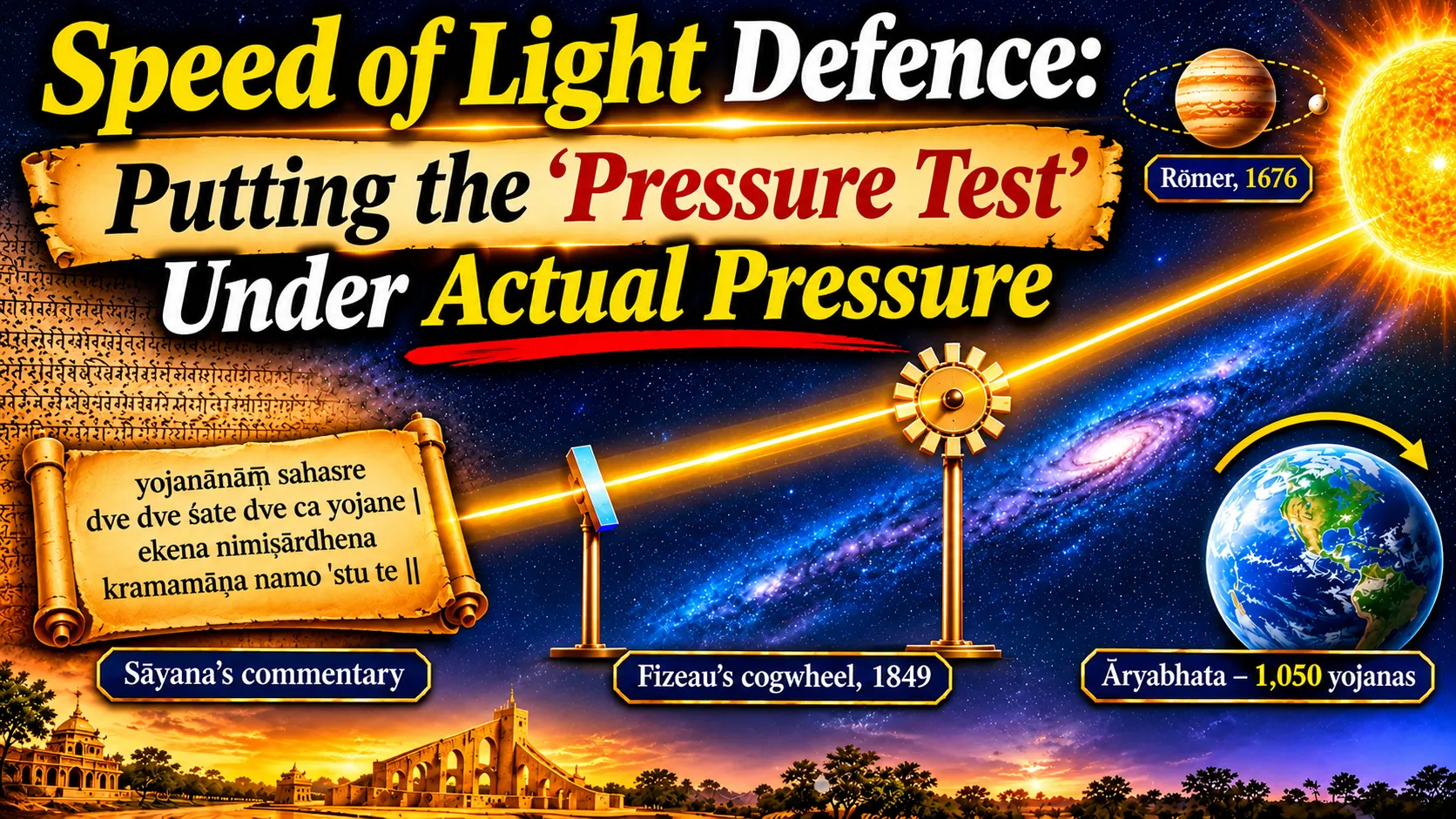
Speed of Light Defence: Putting the ‘Pressure Test’ Under Actual Pressure
Feed a Peer-Reviewed Paper to an AI, Fantasize About Retractions, and Call the Ranting ‘Rigour’
Contents
Introduction and Background
Textual Foundations, Metrological Traditions, and the Calculation Framework
Terrestrial Calibration, Ground-Level Units, and Methodological Validity
Rebuttal to Objections on Astronomical Distance and Speed Determination
The "Physics Pressure Test": A Methodological Blunder in the History of Science
Arthaśāstra Metrology, Commentator Tradition, and Unit Consistency
Selection Criteria for Yojana Standards and Methodological Safeguards
Minor Discrepancies, Textual Continuity, and Historical Technological Capability
Strength of the Argument: Robustness Analysis, Numerical Specificity, and the Opponent’s Flawed Premises
From Chatbot Prompts to Retraction Fantasies: Dissecting the Video
1. Introduction and Background
In August 2026, our peer-reviewed paper, "Pre-Rømer Reflections on the Speed of Light in Indian Texts: A Scientific and Philological Reassessment of Sāyaṇa’s Ṛgveda Commentary," was published in the Proceedings of the Indian National Science Academy (Springer Nature). Recently, a blog post titled "Did an Ancient Text Know the Speed of Light? I Put the Claim to a Physics Test" (by Kshitij Pandey) attempted to dissect our work. While critical engagement is the lifeblood of scholarship, a closer look at the critique reveals a pattern of strawman arguments, selective reading, and a fundamental misunderstanding of the textual traditions involved.
For those who prefer a conversational breakdown of our findings before diving into this point-by-point rebuttal, my podcast episode on this paper, "Kya India Ne Sabse Pehle Discover Ki Thi Speed of Light?" on Decoding with Kartik (http://www.youtube.com/watch?v=jpyJRa_nqUU), is also available to watch.
All co-authors of our study previously convened on the Sanatan Reveals channel (linked here) to address Kshitij’s video critique live and in full. Rather than offering a direct scholarly reply to that session, Kshitij opted to host a separate video flanked by two sidekick rented atheists. Accordingly, this post also refutes every new objection introduced in that broadcast that was absent from Kshitij’s blog, offering readers, as a welcome bonus, an unvarnished showcase of their academic buffoonery.
The opponent opens his piece with an emotional, self-serving preamble designed to cast himself as an objective admirer of Indian heritage, claiming, "When I question an idea like this, I don't mean that ancient India had nothing to offer. I study Indian astronomy in my free time..." and adding that one of his "future plans is to study and explore ancient Indian astronomy more deeply and make documentaries about it." Yet this carefully curated persona of a neutral truth-seeker collapses the moment one examines his actual body of work. For someone who claims to study and admire classical Indian astronomy, his platform contains not a single scholarly paper, detailed breakdown, or educational video celebrating the genuine scientific achievements of the Āryabhaṭīya or the Sūrya Siddhānta. Instead, his content is overwhelmingly dedicated to critiquing researchers like Mohit Gour and Vigyan Darshan while systematically dismissing scientific insights within classical Indian texts.
Kshitij is the kind of armchair debunker who parades himself as a great admirer of ancient Indian knowledge, yet his pronunciation of Āryabhaṭa is so butchered ("Āryabhaṭṭa") that it sounds less like one of India’s greatest astronomers and more like he is talking about bhaṭā (brinjal). Sure, maybe he only ever read English translations and picked up the colonial spelling habit, but he is an Indian, not a Briton.
Had there been any real sincerity behind his claimed commitment to evidence-based Indian science, his channel would be packed with detailed breakdowns of genuine milestones, such as Āryabhaṭa’s formulation of Earth’s axial rotation, his explanation of the Moon shining by reflecting sunlight, the Kerala school’s infinite series for , or the geometric theorems in Baudhāyana’s Śulbasūtras. Tellingly, he maintains a deafening silence on all of these, conveniently parking his alleged admiration in the eternal waiting room of "future plans". Empty disclaimers like "not of our heritage, but of claims..." are merely cheap camouflage, a thin mask of fake neutrality worn by a critic whose entire brand runs on cynicism rather than scholarship. True objectivity is shown through constructive engagement with primary texts, not by declaring oneself neutral while exclusively targeting and undermining Indian knowledge traditions.
2. Textual Foundations, Metrological Traditions, and the Calculation Framework
Before addressing the specific objections raised against our study, it is essential to place the primary textual evidence, variables, and methodological framework clearly before the reader. This context ensures that the debate remains anchored in primary sources rather than misinterpretations.
2.1 The Vedic Context and Sāyaṇācārya’s Quoted Verse
The discussion centres on the fourth mantra of the Sūrya Sūkta in the Ṛgveda (1.50.4), which celebrates the all-illuminating nature of solar light:
Ṛgveda 1.50.4
तरणिर्विश्वदर्शतो ज्योतिष्कृदसि सूर्य । विश्वमा भासि रोचनम् ॥
While commenting on this verse and its continuation into Ṛgveda 1.50.5 and following verses, where the Sun’s light pervades and beholds the entire cosmos, the 14th-century commentator Sāyaṇācārya invokes a traditional smṛti verse to illustrate the extraordinary speed of solar illumination:
Verse Quoted in Sāyaṇa’s Commentary [Ṛgveda 1.50.4] (Devanagari):
तथा च स्मर्यते—योजनानां सहस्रे द्वे द्वे शते द्वे च योजने । एकेन निमिषार्धेन क्रममाण नमोऽस्तु ते ॥
(Translation: "And thus it is remembered: Salutations to thee [O Sūrya/solar light], who traverses two thousand two hundred and two yojanas in half a nimeṣa.")
2.2 Variables and Mathematical Formula
The quoted verse provides a direct ratio of distance to time governed by two historical metrological variables:
Y (Distance Variable): The modern metric equivalent of 1 yojana in kilometres, making the total distance 2,202 × Y.
N (Time Variable): The modern equivalent of 1 nimeṣa in seconds, making the elapsed time half a nimeṣa, or 0.5 × N.
Converting this classical ratio into modern units yields a straightforward formula:
Speed of Light = (2,202 × Y) / (0.5 × N)
2.3 Metrological Traditions Examined
Because Sāyaṇa’s smṛti quotation states the numerical ratio without specifying which textual school’s definitions apply, an unbiased scientific reassessment cannot cherry-pick a single conversion. Instead, our paper systematically evaluates standard values across two primary metrological frameworks:
The Siddhāntic Astronomical Tradition: Encompassing both major astronomical schools, the Āryapakṣa (rooted in Āryabhaṭa’s Āryabhaṭīya and continued by later astronomers such as Nīlakaṇṭha Somayājī and Yallaya) and the Saurapakṣa (centred on the Sūrya Siddhānta and reflected in works such as Bhāskara II’s Karaṇakutūhala), alongside foundational treatises like Varāhamihira’s works and Bhāskara II’s Siddhānta Śiromaṇi, where the yojana is calibrated against Earth’s planetary dimensions.
The Purāṇic, Dharmaśāstric, and Arthaśāstra Metrological Tradition: Comprising classical normative, statecraft, and encyclopedic texts, such as the Manusmṛti, Kauṭilya’s Arthaśāstra, Mahābhārata, Viṣṇu Purāṇa, Matsya Purāṇa, Brahmāṇḍa Purāṇa, and Bhāgavata Purāṇa, which preserve detailed hierarchies of human and cosmic time (nimeṣa, kāṣṭhā, kalā, muhūrta) alongside ground-level linear units, where the Arthaśāstra’s spatial standard is anchored to standardized Indus-Harappan archaeological measurements (such as the 1.763 cm aṅgula documented at Dholavira) rather than relying on translator estimates.
3. Terrestrial Calibration, Ground-Level Units, and Methodological Validity
In "Turning a Yojana into Kilometres," Kshitij Pandey argues that deriving a yojana from Earth’s dimensions is conditional, absorbs errors, and fails to confirm Earth-based speeds. This objection fails on three main counts:
3.1 Standard Academic Metrology
Calibrating historical units against terrestrial dimensions is standard practice across Indian astronomical history, used by scholars like K. V. Sarma, S. Balachandra Rao, and P. Venugopal.
3.2 Earth-Independent Closest Matches
As detailed in Sections 4.4 and 6.2, the three pairings closest to c (Manusmṛti, Brahmāṇḍa Purāṇa, and Arthaśāstra) rely on ground-level metrological units anchored to traditional standards and the Harappan aṅgula rather than Earth-diameter calibrations.
3.3 Transparency Over Selection Bias
Precisely because Sāyaṇa’s verse does not specify a metrological school, an unbiased reassessment must test all major historical standards, both terrestrial-calibrated (Siddhāntic) and ground-measured (Purāṇic and Arthaśāstric), rather than cherry-picking only favourable ones.
4. Rebuttal to Objections on Astronomical Distance and Speed Determination
In the opening of his "Physics Pressure Test," Kshitij Pandey demands that astronomical numbers make sense within a tradition's own model, yet admits that Āryabhaṭa and the Sūrya Siddhānta do not use the nimeṣa and that his calculations are mere cross-textual comparisons. This exposes a basic category error: applying planetary distance tables from Siddhāntic astronomy to a Purāṇic text-transmission verse. A detailed breakdown dismantling these Sun-distance objections is provided in Section 4.3.
Testing a Strawman Model: Sāyaṇa’s quoted smṛti verse belongs to the Purāṇic and Dharmaśāstric tradition where the nimeṣa is native. Incorporating Siddhāntic parameter pairings in our sensitivity tables provides an exhaustive parameter map, but treating those pairings as proof that Sāyaṇa’s verse depends on Āryabhaṭa’s planetary geometry attacks a claim we never made.
4.1 The "Physics Pressure Test": A Methodological Blunder in the History of Science
Most critically, subjecting a classical Indian textual verse to a modern "physics pressure test" reflects a profound ignorance of both Indology and the history of science. In the Indian intellectual tradition, scientific, mathematical, and astronomical knowledge was not recorded in the format of modern experimental research papers but preserved and transmitted across generations in concise, poetic aphorisms (ślokas). The verse in question is demonstrably pre-Rømer, attested not only in Sāyaṇācārya’s 14th-century commentary but also earlier in the 12th–13th-century Kāśī Khaṇḍa of the Skanda Purāṇa and as far back as the 11th-century commentary of Bhaṭṭa Bhāskara (a philological lineage highlighted in Prof. Subhash Kak’s work and cited in our paper). Clearly, a scientific formulation originally composed in an early treatise entered the broader cultural memory as a poetic maxim and diffused across traditions. Applying a modern laboratory physics test to a historical text-transmission problem is a fundamental methodological blunder that violates the basic principles of the history of science.
In reconstructing historical units like the yojana, our study follows established metrological methods in Indology and the history of Indian science, building directly on the work of scholars such as P. Venugopal, S. Balachandra Rao, K. V. Sarma, Subhash Kak, Subhash Patra, and Michel Danino. Their research confirms that ancient Indian measurement systems must be evaluated within their proper textual and archaeological contexts rather than through anachronistic demands for modern, uniform SI-like standards. Moreover, even if one sets aside Earth-diameter calibrations altogether, we will demonstrate below using the Āryabhaṭīya that deriving the yojana strictly from its 8,000-nṛ (puruṣa/daṇḍa) definition and the archaeologically attested aṅgula yields an even stronger correspondence with c.
4.2 Standard Metrological Calibration vs. Circular Reasoning
In his "Test 1", Pandey argues that because our study derives the yojana from Earth’s dimensions and the nimeṣa from the length of the day, any agreement with Earth’s rotational velocity is merely "built-in" and cannot independently validate the speed of light.
This objection misrepresents basic metrological practice and ignores how our primary results were actually obtained:
Unit Conversion Is Standard Practice, Not Circular Reasoning: Converting ancient units into modern equivalents by anchoring them to shared physical constants is the universal standard in the history of science and is routinely employed by Indologists worldwide. For instance, ancient Indian texts divide a full day and night into nimeṣas, ghaṭikās, and praharas, whereas modern timekeeping divides the exact same day into 24 hours (86,400 seconds). Comparing the two to determine how many seconds equal one nimeṣa is completely normal and indisputable, especially since classical Indian astronomers already knew the length of the solar year (~365 days) with high precision, leaving no fundamental discrepancy between ancient and modern day-lengths. The exact same principle applies to converting the yojana into kilometers: alongside terrestrial calibrations, we also have physical, ground-level standards such as the Harappan aṅgula excavated at Dholavira and standard anatomical aṅgula averages. Because this calibration method is the standard consensus followed across the entire field of Indology, the opponent ought to first refute that entire scholarly consensus before pointing fingers at our paper.
Furthermore, in our paper, under the section Analysis and discussions (subsection Quantitative analysis of the speed of light, sub-heading Key observations and implications, p. 8), we explicitly stated:
"During the time of Sāyaṇa (thirteenth-fourteenth century), who quoted Bhaṭṭa Bhāskara (eleventh century), (Kak 1999) it can be said that they were aware of the Purāṇic and Dharmaśāstric concept of distance and time... It is most probable that the source that quoted Sāyaṇa and his predecessor, Bhaṭṭa Bhāskara (Kak 1999), was based on the Purāṇic-Dharmaśāstric tradition. This yields values numerically close to the modern accepted value."
Because we explicitly grounded Sāyaṇa’s source in the Purāṇic–Dharmaśāstric tradition rather than Siddhāntic planetary models, testing our main premise against Āryabhaṭīya or Sūrya Siddhānta solar distances leaves our core argument completely intact.
Note: Opponents should not mistake cautious academic phrasing like "most probable" for a lack of conviction on our part. In peer-reviewed journals, scholarly restraint is simply how serious research is written, though polemicists accustomed to loud, sweeping assertions often confuse basic academic etiquette with self-doubt.
Earth-Calibration Independence: As established in Section 3 and detailed further in Sections 4.4 and 6.2, our closest pairings to c do not rely on Earth-calibrated yojanas, rendering "Test 1" entirely moot.
The Boomerang Critique: There is an old rule in polemics: before throwing a boomerang, make sure it doesn’t come back and shave ten percentage points off your opponent’s error margin.
In the Āryabhaṭīya (Gītikāpāda 7), Āryabhaṭa defines one yojana as 8,000 nṛ (puruṣas), which is the exact same 8,000-daṇḍa standard preserved across the Purāṇic and Dharmaśāstric traditions. Kauṭilya’s Arthaśāstra (2.20.18) explicitly equates daṇḍa, dhanuḥ, nālikā, and pauruṣa as synonymous units of four aratnis (hastas), or 96 aṅgulas. This yields 768,000 aṅgulas per yojana. Applying the archaeologically attested Harappan aṅgula of 1.763 cm from Dholavira (Danino, 2008), Āryabhaṭa’s yojana works out to 13.54 km, or 8.41 miles, matching the Brahmāṇḍa Purāṇa yojana as well as the Viṣṇu Purāṇa and Mahābhārata traditions, both of which also share the exact same nimeṣa value (0.213 s). Crucially, even if we concede the opponent’s objection against calibrating the yojana from Earth’s modern diameter and adopt this ground-level archaeological measure instead, our position only grows stronger: whereas Āryabhaṭa’s Earth-calibrated yojana (12.13 km) previously gave an error of about -16% (-16.34% to -16.46%), this 13.54 km yojana, paired with the Viṣṇu Purāṇa and Mahābhārata nimeṣa (0.211 s and 0.213 s), yields 279,881 km/s to 280,268 km/s, slashing the error to just -6.75% to -6.62%. Once again, the pūrvapakṣa manages to raise an objection that only ends up fortifying our central thesis.
4.3 Sāyaṇa’s Context: Light Propagation vs. Orbital Motion
In "Test 2", the opponent claims that "read literally, the line contradicts the astronomy" because attributing the verse directly to the Sun’s physical motion makes it "more than 200,000 times faster" than Āryabhaṭa’s orbital rate, concluding that "to get a speed-of-light reading, it has to be reinterpreted, which is what the paper does."
This entire objection attacks a strawman while ignoring both our paper and the primary Sanskrit text:
First, we already established this astronomical constraint in our paper: citing Prof. Subhash Kak (p. 9, which the opponent himself highlights in Figure 8), we explicitly noted that neither Siddhāntic nor Purāṇic astronomy attributes such a velocity to the physical solar orb. That is precisely why the verse does not describe the Sun’s orbital chariot.
Second, reading the verse as light requires zero "reinterpretation": it is the explicit, primary subject of Ṛgveda 1.50.4 and Sāyaṇācārya’s surrounding commentary itself:
तथा 'ज्योतिष्कृत्', ज्योतिषः प्रकाशस्य कर्ता । सर्वस्य वस्तुनः प्रकाशयितेत्यर्थः । ... रात्रौ हि अम्मयेषु चन्द्रादिबिम्बेषु सूर्यकिरणाः प्रतिफलिताः सन्तः अन्धकारं निवारयन्ति । यथा द्वारस्थदर्पणोपरि निपतिताः सूर्यरश्मयो गृहान्तर्गतं तमो निवारयन्ति तद्वदित्यर्थः ॥
(“Likewise, [He is called] Jyotiṣkṛt, the creator of light, meaning the one who illuminates all things. At night, the rays of the Sun, after being reflected from the celestial bodies such as the Moon, dispel darkness. Just as the Sun’s rays, falling upon a mirror placed at a doorway, are reflected into the interior of a house and dispel the darkness within, so too [do the Sun’s rays reflected from the Moon and other celestial bodies illuminate the surroundings].” )
A commentator who in the very same breath defines Sūrya as prakāśasya kartā ("creator of light") and illustrates the reflection of sūryakiraṇāḥ ("solar rays") off a mirror (dvārasthadarpaṇa) is plainly speaking of the propagation of solar radiance, not planetary orbital tables.
4.4 Dismantling False Premises on Celestial Distances
In "Test 3", the opponent argues that "read as light, it doesn't fit these traditions' skies" because applying Sāyaṇa’s rate to the Sun’s distances in Āryabhaṭīya (459,585 yojanas), Sūrya Siddhānta (684,870 yojanas), and Viṣṇu Purāṇa (100,000 yojanas) yields solar light-travel times of 22.3 s, 13.7 s, and 4.8 s instead of the modern 499 seconds, claiming that "three things can't all be right at once: its Sun distance, its yojana, and Sayana's line as the speed of light."
This entire test rests on a chain of elementary logical and historical blunders:
1. A Completely False Premise, Earth-to-Sun Distance Is Not Required: Pandey notes that pre-telescopic astronomers underestimated the Earth–Sun distance and treats this as a litmus test against the verse. Yet knowing celestial distances is not a physical prerequisite for determining the speed of light. In 1849, Hippolyte Fizeau measured c entirely within the terrestrial domain using a rapidly rotating toothed wheel (cogwheel) and a mirror, requiring no astronomical distances whatsoever. (While Ole Rømer’s 1676 observation of Jupiter’s moon Io established light’s finite speed and Christiaan Huygens later applied an estimate of Earth’s orbital diameter to convert that delay into a linear velocity, Fizeau proved that astronomical geometry is completely dispensable.) Intricate rotating mechanical gear-systems (yantra assemblies) are explicitly documented in classical Indian engineering treatises such as King Bhoja’s Samarāṅgaṇasūtradhāra (cited on p. 12 of our paper).
2. Cross-Textual Category Error & Self-Refuting Concessions: As we already demonstrated, Sāyaṇa’s smṛti verse belongs to the Purāṇic–Dharmaśāstric tradition, not to Āryabhaṭīya or Sūrya Siddhānta planetary tables. Even worse, the opponent undermines his own table by admitting that "we already know the Sun distances are wrong, so this test alone can't tell us the speed is wrong" and conceding that Viṣṇu Purāṇa’s 100,000 yojanas is "a different kind of picture" rather than a modern centre-to-centre distance. An error in one independent variable (pre-telescopic solar distance) never invalidates another independent physical constant (c).
3. The Absurdity of "Sun-Calibrated" Units: Simply put, the Earth–Sun distance is neither required to validate the speed-of-light formulation nor needed to calibrate the yojana. While both our paper and this blog transparently record the Sūrya Siddhānta and Āryabhaṭīya readings (following established metrological studies such as S. Balachandra Rao et al.), pre-telescopic astronomy worldwide underestimated the Earth–Sun distance by roughly a factor of twenty-five due to the impossibility of naked-eye solar parallax, and as earlier Vedic knowledge traditions eroded, medieval treatises did not preserve an accurate solar distance. Consequently, the opponent’s arithmetic stunt of plugging these underestimated distances into time = distance / c or dividing the modern Earth–Sun distance by them to inflate the yojana is an empty mathematical tautology. Inserting a known ~25× underestimate mechanically shrinks the travel time by ~25×, just as dividing the modern distance by it mechanically inflates the yojana—and hence the resulting speed—by ~25×. All this proves is a textbook fact nobody disputes: pre-telescopic solar distances were too small, especially as earlier knowledge traditions suffered disruption during the medieval era. It leaves Sāyaṇa’s speed-of-light verse completely untouched; to establish the yojana, the classical 8,000-daṇḍa standard backed by the archaeological aṅgula is more than enough, a simple fact that somehow keeps flying right over the head of our self-appointed physics tester.
1. Moving the Goalposts, Reviewing Internet Folklore Instead of Our Paper: By admitting that "the paper disclaims a measurement" yet attacking "the popular claim," the opponent commits a textbook strawman fallacy. Our paper explicitly states in both the Introduction (p. 2) and Conclusions (p. 12) that we do not present Sāyaṇa’s verse as a modern laboratory measurement. A serious critique must engage with what our paper actually argues, not with viral social media claims.
4.5 Absence of Experimental Logs and the Terrestrial Measurement Route
In "Test 4," the opponent opens with a telling admission: "The paper disclaims a measurement, but the popular claim usually implies one." After recounting textbook summaries of Galileo, Rømer (1676), Bradley (1729), and Fizeau (1849), he notes that our paper "cites no instrument or procedure for either route," selectively quotes a single clause from page 12 ("direct evidence of telescopic devices is absent"), and concludes that "agreement with c, reached by choosing units, doesn't validate the conversion on its own."
This closing argument fails on four independent grounds:
2. Ancient Indian Masters Did Not Write Modern Lab Manuals: Demanding a 19th-century European experimental logbook from pre-modern Indian treatises is an anachronistic error. Classical scholars like Āryabhaṭa, Varāhamihira, and the authors of the Sūrya Siddhānta did not write modern research papers or step-by-step laboratory manuals; the modern peer-reviewed paper format did not exist. Traditional Indian knowledge systems preserved and transmitted validated results across generations in concise, aphoristic (sūtra) form. As we documented on page 11 (Precision and reasoning in ancient Indian texts), foundational achievements, from the Pythagorean theorem in the Baudhāyana Śulbasūtras and Āryabhaṭa's accurate approximation of π to Yāska's (Nirukta II.6) recognition that the Moon shines by reflected sunlight, are all stated directly without accompanying experimental protocols. If the absence of a lab manual invalidated ancient results, half the history of Indian mathematics and astronomy would have to be dismissed as "coincidence". Absence of evidence is not evidence of absence.
3. Plausibility of Optical and Mechanical Instruments: Ancient Indian texts explicitly document optical analogies (such as the upanetra in Śaṅkarācārya’s Aparokṣānubhūti) and mechanical gear assemblies (Samarāṅgaṇasūtradhāra); full textual and historical evidence for these is detailed in Section 7.1.
4. ±6% Across Three Distinct Textual Traditions Is Not "Choosing Units":
Kauṭilya’s Arthaśāstra (Dholavira-validated yojana of 15.23 km + Arthaśāstra’s own nimeṣa of 0.24 s) → 279,467 km/s (−6.78% error).
Manusmṛti (yojana of 12.87 km + Manusmṛti’s own nimeṣa of 0.177 s) → 318,784 km/s (+6.33% error).
Brahmāṇḍa Purāṇa (aṅgula-derived yojana of 13.54 km + Purāṇic nimeṣa of 0.213 s) → 279,936 km/s (−6.62% error).
The opponent’s reliance on page 12 ("direct evidence of telescopic devices is absent") is a textbook case of selective quotation. By lifting a single clause out of context, he conceals the broader discussion in our paper (Critical Analysis → Observational Precision and Instruments, pp. 11–12, and Conclusions, p. 12), where we explicitly note that "It is plausible that convex or concave pieces were fashioned and experimented with for optical purposes, possibly even elementary projection or magnification."
5. Arthaśāstra Metrology, Commentator Tradition, and Unit Consistency
The opponent tries to turn basic unit conversions and classical commentator traditions into a mystery, while demanding modern lab manuals from ancient statecraft texts. What follows is a straightforward breakdown of why his Arthaśāstra objections collapse against both the Sanskrit text and archaeology.
5.1 Archaeological vs. Translator Estimates for the Aṅgula
The opponent's core question is whether our paper's speed-of-light estimates within ~7% of c rest on independent textual evidence or merely on selecting and combining modern conversion units (such as the Harappan 1.763 cm aṅgula, 108- vs. 96-aṅgula dhanuṣ, and commentator-based 8,000-unit yojana readings), alongside asking why ancient Indian texts lack evidence of modern laboratory or high-speed optical experiments.
Furthermore, the pūrvapakṣa needlessly insists on running calculations with R. Shamasastry’s 1.6 cm aṅgula, overlooking the fact that 1.6 cm is merely a translator’s rough estimate. Given the clear metrological continuity and historical proximity between Dholavira and Kauṭilya’s Arthaśāstra, prioritizing the archaeologically attested 1.763 cm aṅgula over a modern approximation is not just preferable, it is the only methodologically sound choice.
5.2 Textual Equivalence of Metrological Units and Commentator Traditions
In Arthaśāstra (2.20.18), Kauṭilya explicitly equates daṇḍa, dhanuḥ, nālikā, and pauruṣa at four aratnis:
चतुर्-अरत्निर्दण्डो धनुर्-नालिका पौरुषं च गार्हपत्यं ०२.२०.१८ ॥
This establishes puruṣa and daṇḍa as equivalent designations within that standard. Combined with the Āryabhaṭīya tradition, which treats 8,000 puruṣas as one yojana, and the classical commentator tradition recorded in the textual apparatus (such as 2,000 dhanus per goruta, yielding 8,000 dhanus per yojana across four gorutas, cf. द्विधनुः-सहस्रं गोरुतं ।। ०२.२०.२५ ।। and चतुर्गोरुतं योजनं ।। ०२.२०.२६ ।।), Kshitij is needlessly rejecting the traditional commentator cited by Shamasastry without any basis. Dismissing a classical commentator out of hand without specific counter-evidence neither breaks the tradition nor invalidates the Arthaśāstra, and leaves our thesis completely intact.
5.3 Functional Taxonomy of the Dhanus and Archaeological Alignment
We did not invent calculations on our own. Our prioritization of the 108-aṅgula dhanus rests directly on Kauṭilya’s own functional taxonomy, prior scholarship (including Subhash Kak, 2009), and archaeological convergence. In the Arthaśāstra, the 96-aṅgula unit of 2.20.18 is explicitly designated as gārhapatya (a domestic/ordinary measure), whereas the very next sūtra (2.20.19: अष्ट-शत-अङ्गुलं धनुः पथि-प्राकार-मानं पौरुषं चाग्नि-चित्यानां) defines the 108-aṅgula dhanus specifically as the standard for roads (pathi) and fortification walls (prākāra), while keeping specialized land-grant units such as the brahmadeya daṇḍa (2.20.20: षट्-कंसो दण्डो ब्रह्मदेय-आतिथ्य-मानं) distinct. Because a yojana is a long-distance road measure, and because the deśa-māna (spatial/distance measurement) section defines the goruta specifically in terms of the dhanus (2.20.25) before culminating in the yojana—the road-measuring 108-aṅgula dhanus is the exact domain-appropriate unit.
This textual choice is directly reinforced by archaeological metrology. In his study of Dholavira’s urban planning, Michel Danino reconstructed a master measurement unit of approximately 190.4 cm, corresponding to 108 aṅgulas of 1.763 cm each, and linked it directly to this Arthaśāstra standard. The chronological gap between the Harappan era of Dholavira and the Mauryan period of Kauṭilya is not so vast as to rule out metrological continuity, confirming that the 108-aṅgula measure remained current within that tradition.
Nor does a ~−17% reading from the 96-aṅgula variant refute our paper: we can present calculations across variables without forcing every variant into one number, and even a −17% error in antiquity is far closer to the modern 299,792.458 km/s than Rømer’s ~214,000 km/s estimate (approximately 28.28% lower than the accepted value). Too lazy to open the original Sanskrit Arthaśāstra, or even read the pages of our paper where Subhash Kak is clearly cited, the opponent throws out an objection that reads like a sloppy AI copy-paste. (As we will see in Section 9, they later confessed to doing exactly that in a video.)
6. Selection Criteria for Yojana Standards and Methodological Safeguards
Rather than arbitrarily tuning units to fit c, our selection of yojana standards is governed by strict textual, functional, and archaeological safeguards that keep each metrological tradition internally consistent.
6.1 Historical Metrological Taxonomy
In our paper, we wrote:
"Hereby, the smaller estimates of the yojana shall be disregarded, as they are typically employed for minor localised calculations and are not considered suitable for astronomical or scientific contexts, such as the computation of the speed of light, where larger and more consistent units are required."
The opponent fails to grasp the depth of this sentence simply because he lacks even a cursory familiarity (cañcu-praveśa) with ancient Indian metrological systems. We never claimed that modern physics requires a large unit to express a large velocity; obviously, c is invariant whether expressed in kilometres or millimetres per second. Rather, our statement addresses historical Indian metrological taxonomy. Even the opponent concedes that a real local-versus-astronomical distinction could exist while demanding historical evidence for the quotation rather than unit size alone. That evidence is explicit in the text and tradition: Sāyaṇa’s context in his Ṛgveda commentary is classical and cosmological; the traditional verse quoted by Sāyaṇa isn’t calculating boat fares for a village ferry or local road, making the canonical (Purāṇic–Dharmaśāstric) yojana the historically appropriate unit, even if that distinction is easy to miss if one reads texts like a checklist rather than actually understanding them.
6.2 Systemic Traditions and Internal Consistency
The term yojana did not denote one universally fixed linear distance across all Indian astronomical traditions. Our previously published study (Iyer, Gour, & Maurya, 2026) explicitly examines the systemic divergence between the Āryapakṣa (≈ 12.13 km/yojana) and Saurapakṣa (≈ 8.35 km/yojana) traditions, a ratio of ≈ 1.5 independently corroborated by Parameśvara’s Goladīpikā (30–31), which notes that Āryabhaṭa’s terrestrial and planetary measures scale up by about one and a half times under other astronomical reckonings due to the differing yojana adopted. Because linear units were system-dependent, velocity calculations must pair spatial and temporal parameters from compatible frameworks (without claiming that the Saurapakṣa itself explicitly defines a nimeṣa in direct proportion to its yojana), rather than mixing units drawn from unrelated systems.
Crucially, this systemic separation is direct proof that the speed-of-light correspondence in Sāyaṇa’s verse is not a product of mere coincidence. As Richard L. Thompson demonstrates, classical Indian astronomy preserved strict internal metrological consistency. Within the Saurapakṣa (Sūrya Siddhānta), calibrating its 1,600-yojana Earth diameter yields a ~5-mile (~8–8.35 km) yojana that accurately reproduces Earth–Moon geometry inside its own system. By contrast, the Purāṇic and Arthaśāstra traditions operate on a distinct ~8–8.5-mile (~12.87–13.54 km) yojana standard. When Sāyaṇa's verse is evaluated strictly within those native frameworks, three distinct textual lineages (Manusmṛti at +6.33%, Brahmāṇḍa Purāṇa at -6.62%, and Arthaśāstra at -6.78%, the latter two calibrated on the same 1.763 cm aṅgula) converge tightly around 300,000 km/s while preserving a non-round integer (2,202). A lucky guess or poetic hyperbole does not produce multi-system coherence like that. (See Section 4.4 for additional metrological breakdown).
6.3 Canonical Standards and Archaeological Evidence
Retaining the canonical standard rests on converging textual and archaeological evidence, as established in Section 6. This standard represents a cross-genre consensus across gaṇita, jyotiṣa, and Purāṇic paribhāṣā texts, including Āryabhaṭīya (Gītikāpāda 7: 8,000 nṛ), Līlāvatī (Paribhāṣā: 4 krośas = 8,000 daṇḍas = 32,000 hastas), and the Brahmāṇḍa, Vāyu, and Viṣṇu Purāṇas. On the exact same principle of canonical consistency, we excluded Śrīdhara’s nimeṣa valuation because it diverges from the broader textual tradition, a discrepancy already noted by H. H. Wilson and explicitly addressed in our paper.
6.4 Exclusion of Geographic Back-Calculations
By contrast, the exceptionally small ≈ 0.29 km estimate is excluded on primary-source grounds. No Purāṇic paribhāṣā supplies this figure as an explicit metric conversion; rather, it is a modern geographic back-calculation obtained by dividing an assumed terrestrial span of roughly 2,600 km by 9,000 yojanas (≈ 0.289 km/yojana), presupposing an unverified one-to-one mapping between cosmographic text and modern geography. Ganesh Swaminathan (From the Beginning of Time, 2020) similarly notes that "some verses suggest smaller conversions, including one as small as 0.29 km to a yojana," before citing a separate Matsya Purāṇa passage to illustrate contextual variation. Although he references a different Matsya Purāṇa context, modern scholarly analyses standardly arrive at the ~0.29 km figure through precisely the geographic back-calculation outlined above (as seen in Viṣṇu Purāṇa 2.3 and Matsya Purāṇa 114.9–10, where adjacent verses themselves yield sharply divergent implied scales). Incompatible with both the 8,000-dhanus textual standard and the Dholavira scale, this isolated geographical estimate has no place in astronomical metrology.
6.5 Methodological Safeguards and Protection Against Retrofitting
Finally, this protocol directly refutes the charge of retrofitting. Our inclusion criteria are a priori and outcome-independent: a unit is admitted only if it is (1) explicitly attested in a primary paribhāṣā or established tradition, (2) situated within the astronomical/cosmological domain rather than derived from a modern geographic back-calculation, and (3) paired with a compatible temporal framework. Applying these historical filters eliminates the 0.29 km estimate prior to any calculation involving c. More decisively, retrofitting requires suppressing canonical results that miss the target value (299,792.458 km/s), whereas we transparently retain canonical siddhāntic calibrations even where they overshoot c by more than +30%. Because velocity scales linearly with yojana length, adopting a canonical astronomical standard does not artificially lock results onto c; our study evaluates order-of-magnitude consistency (~10⁵ km/s) across attested astronomical traditions rather than decimal curve-fitting, upholding philological fidelity, historical plausibility, and methodological transparency.
6.6 The Manusmṛti Consensus: Beyond Ganganath Jha’s Gloss
Similarly, the opponent’s dismissal of our Manusmṛti row as resting merely on Ganganath Jha’s parenthetical "(8 miles)" gloss misses the broader textual, lexicographical, and metrological consensus. As H. H. Wilson notes in his translation of the Viṣṇu Purāṇa (Book I, Chapter 6, p. 46, footnote), the Vāyu Purāṇa explicitly cites the authority of Manu (manor yāni pramāṇāni, मनोर्यानि प्रमाणानि) to record the exact linear scale: 24 aṅgulas (fingers) = 1 hasta, 4 hastas = 1 dhanu, 2,000 dhanus = 1 gavyūti, and 8,000 dhanus = 1 yojana. While Wilson correctly observes that this specific verse does not appear in the extant Manu Saṃhitā, that is hardly surprising in textual history: the Manusmṛti underwent documented additions and omissions over time, and numerous classical nibandhakāras and ācāryas quote verses attributed to Manu that are absent from surviving recensions. Crucially, this confirms that there was no substantive divergence in yojana computation between the Purāṇic and Dharmaśāstric lineages—which is precisely why we treat both within a single unified Purāṇic–Dharmaśāstric tradition. Jha, Monier-Williams, and Apte did not invent an arbitrary conversion; their 4-krośa (8–9 mile) range simply reflects this established classical consensus, with the upper 9-mile bound representing a colonial-era anatomical approximation (assuming an 18-inch hasta) of the exact same 8,000-daṇḍa/dhanus standard that the archaeologically attested Dholavira aṅgula (1.763 cm) anchors right in the middle at 13.54 km (8.41 miles). More importantly, even if one substitutes the 9-mile (14.48 km) figure into Manusmṛti’s own nimeṣa (0.1778 s), the resulting speed (~358,661 km/s, or +19.64%) still falls well within our paper’s transparently published range (−16% to +39%) and remains closer to c than Ole Rømer’s 1676 estimate (−28.28%). Thus, the objection leaves our central thesis completely untouched.
7. Minor Discrepancies, Textual Continuity, and Historical Technological Capability
The opponent points out a few minor typographical and rounding discrepancies while himself conceding that they do not affect the central thesis of our paper; such clerical slips can be readily resolved through a standard corrigendum.
7.1 Textual Continuity of Ṛgveda 1.50.5
While Sāyaṇa introduces the velocity formula in his commentary on the fourth mantra (Ṛgveda 1.50.4), the reference to 1.50.5 reflects its thematic continuity (saṅgati) with the fifth and subsequent mantras, specifically the broader textual context (prakaraṇa) in which Sūrya is described as beholding and illuminating the entire world.
7.2 Recalibrating the Sūrya Siddhānta Circumference
Similarly, we candidly acknowledge an attribution slip regarding the 4,800-yojana Earth circumference: that figure belongs to Bhāskara II’s Karaṇakutūhala rather than directly to the Sūrya Siddhānta, an oversight that occurred because Venugopal et al. (2019, p. 403) classify Karaṇakutūhala itself within the Saurapakṣa tradition. However, correcting this to Burgess’s exact Sūrya Siddhānta circumference of 1,600105,059.56yojanas (~5,060 yojanas) only strengthens our case. Calibrating against Earth’s equatorial circumference (~40,075 km) yields a yojana of 7.92 km (instead of 8.35 km). Plugging this into Sāyaṇa’s formula with our tabulated nimeṣa of 0.088 s gives:
Speed=2,2027.92km0.50.088s396,360km/s
This cuts the deviation from c from +39.4% down to +32.2% (and further down to +31.3% if the unrounded 0.0886 s nimeṣa is used), moving the result over seven percentage points closer to the modern value, a point the opponent himself concedes.
Having addressed these minor textual and numerical details, we can now turn to the broader question of ancient technological capability and the validity of historical reconstruction.
7.3 Historical Technological Capability and the Legitimacy of Reconstruction
Our primary evidence rests directly on physical artifacts and primary texts. We deliberately refrained from claiming a documented telescope or modern experimental protocol simply because no such explicit text has surfaced in our research, a basic standard of scholarly integrity that evidently baffles critics accustomed to loud, sweeping assertions. Nobody with a functioning grasp of history waves away advanced ancient engineering or optical insight as "coincidence" simply because surviving manuals are incomplete.
Offering plausible reconstructions where records have vanished is entirely legitimate, and, as our paper has already established and this rebuttal makes even clearer, India’s pre-Rømer speed-of-light figure is anything but a coincidence. Across the ancient world, the absence of surviving technical manuals has never been treated as proof against empirical or engineering mastery. Neither the Great Pyramids of Egypt, with their extraordinary astronomical alignments and precision-fitted masonry, nor Stonehenge, with its megalithic solstice geometry, comes with an extant blueprint detailing every tool and method employed. One sees the exact same principle in India’s own living heritage: the intricate monolithic granite carvings of classical temple architecture exhibit a remarkable geometric exactitude and symmetry that continue to impress modern engineers. No surviving workshop manual tells us the exact mechanical tooling used to achieve such precision, yet these monuments, from Giza and Stonehenge to India’s classical temples, stand before us as undeniable evidence of advanced engineering instruments and technical mastery.
The same holds true for optical knowledge: classical Indian texts explicitly preserve references to optical principles, from the upanetra ("secondary eye", perceiving a distant object as if brought near through a crystal or lens) in Ādi Śaṅkarācārya’s Aparokṣānubhūti (Śloka 81) to the sūryakāntamaṇi, a sunstone functioning on the exact principle of a convex lens by focusing solar rays to ignite fire. The sūryakānta is attested as early as the Mahābhārata (Śānti Parva 12.211.28: रेतो वटकणिकायां घृतपाकाधिवासनम् । जातिस्मृतिरयस्कान्तः सूर्यकान्तोऽम्बुभक्षणम् ॥), where it is cited alongside the magnet (ayaskānta) as an established natural phenomenon of subtle physical power, and is later famously invoked by Kālidāsa in the Abhijñānaśākuntalam (2.7):
शमप्रधानेषु तपोधनेषु गूढं हि दाहात्मकमस्ति तेजः । स्पर्शानुकूला इव सूर्यकान्तास्तदन्यतेजोऽभिभवाद्वमन्ति ॥ ("In ascetics rich in tranquility lies a hidden, burning radiance; like sun-stones [sūryakāntas] that are cool to the touch, they emit fire when acted upon by another brilliance [solar rays].")
Just as no serious scholar dismisses the Pyramids, Stonehenge, or Indian temple engineering as "accidents" for lack of surviving blueprints, dismissing India’s pre-Rømer speed-of-light formulation as mere coincidence simply because the original observational record has not survived is historiographically indefensible.
8. Strength of the Argument: Robustness Analysis, Numerical Specificity, and the Opponent’s Flawed Premises
In his closing section, "How Strong Is the Argument?", the opponent tries to weaken our conclusions by attacking claims our paper never actually makes. Specifically, he raises four objections: that our sixteen velocity values are merely sixteen readings of a single statement rather than sixteen independent measurements; that writing 2,202 rather than 2,200 (a 0.09% difference, dwarfed by our -16% to +39% unit spread) proves nothing about method or accuracy; that our paper allegedly escalates its claims across pages 9, 11, and 12 (from a "figurative" reading to "postulating" a value while disclaiming an "experimental determination"); and that traditional Sun distances lend no independent support to the sunlight reading. Every one of these objections collapses under basic philological and logical scrutiny.
8.1. Sixteen Readings Are a Robustness Analysis, Not Sixteen Lab Trials
Demanding sixteen independent experimental measurements from a single textual passage, especially in the history of science, is an exercise in absurdity. Our paper explicitly examines one numerical formulation (2,202 yojanas in half a nimeṣa) transmitted across Bhaṭṭa Bhāskara, the Kāśī Khaṇḍa of the Skanda Purāṇa, and Sāyaṇa’s Ṛgveda commentary. Because traditional Indian knowledge systems did not operate under a single modern SI standard, yojana and nimeṣa varied across astronomical, administrative, and Purāṇic frameworks. Accordingly, our sixteen velocity/time values function as a sensitivity and robustness analysis across attested historical standards. This directly refutes the charge of cherry-picking: rather than relying on one convenient conversion or uncritically adopting earlier readings such as Raghavarao and Verma’s ~29.3 km yojana, which lacks adequate metrological support, we test whether the order-of-magnitude correspondence (~105 km/s) holds across gaṇita, jyotiṣa, and Purāṇic traditions.
8.2. Injecting a 0.09% Comparison into a Philological Point Is a Category Mistake
Dragging an arithmetic comparison of 0.09% (between 2,202 and 2,200) against our -16% to +39% metrological spread completely misses the point of pages 10–11. We never equated numerical specificity with modern error bars or empirical instrumentation; in fact, the negligible 0.09% gap beside the broader unit spread only underscores that the transmitted figure does not depend on artificial decimal tuning. Our observation is philological: in classical Sanskrit and Purāṇic literature, poetic hyperbole (atiśayokti) relies on sweeping, round magnitudes – 100, 1,000, 10,000, or ten lakṣa yojanas. The preservation of a conspicuously non-round numeral like 2,202 (dve sahasre dve śate dve ca) breaks that literary convention. Recurring across at least three distinct textual witnesses from the 11th to the 14th century, it signals an established traditional formulation encoding an underlying metrological concept rather than an ad hoc poetic flourish. Conflating why a classical verse preserves a non-round integer with how modern conversions vary across historical unit definitions is a textbook category mistake.
8.3. No Shifting Claims: A Basic Failure to Understand Both "Postulate" and Indian Scientific Verse
The charge that our argument contradicts itself across pages 9, 11, and 12 exposes a basic failure to read either English or Sanskrit literature accurately:
Poetic figurativeness and quantitative postulation are not mutually exclusive: The opponent imposes a modern divide between poetry and science that, if applied consistently, would erase India’s classical scientific canon. Because foundational works of gaṇita, jyotiṣa, Āyurveda, and mechanics, from the Āryabhaṭīya, Sūrya-siddhānta, and Bhāskarācārya to the Caraka and Suśruta Saṃhitās and the Samarāṅgaṇasūtradhāra, are composed in ornate verse (śāstrakāvya), his logic would let one dismiss all of Indian astronomy (khagola), medicine, and engineering as "mere poetry" simply because it scans in metre. Across the Dharmaśāstras, Purāṇas, Rāmāyaṇa, Mahābhārata, and technical śāstras, kāvya and vijñāna walked hand in hand; metrical style was the medium of transmission, never a disclaimer of substance. Reading the verse as both a figurative depiction of sunlight through the sun's motion (p. 9) and a quantitative postulate (p. 11) is therefore strict fidelity to the genre, not a shift in claims.
The semantic blunder over "postulate": In standard English and the philosophy of science, to postulate means to put forward or posit a proposition or numerical value; it does not mean to establish it through a modern laboratory experiment. Stating on page 11 that Sāyaṇa’s commentary postulates a numerical value and disclaiming an experimental determination on page 12 is not a retreat; the two statements are completely consistent.
Anachronistic expectations of modern lab manuals: Ancient Indian texts transmitted knowledge via concise, validated aphorisms rather than step-by-step experimental manuals. Disclaiming an experimental protocol while recognizing the text’s numerical postulate demonstrates basic academic discipline, not a retreat in argument.
8.4. The Sun-Distance Objection Rests on an Arbitrary, Flawed Premise
Finally, the opponent’s Sun-distance objection rests on an arbitrary premise, as knowing the Earth–Sun distance is neither logically nor physically required to evaluate the speed of light. After a critique built on strawmen, his conclusion (“So, Where Does This Leave Us?”) merely recycles refuted talking points alongside a patronizing sermon on Indian astronomy. His subsequent video, joined by two associates, followed the same script, ignoring my prior rebuttal on the Sanatan Reveals channel (which had already dismantled the Sun-distance claim) to repeat the same debunked points. Without detailing who raised which objection, it is worth dismantling the fresh claims and publishing blunders they unveiled during that video, starting with the Bhāgavata Purāṇa and the Kāśī Khaṇḍa.
9. From Chatbot Prompts to Retraction Fantasies: Dissecting the Video
If the opponents’ blog objections were weak, the new claims they introduced during their video, ranging from careless misreadings of the Bhāgavata Purāṇa and Kāśī Khaṇḍa to a comical grasp of academic publishing, border on farce. Let us, then, examine their videoed buffoonery point by point.
9.1 On the Bhāgavata Purāṇa Nimeṣa Valuation
Opponent’s Claim: The opponent alleges that we first stated the Bhāgavata Purāṇa (BP) nimeṣa as 0.4 s, changed it to 0.2 s in the next paragraph, and then excluded it to retrofit our results.
One almost pities the sheer intellectual laziness on display here; this is what happens when you outsource your reading comprehension to Claude and blindly parrot its hallucinations in a video to play pretend-scholar. Had the opponent possessed the basic literacy or the attention span to actually read even this single section of our paper himself, he might have spared himself the public humiliation of peddling such a pathetic, two-bit accusation.
Rebuttal: This accusation reflects a careless reading of the section titled "Nimeṣa in other Siddhāntic, Purāṇic, and Dharmaśāstric texts". After surveying mainstream texts, Siddhānta-śiromaṇi (~0.0886 s), Manusmṛti (~0.177 s), Mahābhārata (~0.213 s), and Viṣṇu Purāṇa (~0.213 s), our paper introduces BP separately and explicitly records its value as 0.425 s without ever altering it:
"BP, on the contrary, gives another set of time divisions. In this scheme, one hundred truṭis make a vedha, three vedhas a lava, and three lavas a nimeṣa... Altogether, this framework yields 202,500 nimeṣas in a day, giving each nimeṣa a duration of about 0.425 s in modern terms."
The subsequent paragraph concludes the entire comparative section, not BP alone:
"By comparing the total nimeṣas given in these texts to the modern duration of a day, the value of 1 nimeṣa in seconds can be determined. For a solar day of 86,400 s or a sidereal day of 86,164 s, 1 nimeṣa corresponds approximately to 0.24 s, providing a bridge between ancient measurements and modern time units."
The phrase "total nimeṣas given in these texts" plainly refers to the collective mainstream consensus (~0.2 s), not a fabricated alteration of BP.
Excluding BP from the primary calculation is standard methodology, not retrofitting. Because BP’s nimeṣa is a clear outlier against the broader Purāṇic and Dharmaśāstric consensus, we followed the exact same principle applied by H. H. Wilson in his Viṣṇu Purāṇa translation when rejecting Śrīdhara Svāmī’s divergent nimeṣa valuation. (Amusingly, the pūrvapakṣa’s Three Musketeers of selective reading completely missed this line before crying "deliberate omission", despite our clear reasoning, and the exact same principle holds for the Bhāgavata Purāṇa).
9.2 Antiquity of the Kāśī Khaṇḍa and Pre-Rømer Horizon
Opponent’s Claim: The opponent argues that the oldest Skanda Purāṇa manuscript dates to the 8th century CE and does not contain this verse, since the verse belongs to the Kāśī Khaṇḍa.
Rebuttal: The opponents are heroically demolishing a claim we never made. Nowhere did we date the Kāśī Khaṇḍa itself to the 8th century CE; we merely noted the antiquity of the broader Skanda Purāṇa tradition: "Moreover, in the Skanda Purāṇa (Tripāṭhī 1991), whose manuscripts are believed to predate 800 CE (Mann 2011), the same śloka appears with minor textual variations."
More hilariously, they concede in their own video that the Kāśī Khaṇḍa and this verse appear around the 14th century CE, leaving one to wonder whether they sat down to perform khaṇḍana (refutation) or accidentally delivered maṇḍana (validation). Unless the 14th century somehow occurred after Ole Rømer’s 1676 CE estimate, their big "gotcha" only confirms our explicitly pre-Rømer thesis.
Worse still for their chronology, even the Purāṇic scholars they invoked in their video, such as Hans Bakker and Diana Eck, place the underlying textual layers well before the modern era, while the British Library's Endangered Archives Programme catalogues two Kāśī Khaṇḍa manuscripts (EAP781/1/1/363 and EAP781/1/1/506) from the 13th century CE, physical evidence earlier scholars like R. C. Hazra did not have access to. Because extant manuscripts establish only a terminus ante quem, the text could well be older still. To refute us, the opponents would need to prove the verse post-dates 1676 CE; instead, with the formulation attested across Bhaṭṭa Bhāskara, the Kāśī Khaṇḍa, and Sāyaṇa, their own concessions graciously do our job for us.
9.3 The Myth of the Rubber-Stamp Reviewer: A Crash Course in Data Availability
During the same video At 42:00, one speaker tried to question our journal’s peer review with a point that wasn’t even clearclaiming experimental papers get a free pass just because "it’s an experiment," with no real check on data availability, while hinting that text- or śāstra-based work gets waved through without serious scrutiny. If he thinks śāstra-based papers get an easy pass, someone who couldn’t even read our Bhāgavata Purāṇa nimeṣa section properly should spare us the lecture on peer reviewer, who are, after all, experienced professors and working scientists. Conversely, if he meant that reviewers do check textual work properly, why did he claim elsewhere in the very same video that the reviewers failed to do their job? (Yes, minor typos exist, they slip into top-tier papers all the time, but they hardly invalidate a study.) And if he believes experimental papers are published without data checks, he has clearly never seen Data Availability Statements or supplementary appendices, which in many scientific journals run two to three times longer than the paper itself, packed with raw experimental data and step-by-step details. Watching three armchair critics sit in a video and grade experienced scientists is comedy at its finest. For the record, our paper went through three full rounds of review before it was accepted.
9.4 Chatbot Forensics Gone Wrong: The Myth of the "Hidden" Values
The insinuation that we hid inconvenient values or manipulated numbers collapses under its own absurdity. If we were in the business of concealing inconvenient facts, why on earth would we transparently publish error margins stretching from -16% all the way to +30–39%? Sweeping those under the rug would have made our job infinitely easier. Even better: Raghava Rao had already produced a convenient match for the speed of light by pairing the Bhāgavata Purāṇa’s nimeṣa with a 29 km yojana. If our sole objective were to force a result by any means necessary, we could have simply stopped there; why bother writing an entirely new, critically vetted paper? This entire line of attack makes neither head nor tail.
At 45:33, the mask slips entirely: one of the three cut-rate armchair debunkers openly confesses that he simply fed our paper into an AI to hunt for errors. That single, embarrassing admission explains the entire circus. Devoid of the Sanskrit literacy to touch a primary text and too intellectually lazy to verify a single metrological equation themselves, they outsourced their thinking to a chatbot and then recorded its prompt output in a video as if they were a panel of groundbreaking peer reviewers. The comedy practically writes itself: self-appointed guardians of "academic rigour" who spend an hour lecturing published researchers on scholarly standards, yet lack the basic reading comprehension to survive a twelve-page paper without an AI spoon-feeding them every talking point. That explains everything: it is precisely why they mistook our Bhāgavata Purāṇa discussion for an error and never even bothered to read the Śrīdhara argument sitting right in front of them.
9.5 Retraction Fantasies and Our Open Challenge
At 35:30, one of the panellists launches into a solemn sermon about publishing an ACS paper where a single erroneous value had to be corrected at his supervisor’s insistence before grandly declaring that an error in a "fundamental assumption" warrants a full retraction. The implied insinuation is obvious, and it betrays a remarkable confusion about how academic publishing actually works. Under standard COPE (Committee on Publication Ethics) guidelines, retraction is reserved for misconduct, fabricated data, or fatal errors that invalidate a study’s core conclusions, not for a YouTube panel’s methodological disagreements or minor clerical points that academic publishing routinely resolves with a simple Corrigendum or Erratum. What breathtaking folly: expecting an author to march back to a journal and retract a peer-reviewed study when our central thesis has not been refuted even remotely.
More importantly, which fundamental assumption of ours has been invalidated? Every single objection they raised has backfired: dropping Earth-calibration for Āryabhaṭa’s yojana slashed our error margin from −16% to -6.6%, and their own video citations of scholars like Bakker and Eck on the Kāśī Khaṇḍa still left the text centuries earlier than Ole Rømer. Sitting on YouTube and ranting into a microphone does not magically trigger retractions.
If this self-styled guardian of ACS standards genuinely believes he has uncovered a fatal flaw, the remedy is not a videoed retraction fantasy built on chatbot prompts; it is to step out of the video echo chamber and submit a formal, peer-reviewed Comment or rebuttal paper to the journal. In fact, we openly and unequivocally challenge him: take your Claude-generated "findings", write directly to the editorial board of Proceedings of the Indian National Science Academy (INSA), and try to get our paper retracted. Good luck; we will gladly wait.
Rest assured, however, that we will indeed write a comprehensive follow-up paper that addresses and dismantles every possible objection, actual or anticipated, while further strengthening our core arguments and calculations, proving indisputably that the speed of light had been determined in the ancient Indian tradition. In fact, we owe you, and your remarkable foolishness, a genuine debt of gratitude: you have generously handed us plenty of fresh material to add to it.
References
Apte, V. S. (1890). The practical Sanskrit-English dictionary. Shiralkar.
British Library Endangered Archives Programme. (2015a, January 27). Kāśīkhaṇḍa of the Skanda Purāṇa [Sanskrit manuscript, EAP781/1/1/363, 13th century CE]. British Library. https://searcharchives.bl.uk/catalog/040-003395635
British Library Endangered Archives Programme. (2015b, March 19). Kāśīkhaṇḍa of the Skanda Purāṇa [Sanskrit manuscript, EAP781/1/1/506, 13th century CE]. British Library. https://searcharchives.bl.uk/catalog/040-003395778
Burgess, E. (Trans.). (1935). Translation of the Sūrya Siddhānta. University of Calcutta.
Chinmayananda, S. (1985). Aparokṣānubhūti: Intimate experience of the reality (1st ed., Śloka 81, p. 87). Central Chinmaya Mission Trust.
Danino, M. (2008). New insights into Harappan town-planning, proportions and units, with special reference to Dholavira. Man and Environment, 33(1), 66–79.
Danino, M. (2015). Issues in Indian metrology, from Harappa to Bhāskarāchārya. Gaṇita Bhāratī, 37(1–2), 125–143.
Hazra, R. C. (1940). Studies in the Purāṇic records on Hindu rites and customs. University of Dacca.
Iyer, K., Gour, M., & Maurya, G. (2026). Pre-Rømer reflections on the speed of light in Indian texts: A scientific and philological reassessment of Sāyaṇa’s Ṛgveda commentary. Proceedings of the Indian National Science Academy. https://doi.org/10.1007/s43538-026-00814-x
Jha, G. (Trans.). (1920). Manusmṛti with the commentary of Medhātithi. https://www.wisdomlib.org/hinduism/book/Manusmrti-with-the-commentary-of-medhatithi/d/doc201341.html
Kak, S. (1999). The speed of light and Purāṇic cosmology. Annals of the Bhandarkar Oriental Research Institute, 80(1/4), 113–123. https://www.jstor.org/stable/41694580
Kak, S. (2009). The universe, quantum physics, and consciousness. Journal of Cosmology, 3, 500–510. https://thejournalofcosmology.com/QuantumConsciousness100.html
Kanungo, A. (2023). Development of glass in India. In Encyclopaedia of the history of science, technology, and medicine in non-Western cultures. https://www.academia.edu/99348091/Development_of_Glass_in_India
Mann, R. D. (2011). The rise of Mahāsena: The transformation of Skanda-Kārttikeya in North India (p. 187). Brill.
Monier-Williams, M. (1899). A Sanskrit-English dictionary. Oxford University Press.
Parameśvara. (1916). Goladīpikā. Government Press, Trivandrum.
Shamasastry, R. (Trans.). (1951). Arthaśāstra (4th ed.). Raghuveera Printing Press.
Swaminathan, G. (2020). Concepts of distance and time from the Purāṇas [Book extract]. In From the beginning of time. https://www.academia.edu/49986599/Concepts_of_Distance_and_Time_from_the_Puranas_a_book_extract
Tagare, G. V. (Trans.). (1958). Brahmāṇḍa Purāṇa (Part 1 of 5).
Thompson, R. L. (2004). Vedic cosmography and astronomy. Motilal Banarsidass. (Original work published 1989)
Thompson, R. (1997). Planetary diameters in the Sūrya-siddhānta. Journal of Scientific Exploration, 11(2), 193–200. https://richardlthompson.com/sites/default/files/1997_JSE_Planetary_Diameters_SuryaSiddhanta_0.pdf
Tripāṭhī, K. P. (Ed.). (1991). Kāśīkhaṇḍa (Part One) of Maharṣi Vyāsa, with commentaries Rāmānandī and Hindi Nārāyaṇī (Gaṅgānātha Jhā Granthamālā, Vol. 13). Sampūrṇānanda Sanskrit University.
Venugopal, P., Rupa, K., Uma, S. K., & Rao, S. B. (2019). The concepts of deśāntara and yojana in Indian astronomy. Journal of Astronomical History and Heritage, 22(3), 401–406.
Wilson, H. H. (Trans.). (1840). The Vishnu Purana: A system of Hindu mythology and tradition. John Murray.
https://archive.org/details/in.ernet.dli.2015.220642/page/46/mode/2up