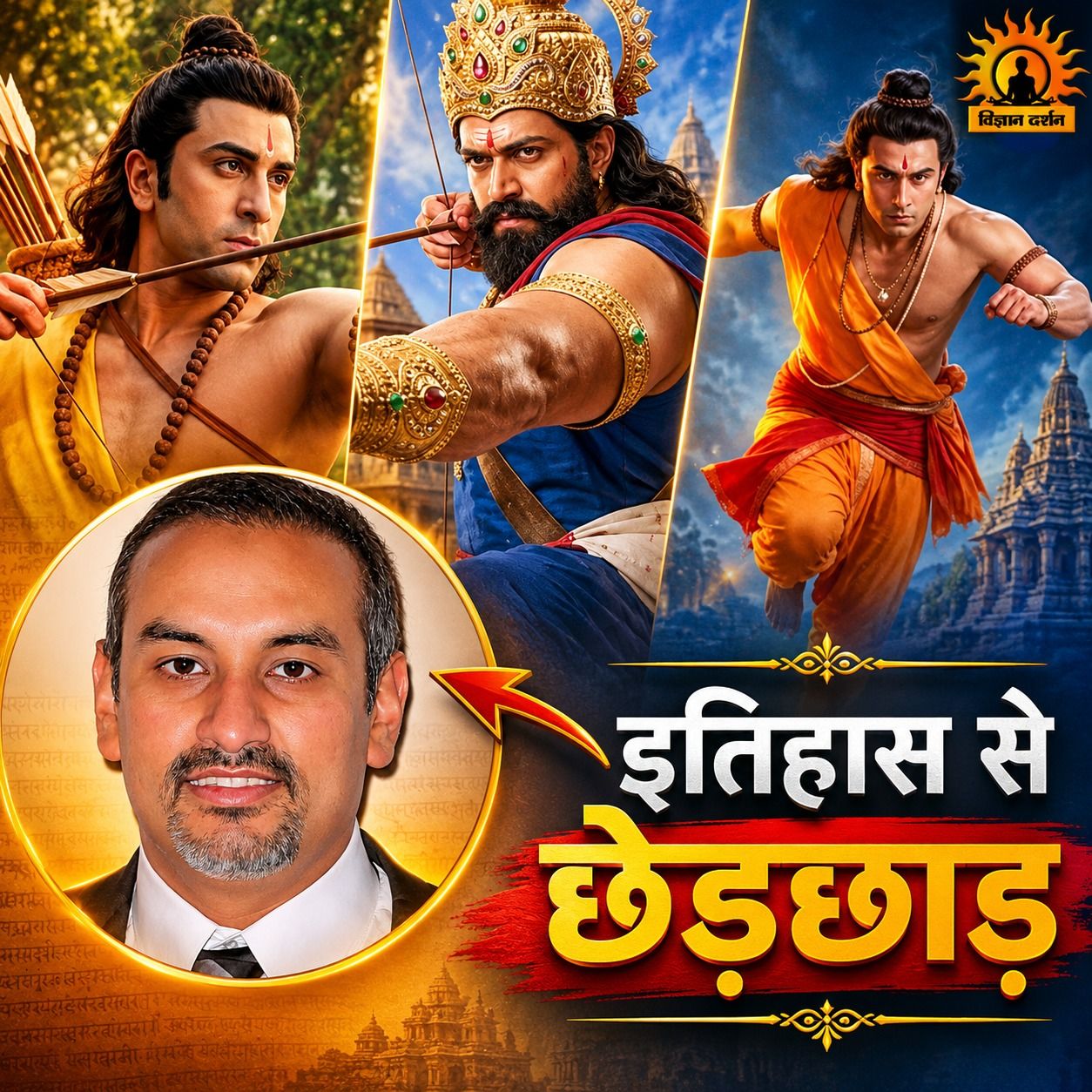
In cinema, "creative freedom" means adapting a story for the visual medium while safeguarding its core soul—not distorting historical and scriptural characters to impose a modern ideological agenda. The tampering with Maharishi Valmiki’s Ādi-Kāvya (the primordial epic) in the film Ramayana—produced by Namit Malhotra and directed by Nitesh Tiwari (previously also discussed in connection with references like Manoj Rathi, etc.)—is not a mere narrative alteration, but a calculated ideological discourse.
Namit Malhotra’s Ramayana not only disregards Sage Valmiki’s original Ādi-Kāvya and Indian history, but also completely bypasses the universally accepted, popular essence of the Ramayana that we have heard and lived since childhood through our grandmothers' lullabies, folktales, and traditional Ramlilas. Mounted on a colossal budget of ₹4,000 crore, this magnum opus undoubtedly sets a grand benchmark that inspires other producers and directors to bring our great historical and epic figures to the big screen. While we wholeheartedly welcome and encourage such ambitious cinematic ventures, we stand firmly against any attempt to distort historical facts and subvert sacred traditions under the guise of creative freedom.
Unfortunately, under this very pretext of "creative freedom," a deeply calculated ideological propaganda has been served within this film. On one hand, Ravana has been fabricated as a modern "communist" or "socialist" revolutionary—declaring to his followers, "What I eat, you shall eat; what I wear, you shall wear"—while depicting the Asuras as oppressed by the Devas to inject the same old, toxic narrative of a fabricated "Aryan-Dravidian" and "Brahmin-Shudra" conflict into the minds of the audience. In reality, there is not even a shred of evidence in the scriptures or the Puranas of any such exploitation of Asuras by the Devas. On the other hand, forced and unwarranted "feminism" has been shoehorned into the film—whether it is Sita needlessly wielding a sword, Ravana’s mother Kaikesi being turned into a military commander of the Rakshasas, or the character of the cruel Shurpanakha being whitewashed. It crosses all limits when, in an attempt to prove even the lustful Ravana to be a "feminist," a false scene is fabricated in which he engages in a duel and kills his own brother-in-law (Vidyutjihva) for grabbing a maidservant's hand. It is evident that this film is not a cultural presentation, but merely a vehicle to promote ideological propaganda aimed at distorting Sanatan values.
In this article, we will examine the hidden ideological propaganda, the violation of Indian poetics (Kāvyaśāstra), and the artificial whitewashing of Ravana’s character in the film, supported by scriptural evidence.
1. The 'Victim' Portrayal of Asuras: Fueling the Aryan-Dravidian and Oppressor-Oppressed Narrative
Right in the opening scenes of the film, an absurd and anti-scriptural sequence is fabricated: the Devas drop rice (food grains) from the sky above, while the Asuras live below the earth in dark tunnels or caves, scavenging for it. Meanwhile, the Devas roam the skies seated on elephants. This scene is a deliberate attempt to reinforce the discredited colonial-era "Aryan-Dravidian" and "oppressor-oppressed" theory, which portrays the Devas (or Aryans/upper castes) as tyrants and the Asuras (or indigenous people) as enslaved and deprived.
Scriptural Reality: Nowhere in the Valmiki Ramayana, the Mahabharata, or any of the Puranas are the Asuras depicted as impoverished or starving for food in caves. On the contrary, the opulence of the abodes of the Asuras and Danavas (Patala Loka and Lanka) is described as surpassing even heaven (Svarga):
In the Sundarakāṇḍa, when Hanuman enters Lanka, he is astonished by the splendor of the golden city and compares it to Indra’s Amaravati:
toraṇaiḥ kāñcanair divyair latāpaṅktivicitritaiḥ |
dadarśa hanumān laṅkāṃ divi devapurīṃ yathā || 18 || (Sundarakāṇḍa, Sargas 2–3)In the Viṣṇu Purāṇa (Book 2, Chapter 5), while describing Patala Loka, Maharishi Parashara states that the palaces, jewels, and gardens of Patala built by Maya Danava are so enchanting that even Devarshi Narada declared Patala to be more magnificent than heaven itself.
Therefore, depicting Asuras as impoverished victims is not only contrary to Puranic facts, but also a planned piece of ideological propaganda.
2. Irrelevant 'Feminism' and the Distortion of Characters
In Indian Sanātana tradition, women have always held the highest honor and authority—from the scholar-philosophers Gargi and Maitreyi to Queen Kaikeyi, who accompanied King Dasharatha onto the battlefield. Yet, in modern cinema, the fundamental nature of characters has been tampered with in the name of showcasing "feminism":
The Fictional Military Leadership of Kaikesi: In the film, Ravana’s mother, Kaikesi, is presented as a warrior or military commander. However, according to the Uttarakāṇḍa of the Valmiki Ramayana (Sargas 4 to 9), the war against the Devas and Lord Vishnu was fought by Ravana’s maternal grandfather Sumali and his brothers Mali and Malyavan. Defeated in battle, Sumali retreated to Rasatala and later sent his daughter Kaikesi to Maharishi Vishrava so that illustrious progeny could be born. Kaikesi was never a general.
Sita Unnecessarily Wielding a Sword: The character of Janaki (Sita) embodies sacrifice, radiant fidelity (Pātivratya), wisdom, and spiritual strength. Showing her repeatedly drawing a sword to fight without any scriptural basis is a cheap attempt to force her into the mold of a modern "action heroine"—a choice that later creates glaring contradictions within the film’s own screenplay (as will be examined in the Sita abduction episode).
3. Casting on the Touchstone of Poetics (Kāvyaśāstra) and Aesthetics
Indian poetics (Nāṭyaśāstra, Sāhityadarpaṇa, etc.) lay down clear canons regarding the qualities and physical grace of the hero (Nāyaka) and heroine (Nāyikā). A hero must be Dhīrodātta (noble, resolute, and self-controlled), bearing serenity and gravitas on his face and vigor in his voice.
Ranbir Kapoor as Shri Rama and Parashurama: Valmiki describes Shri Rama’s countenance as "saumyaḥ saumyataraḥ" (gentle and exceedingly serene) and "ājānubāhuḥ sumukhaḥ" (long-armed and handsome-faced; Ayodhyākāṇḍa 1.10–12). Ranbir Kapoor’s face lacks that divine serenity, and his dialogue delivery lacks the vigor of the Vedic era—so much so that he struggles to clearly pronounce simple Sanskrit names like "Agastya." Casting the same actor for both avatars of Lord Vishnu (Rama and Parashurama) may be conceptually acceptable, yet he fails completely to embody Parashurama’s fierce aura and thunderous roar—on top of which, showing Parashurama kneeling before Shri Rama violates all Puranic dignity.
The Inverted Portrayal of Sita and Shurpanakha: In the Valmiki Ramayana, Sita is described as "sarvalakṣaṇasampannā" (endowed with all auspicious marks and unmatched beauty), whereas in the Araṇyakāṇḍa, Shurpanakha is described as terrifying, pot-bellied (mahodarī), deformed-eyed, and harsh-voiced. In complete inversion of the text, the film presents Shurpanakha as remarkably attractive, while Sai Pallavi as Sita falls short of the classical aesthetic standards laid out in Kāvyaśāstra.
4. The Whitewashing of Ravana and Disregard for the Facts of Uttarakāṇḍa
Rather than depicting Ravana as the cruel, lust-driven, and unrighteous antagonist of the Valmiki Ramayana, the filmmakers have gone out of their way to turn him into an "idealistic anti-hero":
Sole Credit for Penance and Conquest: While the visual depiction of Ravana’s penance is cinematically grand, showing that Ravana performed penance alone and defeated the entire army of the Devas single-handedly and unarmed upon receiving his boon is completely false. According to the Valmiki Ramayana (Uttarakāṇḍa, Sarga 10), Kumbhakarna and Vibhishana also performed severe austerities alongside Ravana at the Gokarna hermitage. Similarly, during the assault on heaven, Ravana was not alone; the Devas were defeated largely through the prowess of Meghanada (Indrajit) and Kumbhakarna (Uttarakāṇḍa, Sargas 27–29). Moreover, the scenes of Ravana wandering around appear to be a direct copy of the character Gorr from the Hollywood film Thor: Love and Thunder.
Kaikesi’s Insult to Kubera: In the film, Kaikesi calls her own stepson and Lokapala, Kubera, "the shoe at the feet of the Devas," which runs entirely counter to the decorum and dialogue style of the Valmiki Ramayana.
The Falsehood of the Ashvamedha Yajna: The film shows Ravana performing an Ashvamedha Yajna, which is historically and scripturally absurd. Only a Chakravarti Samrat (universal emperor) performed the Ashvamedha. According to the Valmiki Ramayana, King Dasharatha was the sovereign emperor of the entire earth up to the oceans. Ravana had merely subjugated a few islands and kings by brute force; portraying him as a Chakravarti emperor is an unwarranted glorification of a villain.
The Distorted Episode of Vidyutjihva’s Slaying: This is the most blatant example of whitewashing Ravana’s character. The film shows Shurpanakha’s husband, Vidyutjihva, getting drunk in court, molesting a maidservant, and taunting Ravana as a "slave"—prompting Ravana to kill him in a duel to defend women’s honor and Rakshasa pride.
The Truth: According to the Valmiki Ramayana (Uttarakāṇḍa, Sarga 23.16–18), while Ravana was warring against the Kalakeya Danavas, blinded by battle-frenzy and arrogance, he slaughtered his own brother-in-law Vidyutjihva. There was neither an insult to any maidservant nor any moral nobility on Ravana’s part.
Khara-Dushana and the Artificial Shaiva-Vaishnava Divide: Ravana’s brothers Khara and Dushana are portrayed in the film as gory, feral beasts. Furthermore, by placing Shaiva tilaks on the foreheads of the Rakshasas and Vaishnava tilaks on Rama and his companions, the film propagates the false notion that Rakshasas were worshippers of Shiva while humans worshipped Vishnu. In reality, Lord Rama himself establishes the Shivalinga at Rameshwaram (Yuddhakāṇḍa, Sarga 123), and the worship of Lord Brahma was equally prominent in Ravana’s lineage. This Shaiva-Vaishnava binary is entirely modern and ahistorical.
5. Bālakāṇḍa and Ayodhyākāṇḍa: Chronological Anachronisms and Violation of Decorum
Authenticity of chronology and setting is vital in adapting any historical or Puranic epic. The film grossly neglects both:
The Bizarre Appearance of Jatayu During Rama’s Youth and Wedding: In the film, when a young Shri Rama is horseback riding, and later during his wedding in Mithila, Jatayu and a flock of vultures appear flying overhead. Vultures circling over an auspicious wedding ceremony is not only contrary to Indian omen-lore (Śakuna-śāstra), but also completely incoherent narratively. In the Valmiki Ramayana, Jatayu enters the narrative directly in the Araṇyakāṇḍa (Sarga 14), when Shri Rama encounters him en route to Panchavati and Jatayu introduces himself as a friend of King Dasharatha.
'Lily' Flowers in Mithila: During the Swayamvara scenes, modern foreign "lily" plants and trees are shown in the gardens of Mithila. In the Valmiki Ramayana, the groves of Mithila and Janakpur are described with indigenous Indian flora such as Ashoka, Champaka, mango, Kadamba, lotus, and Malati (Bālakāṇḍa, Sarga 67). This oversight reflects a severe lack of research.
6. Violation of Gurukula Decorum: Pre-Marital Garden Strolls and 'College Boy' Dialogue
The most objectionable aspect of the Bālakāṇḍa sequence is the trivialization of Rama and Lakshmana’s characters. Two radiant Kshatriya princes under the tutelage of Maharishi Vishvamitra are shown behaving like modern college students:
Undignified Curiosity Before Vishvamitra: Prior to the wedding, Rama and Lakshmana speak to Maharishi Vishvamitra in a casual tone suggesting it would be nice to know something about—or meet—the brides beforehand. Such dialogue destroys the gravity of the Guru-Śiṣya (teacher-disciple) tradition.
Pre-Marital Garden Courtship: Worse still, before the wedding rites are even performed, all four brothers (Rama, Lakshmana, Bharata, and Shatrughna) are shown strolling and romancing in gardens with their prospective brides (Sita, Urmila, Mandavi, and Shrutakirti).
Scriptural Truth: In Arya culture and the Valmiki Ramayana, secluded romantic trysts between bride and groom prior to the Pāṇigrahaṇa (wedding) sacrament were strictly forbidden. The first sight of Rama and Sita occurs within dignified bounds in the flower garden (Puṣpavāṭikā in Tulsidas’s Ramcharitmanas) or at the Swayamvara/wedding pavilion. In Bālakāṇḍa (Sarga 73) of the Valmiki Ramayana, the weddings of all four brothers take place with Vedic chants in the presence of Maharishi Vasishtha and King Janaka, with no mention whatsoever of any prior garden trysts.
7. The Tataka Slaying and Subahu Episode: Flawed Scriptural Logic and 'Video Game' Aesthetics
In the episode of protecting Vishvamitra’s yajna, the filmmakers sacrifice both logic and scripture:
Vishvamitra’s Misleading Dialogue: When Shri Rama hesitates to shoot an arrow at Tataka, Vishvamitra in the film states, "A Rakshasi has no dharma." This dialogue is scripturally inaccurate. In the Sundarakāṇḍa of the Valmiki Ramayana, Hanuman himself hears Vedic chanting and scriptural recitation (svādhyāya) coming from the homes of Rakshasas in Lanka (Sundarakāṇḍa, Sargas 4 and 18). Rakshasas were learned in the Vedas, yet they were Adharmī (tyrants and destroyers of sacrifices). In the original text, Vishvamitra explains to Shri Rama that for a king sworn to protect his subjects, slaying a wicked oppressor is the supreme dharma, even if the perpetrator is a woman (Bālakāṇḍa, Sarga 25.17–18):
"na hi te strīvadhakṛte ghṛṇā kāryā narottama |
cāturvarṇyahitārthaṃ hi kartavyaṃ rājasūnunā ||"Subahu’s Disguise and 'Zombie' Monsters: The film shows Subahu arriving disguised as Vishvamitra, which has no basis in the Valmiki Ramayana. The battle against Tataka, Maricha, and Subahu has been staged to resemble a Hollywood Avengers movie or a "zombie" attack from a video game. Furthermore, showing Shri Rama running away from Tataka and her cohorts is an insult to his Kshatriya valor.
8. The Parashurama Dialogue and Screenplay Inconsistency Regarding the Divine Bow
The arrival of Parashurama during the return journey from Janakpur is depicted with immense majesty in the Valmiki Ramayana (Bālakāṇḍa, Sargas 74–76), yet the film commits two major blunders here:
Internal Screenplay Contradiction: Earlier in the film, Maharishi Vishvamitra tells Shri Rama that to wield divine astras, he will need a celestial bow such as the Shiva-Dhanush or the Vaishnava-Dhanush. Subsequently, the story has Rama break the Shiva-Dhanush, thereby demolishing the film’s own narrative setup.
Demeaning Parashurama: Depicting Parashurama kneeling before Shri Rama goes against Puranic decorum. In the Valmiki Ramayana, Parashurama places his Vaishnava bow into Shri Rama’s hands, has him string it, recognizes Rama’s supreme radiance, and departs respectfully toward Mount Mahendra—he never falls to his knees.
9. Ayodhyākāṇḍa: Relying on an Interpolated Vow and Lakshmana Drawing His Sword on Kaikeyi
The manner in which Queen Kaikeyi’s demand for her boons is presented in the film violates both textual criticism and familial decorum:
False Mention of a Marriage-Time Promise (Rājya-śulka): In the film, Manthara reminds Kaikeyi that at the time of her marriage, King Dasharatha promised her father (Ashvapati) that Kaikeyi’s son would become the King of Ayodhya.
Scriptural Evidence: Throughout the Ayodhyākāṇḍa of the Valmiki Ramayana, Kaikeyi cites only the two boons she earned by saving Dasharatha’s life during the Deva-Asura war (Ayodhyākāṇḍa, Sargas 9 and 11). A mention of a marriage-time promise of the kingdom appears at only one isolated verse in the entire text (when Bharata visits Rama at Chitrakuta—Ayodhyākāṇḍa, Sarga 107.3), which modern textual critics and authoritative critical editions (such as the BORI Critical Edition) have conclusively proven to be a later interpolation (Prakṣepa). Had such a vow ever existed, King Dasharatha, Vasishtha, Kaushalya, and Bharata himself would not have repeatedly affirmed that under the Ikshvaku dynastic tradition, the eldest son (Rama) alone inherits the throne ("jyeṣṭho rājā bhavatīti" — Ayodhyākāṇḍa 101.2).
Lakshmana Drawing a Sword Against Stepmother Kaikeyi: Upon hearing of the boons in the film, Lakshmana draws his sword in rage against his own mother (stepmother) Kaikeyi. This scene is a direct stain on Lakshmana’s character. In the Valmiki Ramayana, Lakshmana certainly expresses anger at King Dasharatha’s unjust decision and urges Shri Rama to seize the kingdom by force (Ayodhyākāṇḍa, Sarga 21), yet he would never even dream of committing the grave sin of raising a weapon against his mother Kaikeyi.
10. Unrealistic Depiction of Dandakaranya and 'New Age' Dialogue
Right at the start of the Araṇyakāṇḍa, the film’s visual design strays from both realism and scripture:
Lilliputian Proportions and Gigantic Trees: The trees in the Dandakaranya forest are rendered so unnaturally colossal that Shri Rama, Lakshmana, and Sita appear like "Lilliputians" (ant-sized dwarfs). Rather than reflecting the authentic ecology of Indian forests, this looks like a scene from a fantasy video game.
Absurd 'Law of Attraction' Dialogue in the Vedic Era: Shri Rama is made to utter the line, "Bow to the universe and thank it." This is the vocabulary of modern Western "New Age spirituality" (thanking the Universe / Law of Attraction), which has zero connection to Vedic or Treta Yuga culture. In the Vedic tradition, worship was offered to Surya, Agni, Varuna, Indra, or Parabrahman—not to an abstract modern concept of saying "thank you" to the universe.
11. The Whitewashing of Shurpanakha and Aspersions on Shri Rama and Lakshmana
In the film, Shurpanakha’s character is completely overhauled into a sensitive, rational, and wronged woman, while Shri Rama and Lakshmana are painted as guilty and helpless. Violating the foundational rules of Indian poetics, the antagonist is given unwarranted "character development" to diminish the protagonists:
Arrival on a Lion-Drawn Chariot and Fabricated Dialogue: Shurpanakha arrives seated on a bizarre chariot pulled by lions and questions Shri Rama as to why he killed the Rakshasas, to which Rama replies, "In self-defense." Thereafter, she adorns herself, proposes to Rama while he is chopping wood, and eventually assumes Sita’s form—whom Rama fails to recognize!
Distorted Mutilation Scene and Sita Rebuking Lakshmana: In the film, Lakshmana merely makes a light scratch on Shurpanakha’s nose with his sword, and she transforms into a bird and flies away! Even more objectionably, Sita afterward reprimands Lakshmana, saying, "For a woman, her beauty is everything; you should not have disfigured her," to which Lakshmana offers an excuse that he did so because she had impersonated Sita. Thus, instead of acting on Shri Rama’s command, Lakshmana is portrayed as committing an act of cruelty on his own whim.
[ Note: We authored a research paper titled “Was Rāvaṇa an Ideal Brother? A Comparative Reading of the Rāmāyaṇa,” published as part of the Eighth International Ramayana Conference (2025). Through a comparative and evidence-based examination of episodes from the Rāmāyaṇa, the paper challenges the conventional portrayal of Rāvaṇa as an ideal brother or an exemplary human being. It critically examines his lustful and unethical conduct, particularly his behaviour towards women. The paper also discusses Śūrpaṇakhā’s advances towards Rāma and Lakṣmaṇa, her subsequent attack on Sītā after being rejected, and the episode in which Lakṣmaṇa cuts off her nose and ears at Rāma’s direction. A detailed discussion of these issues, supported by textual analysis, is presented in the research paper. Readers interested in these questions may consult the original publication for a comprehensive examination.- Iyer, K., & Gaur, M. (2025). Was Rāvaṇa an ideal brother? A comparative reading of the Rāmāyaṇa. In O. K. Gupta & S. Agrawal (Eds.), Rāmāyaṇa aur satat vikās: Eighth International Ramayana Conference (pp. 435–444). ISBN 978-1-960627-07-0.]
The Actual Episode in the Valmiki Ramayana (Araṇyakāṇḍa, Sargas 17–18):
Shurpanakha’s True Form and Lustful Conduct: In the original text, Shurpanakha does not arrive on any chariot; she is a terrifying, pot-bellied (mahodarī), deformed-eyed (virūpākṣī), copper-haired (tāmramūrdhajā), harsh-voiced Rakshasi (Araṇyakāṇḍa 17.8–10). Overcome with lust upon seeing Shri Rama’s beauty, she initiates a carnal proposal.
Lethal Attack on Sita: When Shri Rama declines on account of being married and gestures toward Lakshmana—and Lakshmana refuses by declaring himself Rama’s servant—a humiliated Shurpanakha lunges like a blazing meteor to devour Sita alive ("abhidudrāva vaidehīṃ mahāulkeva rohiṇīm" — Araṇyakāṇḍa 18.17).
Shri Rama’s Explicit Command: To protect Sita’s life, Shri Rama himself orders Lakshmana to disfigure the cruel and wicked Rakshasi ("virūpayitumarhasi" — Araṇyakāṇḍa 18.20). Lakshmana then severs both her nose and ears with his sword, causing blood to gush forth as she flees screaming in terror (she does not turn into a bird and fly away).
12. The Khara-Dushana Battle: Cowardice of Shri Rama and Hollywood Imitation
When Khara and Dushana arrive in the film to avenge Shurpanakha’s humiliation, Shri Rama is shown apologizing to them—an act diametrically opposed to Kshatriya dharma and the core ethos of the Ramayana. Additionally:
Fleeing Heroes and Guerrilla Warfare: Throughout the film, from Tataka to Khara-Dushana, Rama, Lakshmana, and Sita are repeatedly shown running away or hiding to wage "guerrilla warfare."
Imitation of Hollywood Films and Video Games: Shri Rama conjuring a tornado to destroy Khara-Dushana’s army is a direct copy of the tornado scene that destroys the Destroyer at the climax of Marvel’s first Thor film (2011). Meanwhile, the sword fight slaying Khara and Dushana looks straight out of the PlayStation 2 video game Mortal Kombat.
Scriptural Truth (Araṇyakāṇḍa, Sargas 19–30): In the Valmiki Ramayana, Shri Rama neither apologizes nor fights from hiding. Entrusting Sita’s protection to Lakshmana, he stands alone on the open battlefield and, within just one and a half muhūrtas (approximately 72 minutes), annihilates Khara, Dushana, Trishira, and 14,000 Rakshasas in direct combat using celestial weapons and his bow.
13. Ravana’s Fake 'Brotherly Love', and the Blunder of the 'Final Avatar'
Upon Shurpanakha’s arrival in Lanka, the film fabricates another major falsehood—a subject also examined in detail in our research paper (by Kartik Iyer and Mohit Gour) presented at the International Ramayana Conference at IIT Kharagpur (2025):
The False Agenda of Avenging a Sister’s Honor: The film claims Ravana abducts Sita to avenge his sister Shurpanakha’s humiliation. In reality, according to the Valmiki Ramayana (Araṇyakāṇḍa, Sarga 34), the cunning Shurpanakha completely conceals from Ravana that she had approached Rama out of lust. Instead, to inflame Ravana’s carnal desire, she deliberately tells him: "Sita is the most beautiful woman in the three worlds; I was bringing her to be your wife when Rama and Lakshmana reduced me to this state." Ravana plots Sita’s abduction not out of brotherly affection, but out of his own blind lust.
Concealing Ravana’s Crimes: While the film dramatizes the curses behind Ravana’s multiple heads, it suppresses the fact that Ravana was a habitual adulterer and rapist who violated women such as Punjikasthala, Rambha (betrothed to Nalakubara), and the ascetic Vedavati (Uttarakāṇḍa, Sargas 17, 26; Yuddhakāṇḍa 13.11–14).
Arya Samaj Influence and the Hiranyagarbha Sukta: The film includes a dialogue featuring Vedic mantras and the Hiraṇyagarbha Sūkta (Ṛgveda 10.121) between Ravana and Sita, which aligns appropriately with the broader Vedic spirit of the narrative.
The Grave Error of Vishnu’s 'Final Avatar': In the film, Ravana addresses Shri Rama as the "final avatar" (Antima Avatāra) of Lord Vishnu! This is an unforgivable mythological and historical blunder. According to the scriptures, Shri Rama is the seventh avatar of Vishnu, followed by Shri Krishna, Buddha, and finally Kalki at the end of Kali Yuga.
14. The Abduction of Sita: Demeaning the Heroic Janaki or a 'Business Class' Flight?
In the abduction sequence, the film’s screenplay collapses into its own trap:
Internal Contradiction: When Maricha cries out in Shri Rama’s mimicked voice and Lakshmana explains it is Rakshasa illusion, Sita in the film draws her sword to go fight, leaving Lakshmana helpless. Yet, ironically, the very Sita who was brandishing a sword moments earlier fails to lift a blade, throw a punch, or put up any physical struggle when Ravana arrives!
Sita Like a 'Business Class' Passenger: The Valmiki Ramayana (Araṇyakāṇḍa, Sarga 49.16–20) describes how the wicked Ravana seizes Sita’s hair with one hand and her thighs with the other, forcing her into the Pushpaka Vimana. Distraught and weeping, Sita fearlessly rebukes Ravana mid-air—calling Shri Rama a "lion" (Siṃha) and Ravana a "jackal" (Śṛgāla; Araṇyakāṇḍa, Sargas 47–48). By contrast, in the film, Sita’s face shows no trace of struggle; she sits calmly inside the aircraft as though traveling in "business class"!
The Inverted Scene of Dropping Ornaments: In the film, Ravana himself rips off Sita’s ornaments and throws them down! According to the Valmiki Ramayana (Araṇyakāṇḍa, Sarga 54.1–4), while Ravana was carrying her away, Sita spotted five Vanaras (Sugriva and his companions) seated atop Mount Rishyamuka and, discreetly out of Ravana’s sight, tied her divine ornaments in her yellow upper garment (uttarīya) and dropped them down so Shri Rama could trace her path. (While the battle between Jatayu and Ravana is cinematically commendable, it cannot compensate for the distortion of the core narrative.)
Conclusion
Maharishi Valmiki’s Ramayana is not merely a story; it is the benchmark of India’s cultural consciousness and ethical decorum (Dharma-Maryādā). When villains like Ravana and Shurpanakha are glorified in the name of cinema, while the radiant characters of Maryada Purushottama Shri Rama, Lakshmana, and Mata Sita are weakened, rendered dubious, or reshaped to fit modern propaganda, it is not "creative freedom"—it is cultural distortion. It is the duty of viewers and researchers alike to look beyond superficial spectacle, recognize the authenticity of Maharishi Valmiki’s original Ādi-Kāvya, and logically counter every such fabricated narrative.
Bibliography
Maharishi Valmiki. Valmiki Ramayana.
Vishnu Purana.
Bharata Muni. Natyashastra.
Kaviraja Vishwanatha. Sahityadarpana.
Iyer, K., & Gaur, M. (2025). Was Rāvaṇa an ideal brother? A comparative reading of the Rāmāyaṇa. In O. K. Gupta & S. Agrawal (Eds.), Rāmāyaṇa aur satat vikās: Eighth International Ramayana Conference (pp. 435–444). ISBN 978-1-960627-07-0.